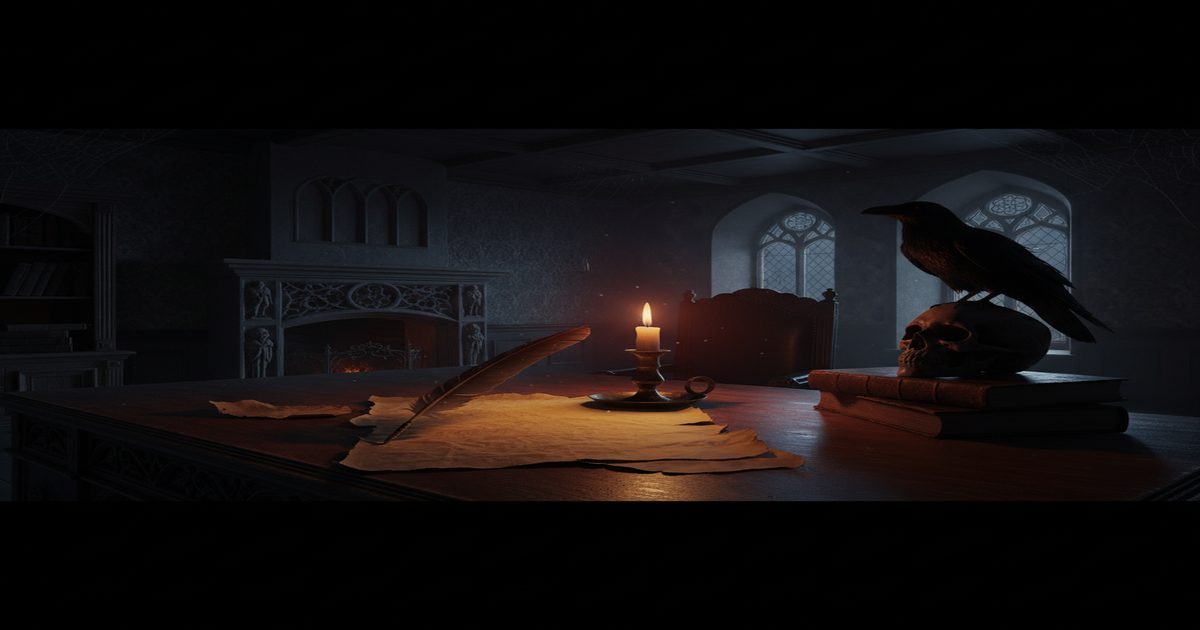
Edgar Allan Poe didn’t write horror stories. He wrote autopsies of the mind. The difference is everything.
When “The Tell-Tale Heart” appeared in 1843, it broke a convention no one had named yet: the narrator could lie — to you, and to himself. That ambiguity, that refusal to resolve cleanly, became the engine of everything that followed.
A Man Who Understood Fear From the Inside
Poe was poor, alcoholic, and dead at forty under circumstances no one has fully explained since. His life was authentic horror — not metaphor. Small wonder he knew where real terror lives: not in castles, but in the mind.
American contemporaries ignored or mocked him. Baudelaire translated him into French and declared him the first genuinely modern writer. Europe discovered Poe decades before America did. That’s not historical irony. That’s delayed justice.
Poe wrote about paranoia, obsession, guilt that never dissolves. Not fear of the dark outside, but fear of what you are. An uncomfortable subject in the nineteenth century — and one the twenty-first century knows with bone-deep intimacy.
Born in Boston in 1809 to actor parents, orphaned at three, informally adopted by the Allans and never truly loved by his foster father John — rejection, loss, loneliness aren’t just biography here. They are the thematic bricks of every story he ever wrote.
The Narrator Who Lies — And You Believe Him
Before Poe, gothic novel protagonists were reliable. The reader trusted the narrating voice. Then the speaker of “The Tell-Tale Heart” arrived — and that trust was broken for good.
The man tells you outright: I’m not mad, let me prove it. And it’s precisely this obsessive precision, this desperate need to justify, that convinces you he’s losing his mind. Poe weaponized a madman’s logic. Nobody had done it before.
“True! — nervous — very, very dreadfully nervous I had been and am; but why will you say that I am mad? The disease had sharpened my senses — not destroyed — not dulled them.”
— Edgar Allan Poe, The Tell-Tale Heart (1843)
In “William Wilson”, Poe pushes the mechanism further: the protagonist hunts and kills his double, but it’s clear the double is himself. Dissociation as horror, identity as battleground — a theme that would haunt horror fiction for two centuries.
This mechanism — the narrator lying to himself — is the foundation of all modern psychological horror. Shirley Jackson, Thomas Harris, Gillian Flynn: all direct heirs of this invention. Once the reader’s trust is violated, it never fully reforms.
The Fall as Metaphor: Usher, the Pit, the Abyss
In Poe’s tales, every physical collapse is symbolic. The House of Usher doesn’t fall for structural reasons. It falls because the family inside has stopped being alive in any meaningful sense.
Roderick Usher feels the house as a sentient organism. The external environment becomes projection of the interior — what Freud would later call the Unheimliche. Poe reached the concept fifty years earlier, by pure intuition. Our piece on the uncanny in horror maps this direct lineage.
In “The Pit and the Pendulum”, horror has no name, no face. There is only darkness, the cold stone floor, the sound of the blade descending. Touch and hearing, not sight. Two senses do more work than a thousand visual descriptions. Poe knew this better than anyone.
In “The Cask of Amontillado”, Montresor walls a man alive and narrates it as a personal triumph. No remorse, no punishment, no moral reckoning. Just the cold satisfaction of a plan executed perfectly. This absence of justice may be the most disturbing thing Poe ever wrote.
From Poe to Lovecraft: the Bloodline of Darkness
H. P. Lovecraft loved Poe above all other writers. He said so explicitly, studied him closely, cited him as the primary model in “Supernatural Horror in Literature” (1927). Without Poe, there is no cosmic horror.
But the bloodline runs far beyond Lovecraft. Stephen King has said in multiple interviews that “The Tell-Tale Heart” is the perfect story — the one that taught him brevity is terror. Ray Bradbury called Poe the founding father. Thomas Ligotti acknowledges his direct influence on all of Ligotti’s pessimist work.
Every author who treats the mind as a horror location, every story where you can’t trust the narrator, every ending that opens rather than closes — all of it leads back to Baltimore, 1843. Weird fiction wouldn’t exist without him.
The through line is precise: Poe refuses to end without resolution because he refuses to lie. His stories don’t comfort, don’t justify, don’t explain. They leave the reader with a void shaped exactly like an unanswered question. That is the model all authentic horror has inherited and never let go.
Why Does 2026 Need Edgar Allan Poe More Than Ever?
The boundary between real and perceived has become the central question of our era. AI generates text indistinguishable from human prose. Deepfakes make video evidence unreliable. We woke up inside a Poe story.
Every time you wonder whether a piece of news is true, you’re inside “The Tell-Tale Heart”. Every time your perception says one thing and the facts say another, the unreliable narrator has invaded reality itself — not just the pages of a book.
The most compelling contemporary horror uses exactly this technique: not the monster, but the doubt. Not the external threat, but the internal betrayal. The best horror novels of 2026 owe something to that man in Baltimore who died in an alley and nobody understood why.
The most unsettling part? Poe had no plan. He had a deep instinct about how human terror works. He was right by a hundred and eighty years.
The Brothel of Shadows and Poe’s Secret Heir
Alex, the protagonist of The Brothel of Shadows, is a narrator who might be lying. Not deliberately — Poe teaches us that the most dangerous narrators are those genuinely convinced of their own clarity.
The dreams that pull Alex toward the interdimensional brothel follow the same logic as the Usher descent: each night more real than the day before, each visit truer than waking life. The line between forbidden knowledge and madness that Poe drew is the same line Jan Willem Koster crosses in every chapter.
Poe’s true legacy isn’t fear of ravens or catacombs. It’s the question he leaves open in every story: the voice you’re hearing — that one that sounds so lucid, so rational — can you trust it? Alex’s voice. Yours.
Some doors should never be opened. Alex opened the wrong one.
Read what he found →