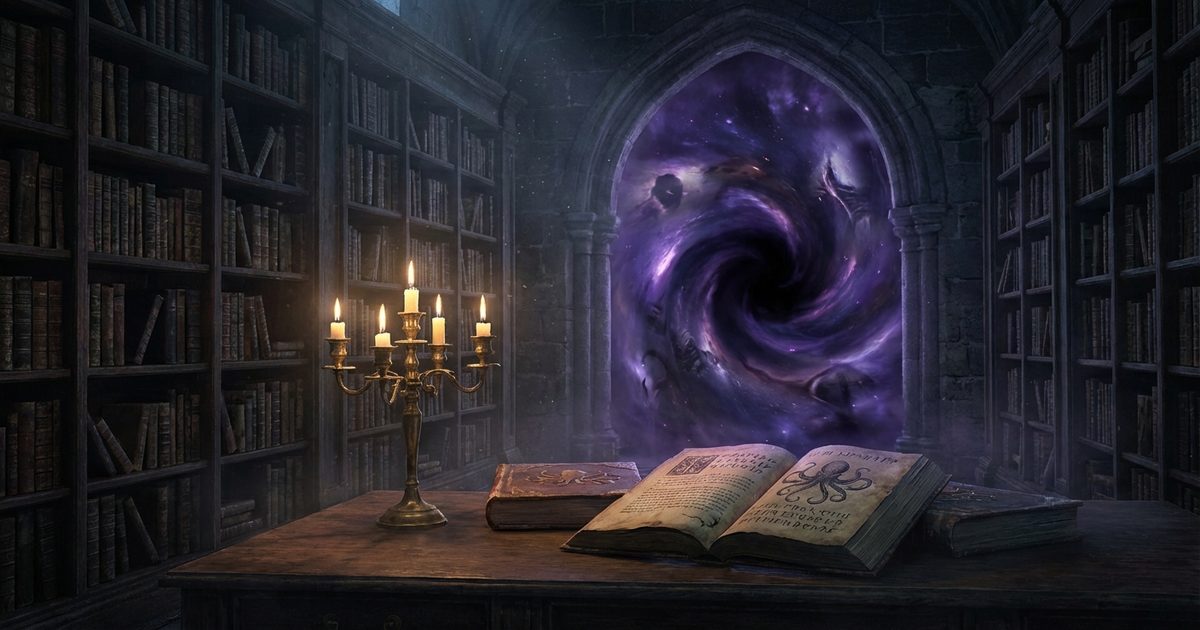
There is a moment in nearly every cosmic horror story — a hinge on which the entire narrative turns — when the protagonist learns something that cannot be unlearned. It is not a jump scare. It is not a monster leaping from the shadows. It is quieter than that, and infinitely worse. It is the moment when the character looks at the true shape of reality and understands that everything they believed about the world, about themselves, about the nature of existence, was a merciful lie. After that moment, there is no going back. There is only the knowledge, and the slow, terrible process of living with it.
This is the fundamental mechanism of cosmic horror: not the fear of death, but the fear of understanding. And it is a mechanism as old as storytelling itself.
The Promethean bargain
Long before H.P. Lovecraft wrote a single word, the myth of forbidden knowledge was already ancient. Prometheus stole fire from the gods and was punished with eternal torment. Eve ate from the Tree of Knowledge and was expelled from paradise. Pandora opened the box she was told never to open. Orpheus looked back. Lot's wife turned around. In every case, the pattern is identical: a boundary is set, the boundary is crossed, and the crossing is irrevocable.
What these myths share — and what cosmic horror inherited from them — is the understanding that knowledge is not neutral. It is not a benign accumulation of facts that makes your life incrementally better. Knowledge, the oldest stories tell us, has a cost. And some knowledge costs everything.
The dark academia movement has revived this ancient anxiety for a modern audience, dressing it in the robes of scholarly ambition. But cosmic horror strips away even that civilized veneer. In Lovecraft's universe, the knowledge that destroys you does not come from a forbidden book in a university library. It comes from the structure of reality itself.
Lovecraft and the indifferent cosmos
Lovecraft's contribution to the forbidden knowledge tradition was not the invention of new monsters, though his bestiary is formidable. His true innovation was the nature of the knowledge itself. In earlier horror, forbidden knowledge typically revealed the existence of evil — demons, curses, malevolent spirits. The universe, in these stories, was still a moral place. Evil existed, but so did good, and the knowledge of evil, however terrible, could at least be placed within a framework of meaning.
Lovecraft demolished this framework. In his fiction, the forbidden knowledge is not that evil exists. It is that meaning does not. The cosmos is not hostile. It is not benevolent. It is indifferent — vast, cold, ancient, and utterly unconcerned with human existence. The entities that lurk beyond the veil of perception are not evil in any moral sense. They are simply too large, too alien, too fundamentally other for human categories to apply. Learning this is what drives Lovecraft's protagonists mad. Not the sight of a monster, but the realization that they themselves are the monster's equivalent of an insect — too small to hate, too insignificant to notice.
This is why Lovecraft's most effective stories are not about tentacled horrors rising from the deep. They are about men who read the wrong book, who perform the wrong calculation, who look through the wrong telescope — and who are destroyed not by what they see, but by what they understand.
After Lovecraft: the price of seeing
The writers who followed Lovecraft extended his central insight in directions he could not have imagined. Thomas Ligotti, perhaps the most philosophically rigorous horror writer alive, took Lovecraft's cosmic indifference and turned it inward, arguing that consciousness itself is the forbidden knowledge — that to be aware of your own existence is already to know too much. Laird Barron set his cosmic horror in the wilderness of the Pacific Northwest, where the forbidden knowledge is written in the landscape itself, in geological formations that predate human comprehension by billions of years.
Jeff VanderMeer's Southern Reach trilogy presented forbidden knowledge as a biological phenomenon — an alien ecology that does not communicate through language or symbols but through the transformation of living flesh. In VanderMeer's Area X, to learn is to be changed, physically and irreversibly. The knowledge is not information stored in the mind. It is mutation written in the body.
Each of these writers understood the same truth: the most terrifying knowledge is not a fact that can be contained in a sentence. It is a shift in perspective so profound that the person who undergoes it is no longer the same person who existed before. The knowledge does not add something to you. It replaces you.
The brothel as source of cosmic truth
Jan Willem Koster's The Brothel of Shadows brings the forbidden knowledge tradition to a setting both ancient and unprecedented: a supernatural brothel in the heart of 1980s Amsterdam. What Koster understands, and what makes his novel such a distinctive entry in the cosmic horror canon, is that desire is itself a form of seeking. The protagonist Alex does not arrive at the brothel looking for cosmic truth. He arrives looking for something far more human. But in Koster's universe, the two searches are the same.
The brothel is a place where veils are lifted — not only the veils of social propriety but the veils that separate ordinary reality from something vaster and more terrible. Each room offers not merely a physical encounter but a revelation, and each revelation strips away another layer of the protagonist's understanding of what is real. The deeper he goes into the brothel, the deeper he goes into a knowledge that reshapes him from the inside out.
This is Lovecraft's forbidden knowledge filtered through the lens of erotic horror: the idea that the most dangerous way to know is through the body. That the flesh, opened to the wrong kind of experience, becomes a doorway through which cosmic truths enter uninvited. Alex does not read a forbidden book. He does not decode an ancient inscription. He surrenders his body to an experience that writes its knowledge directly into his bones, his blood, his cells — knowledge that is not abstract but visceral, not intellectual but physical, and utterly beyond his ability to refuse or forget.
Why we keep reaching for the fire
The deepest question posed by the forbidden knowledge tradition is not why the knowledge is forbidden. It is why we reach for it anyway. Every protagonist in every cosmic horror story has a moment of choice — a moment when they could close the book, leave the room, look away from the telescope. And they never do. Not because they are stupid or reckless, but because the desire to know is as fundamental as the desire to breathe. We are the species that ate the fruit. We are the ones who opened the box. We cannot help ourselves.
This is what makes cosmic horror not merely frightening but tragic. Its protagonists are not victims of circumstance. They are victims of their own deepest nature. The same curiosity that built civilizations, that sent ships across oceans and telescopes toward the stars, is the curiosity that draws them to the threshold of knowledge that will destroy them. The fire that warms us and the fire that consumes us is the same fire. Prometheus knew this. He reached for it anyway.
The Brothel of Shadows grasps this paradox with both hands. Alex is not a passive victim. He is a seeker, driven by the same hunger that drives every scholar, every explorer, every reader who picks up a book stamped with a warning. He wants to know. And the novel's terrible honesty lies in its refusal to pretend that this wanting is anything other than exactly what it is: the oldest and most dangerous impulse of the human animal, reaching once again for the fire that will burn the hand that grasps it.
Some doors, once opened, cannot be closed. Are you ready to step through?
Read the Novel →