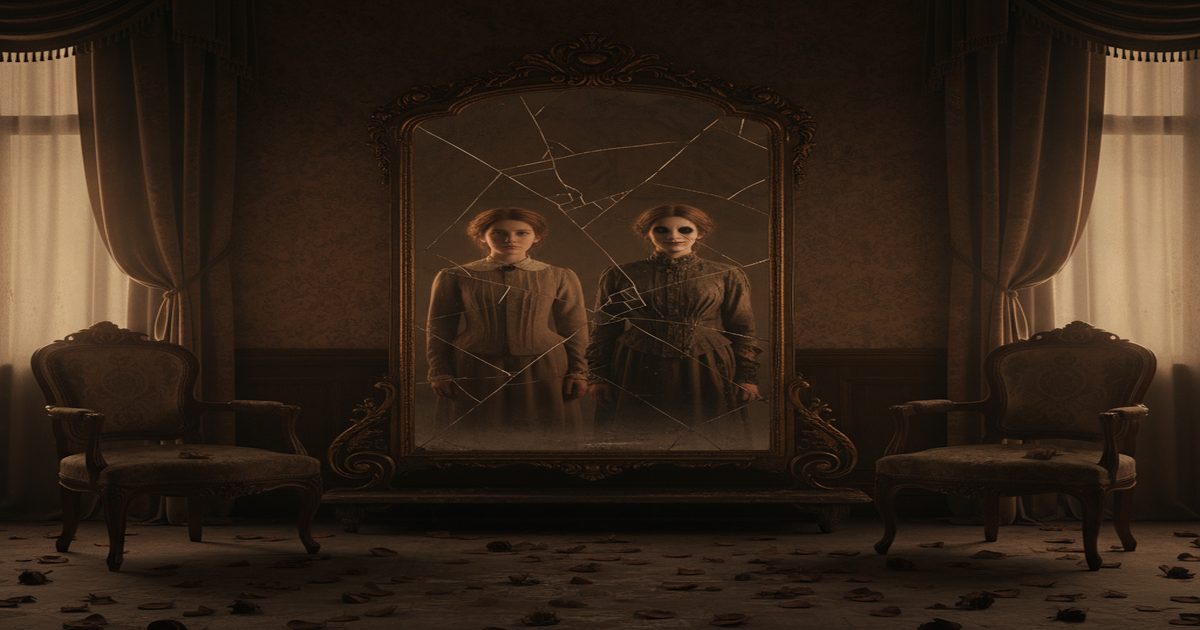
There’s something wrong with the doll on the shelf. You don’t know what. You look away. You look back.
Sigmund Freud had a name for this: das Unheimliche — the uncanny. In 1919 he wrote that no horror cuts deeper than what we already know.
What Is the Uncanny, Exactly?
The German word unheimlich is the opposite of heimlich: “homely, familiar.” But Freud noticed something strange in the dictionary: heimlich also meant “secret, concealed.” The two meanings overlap at a precise point. That’s where the uncanny lives.
His 1919 definition remains the sharpest we have: “that class of the frightening which leads back to what is known of old and long familiar.” It’s not the alien that disturbs. It’s the familiar that reveals itself as strange.
This explains something every horror reader recognizes. Ghosts in suburban houses scare us more than ghosts in medieval castles. A baby smiling at 3 a.m. is more unsettling than any monster from the deep. The issue isn’t the intensity of the threat. It’s the location. The home is supposed to be safe. When it turns against you, there’s nowhere left to go.
“The uncanny is that class of frightening which leads back to what is known of old and long familiar.” — Sigmund Freud, Das Unheimliche, 1919
Why Is the Horror of the Familiar So Unbearable?
Ernst Jentsch had already identified the core of the problem in 1906, in his essay On the Psychology of the Uncanny. His thesis was precise: the uncanny emerges from “intellectual uncertainty” — not knowing whether an object is alive or inanimate.
His example was the wax museum. The brain processes the statue as human. Then it corrects itself. That delayed correction — the split second where both hypotheses remain open — produces something that isn’t fear in the classical sense. It’s more visceral than that. Harder to name.
Freud appreciated Jentsch’s insight but found it incomplete. For Freud, the mechanism ran deeper: the return of the repressed. Forgotten psychic material — childhood beliefs in animism, magic, the omnipotence of thought — suddenly resurface, triggered by an object, a sound, a reflection.
Neurologist Antonio Damasio has studied how the limbic system reacts to vaguely human figures before the cortex can rationally process them. The uncanny’s disgust is somatic: you feel it in your stomach and the back of your neck before you understand what’s frightening you. The body knows before the mind does.
The horror isn’t new. It’s ancient. It’s been inside us since we were children who believed dolls dreamed at night. The uncanny doesn’t bring fear from outside — it wakes what we thought was buried. Anyone who’s explored dreams as portals in horror literature has touched this at least once.
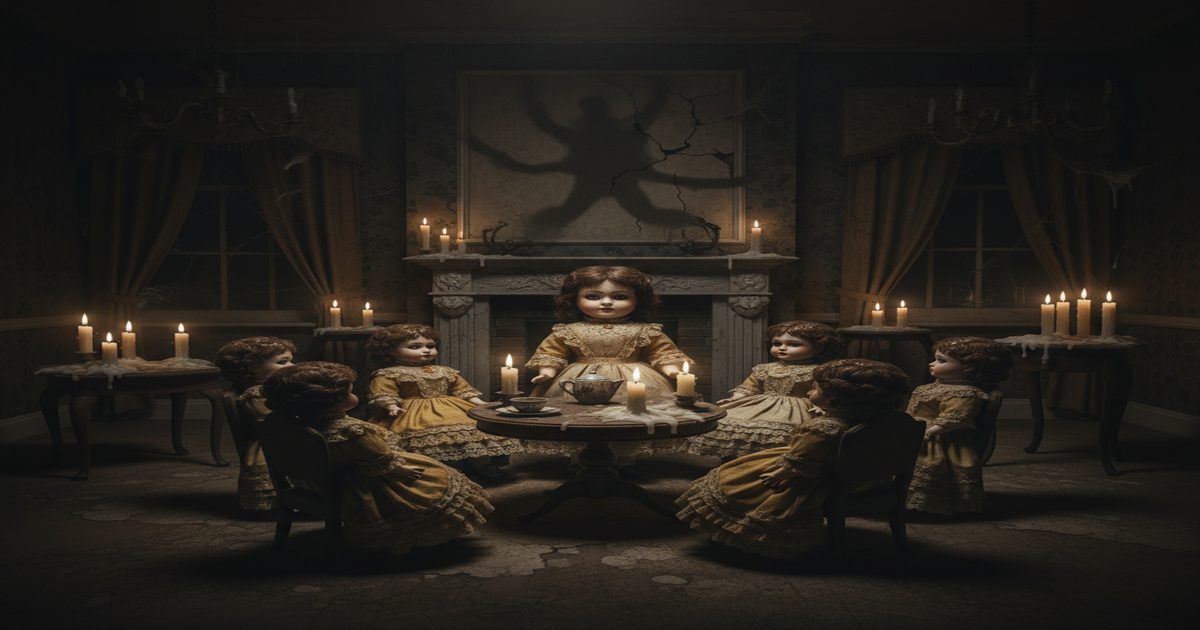
Dolls, Doubles, and Automata: The Uncanny Triad
E.T.A. Hoffmann wrote “The Sandman” in 1817. The student Nathanael falls in love with Olimpia without knowing she’s an automaton built by a mad optician. When he discovers the truth, the rupture is total: he goes insane. Freud cites this story as the canonical example of literary uncanny — the automaton that deceives the heart.
The mechanism still works in 2026. Annabelle, Chucky, M3GAN: these horror-film dolls aren’t monsters in the traditional sense. They don’t have sharp teeth, they don’t come from space. They’re almost human objects. That almost-humanity is the poison: it activates both the recognition circuits and the defense circuits simultaneously, producing a cognitive short-circuit we feel before we can name it.
The double is the parallel form. The Doppelgänger, the lookalike, the shadow that detaches and acts independently. Dostoevsky’s The Double (1846) uses it to explore paranoia. Stevenson’s Jekyll and Hyde (1886) applies it to Victorian morality. Poe’s “William Wilson” (1839) makes it a mechanism of self-destruction. In all of them, horror originates from within — not from an alien creature, but from another version of the self.
Jordan Peele builds Us (2019) entirely on the uncanny double. The copies emerging from underground aren’t cosmic monsters. They’re versions of ourselves we left behind. That familiarity — your own movements distorted, your own voice warped — is more unbearable than any absolute otherness.
From the Gothic Tradition to Weird Fiction
The entire Gothic literary tradition is built on the uncanny. Daphne du Maurier’s Rebecca (1938) is pure uncanny: the nameless protagonist in a house that knows its first mistress better than it knows her. Manderley’s corridors remember. The new bride pays for that memory.
Charlotte Perkins Gilman builds the uncanny around a room itself in “The Yellow Wallpaper” (1892). The protagonist, confined, begins to see faces and figures in the wallpaper that grow increasingly familiar. Until she can no longer distinguish between the wall and herself. Madness as recognition, not as disorientation.
Weird fiction — whose roots we explored in our piece on Lovecraft and cosmic horror — takes the uncanny beyond the domestic. Lovecraft’s alienness isn’t purely astronomical: it’s the uncanny applied to the entire universe. “The Whisperer in Darkness” doesn’t frighten because of the Mi-Go. It frightens because the letter you read at the start felt normal.
Thomas Ligotti, in The Conspiracy Against the Human Race, describes the uncanny as what hides beneath the surface of ordinary life. It’s not the world’s beauty that generates horror — it’s its insistence on seeming normal. The cosmic pessimism of Ligotti is built on this: the uncanny as philosophical weapon.
From the 19th Century to Ari Aster: The Uncanny in Modern Cinema
Ari Aster builds his entire cinema on the uncanny. In Hereditary (2018) the family home becomes a prison: every frame distorts domestic space until it feels alien. It isn’t dark or decrepit. It’s the normal house where a family is supposed to feel safe. That normalcy is the danger.
Midsommar (2019) weaponizes light itself. The terror doesn’t arrive at night — it arrives in full summer daylight, surrounded by flowers and folk songs. No dark corner to hide in. Just this blinding familiarity concealing something ancient and feral, smelling of herbs and old blood.
Robert Eggers works from the same principle. In The Witch (2015) the Puritan farmstead is apparent refuge — family, prayer, cultivated earth — yet it seeps threat from every wooden plank. With Werwulf (2026) Eggers carries this into medieval Nordic folklore. The creature is human and familiar. Then it isn’t. That transition is the uncanny’s heartbeat.
1980s horror cinema — the decade of The Brothel of Shadows — had intuited the mechanism before the theory caught up. Poltergeist (1982) uses the American suburban home as uncanny space: the dream house with a television that turns on in the dark. The television as door to the unimaginable — exactly what any well-made psychological horror novel does.
Why Is the Uncanny the Hardest Horror to Shake?
The uncanny has a quality no other type of horror can replicate: it’s personal. Lovecraft’s cosmic monster terrorizes everyone equally, with the same indifference. The uncanny uses the specific material of your life — your home, your faces, your neighborhood — and bends it.
This is why the most effective psychological horror works with universal archetypes: the child you no longer recognize, the partner behaving in ways you can’t explain, the childhood home that hides something. These tropes activate the uncanny in nearly every reader, because nearly everyone — at least once — has had that feeling.
Forbidden knowledge in cosmic horror works on the same principle: it doesn’t reveal the unknown. It reveals what was already there, in a form you never wanted to look at directly. The uncanny brings nothing new. It just shows you what you buried.
How The Brothel of Shadows Inhabits the Uncanny
Some stories live so deep inside the uncanny that sleep becomes difficult afterward. Not because they show monsters — because they show something you already know, transformed.
Alex dreams of a brothel in 1980s Amsterdam. He recognizes it. He knows where it sits in the city. He knows the streets, the canal, the particular quality of Dutch evening light. But something in that place is fundamentally wrong: the geometry of its rooms, the creatures that inhabit it, the cosmic hunger of Xyl’khorrath saturating every corner of that impossible house.
This is the uncanny structure in its purest form — the familiar that becomes strange without ever ceasing to be familiar. The city is Amsterdam. The street is real. The door shouldn’t exist. Yet here it is, warm under the hand. As though you’ve opened it a thousand times before.
Freud was right about one fundamental thing: the hardest horror to shake doesn’t come from outside. It comes from within. From the part of us that already knows the answer but refuses to look it in the face.
The most intense moment of terror isn’t when the monster appears. It’s one second before. When you think: wait. I’ve seen this before.
Something moves behind reality. Jan Willem Koster saw it and wrote it down.
Read the novel →