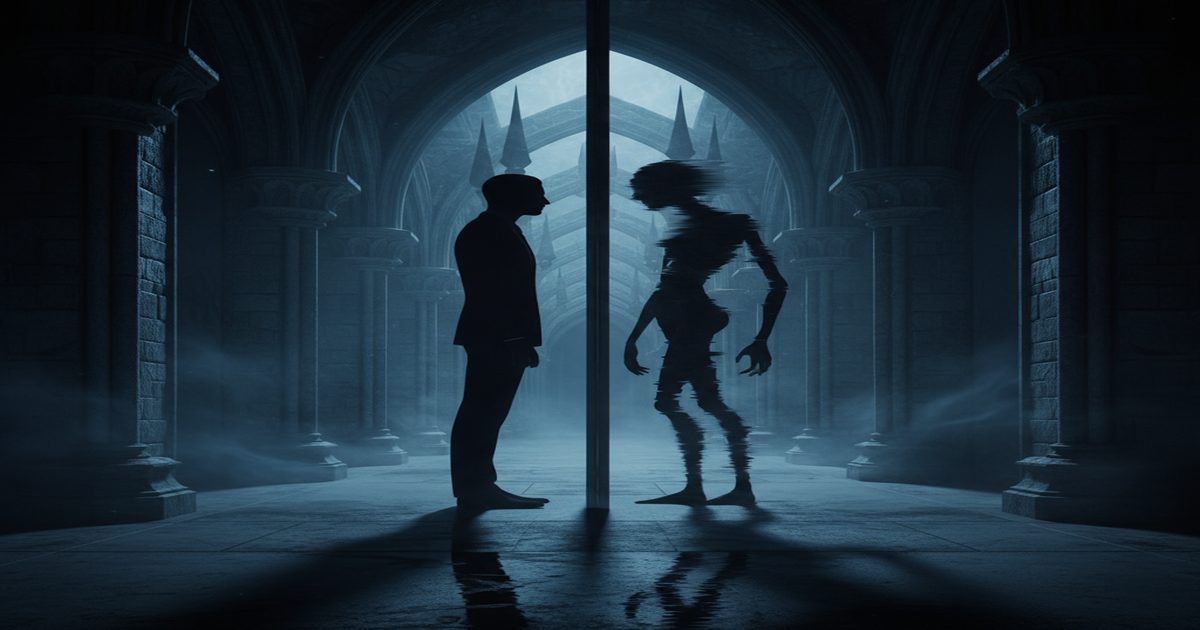
Meeting your own double is always a death sentence. Not a threat. A promise.
The doppelgänger knows your name, your step, the shape of your hands. It is you — but distorted in a way you can’t quite name. That imperceptible distortion is more terrifying than any creature from outside you could imagine.
Why Is the Double More Frightening Than Any External Monster?
The word comes from German: Doppel (double) and Gänger (walker). Literally, the double-walker. In Germanic folklore, seeing your own image without a reflection was a death omen — a sign that the end was near.
But folklore is only the surface. The deep horror of the double isn’t supernatural. It’s psychological. The double terrifies because it challenges the most fundamental thing you believe about yourself: that you are one coherent, continuous person.
The external monster — the vampire, the werewolf, the cosmic entity — comes from outside. You can run. You can close the door. But the double comes from inside. It’s already there when you wake up. It’s in the tone of voice you use when you’re tired, the decision you make without understanding why.
This is why horror literature has returned obsessively to the doppelgänger for two centuries. Not from lack of imagination. From surgical precision about the exact place it hurts most.
Hoffmann and German Romanticism: the First Map of the Abyss
Ernst Theodor Amadeus Hoffmann was the first to chart this territory systematically. In “The Sandman” (1816), protagonist Nathanael is haunted by a figure who seems to know him better than he knows himself. Paranoia and reality dissolve into each other without resolution.
German Romanticism was obsessed with the doppelgänger because it was obsessed with the self. If the individual is the center of the universe — as German Idealism taught — what happens when the individual is double? When there’s a crack in the very foundation of the self?
Hoffmann gave no answers. He gave glimpses. His stories open like windows onto a darkness that never ends. The uncanny that Freud would theorize a century later was already there, pulsing, in Hoffmann’s pages.
Jean Paul Richter had coined the term in 1796, but it was Hoffmann who turned it into authentic literature. The word existed. The narrative form made it flesh.
Stevenson, Dostoevsky, Poe: Three Ways to Lose Yourself
Robert Louis Stevenson published “Strange Case of Dr Jekyll and Mr Hyde” in 1886. The surface reading sees a Victorian moral fable: good and evil separated. The deeper reading finds something more disturbing: Jekyll and Hyde aren’t opposites. They’re the same person choosing which face to show.
Hyde isn’t Jekyll’s dark side. He is Jekyll without the mask. That is the terror Stevenson hides beneath the explicit moral: not that evil exists, but that evil and good share the same body, the same voice, the same dreams.
“I was forced to admit that I was both persons: Dr Jekyll was as true as Mr Hyde, and when I tried to be one, the other made himself felt.”
— Robert Louis Stevenson, Strange Case of Dr Jekyll and Mr Hyde (1886)
Dostoevsky tackled the theme in 1846 with “The Double”. Golyadkin encounters his own double — more confident, more capable, universally liked — and watches it progressively steal his identity. The novel is often dismissed as a madness tale. It’s actually a story about the fear of being replaced. A fear that in 2026 sounds uncomfortably familiar.
Poe, writing in the same decade as Dostoevsky, gave us “William Wilson”: the protagonist hunts and kills his double, only to realize he has killed himself. Psychological horror as dissociation was already complete, stated with absolute precision, by 1839.
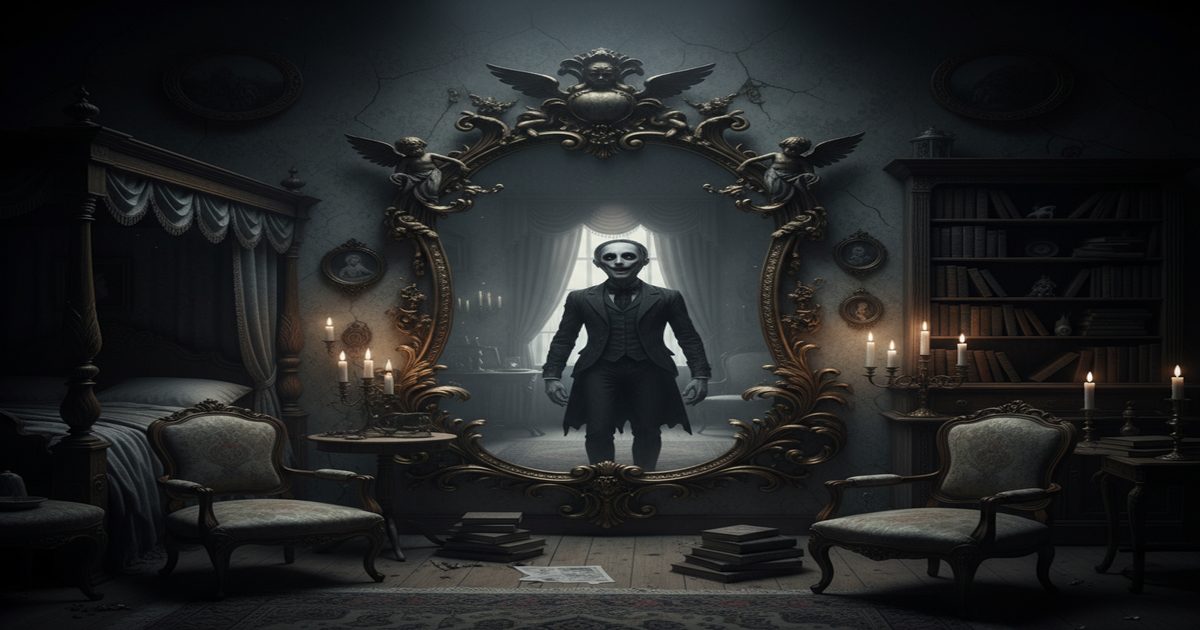
The Doppelgänger on Screen: from Bergman to Cronenberg
Ingmar Bergman’s “Persona” (1966) takes the doppelgänger beyond metaphor: the two protagonists literally merge on screen, their faces superimposed in cinema’s most celebrated shot. Identity doesn’t collapse — it dissolves. Slowly. Without return.
David Cronenberg built an entire filmography on the idea that the body betrays identity. In “Dead Ringers” (1988), two identical twins begin swapping roles until neither knows which is real. Cronenberg’s body horror is always, at its core, a doppelgänger story: the flesh becoming alien, the body refusing to be only yours.
Jordan Peele updated the myth in “Us” (2019): the doubles rise from underground, from a forgotten and resentful America. The doppelgänger as social critique. Your double isn’t just you — it’s also everything you’ve chosen not to see about your own life.
Every decade produces its version of the double because every decade has its version of the identity crisis. The doppelgänger never ages because the question it poses — who are you, really? — has never had a definitive answer.
Why Does the Doppelgänger Terrify Us More Than Ever in 2026?
In 2026 the doppelgänger has left literature and invaded reality. AI voice clones replicate your voice from a few seconds of audio. Deepfakes put your words into the mouth of another version of you. Technological horror has found its most ancient form.
Dostoevsky’s fear — being replaced by a better, more capable, more beloved version of yourself — is no longer Romantic fantasy. It’s a practical concern for millions of workers whose digital double might perform their job better than they do.
Yet the emotional response hasn’t changed in two hundred years: nausea, disorientation, the sense that something fundamental has been violated. Hoffmann would recognize the feeling immediately. So would Stevenson.
The doppelgänger wasn’t a metaphor for the future. It was a map of the present waiting to become the future.
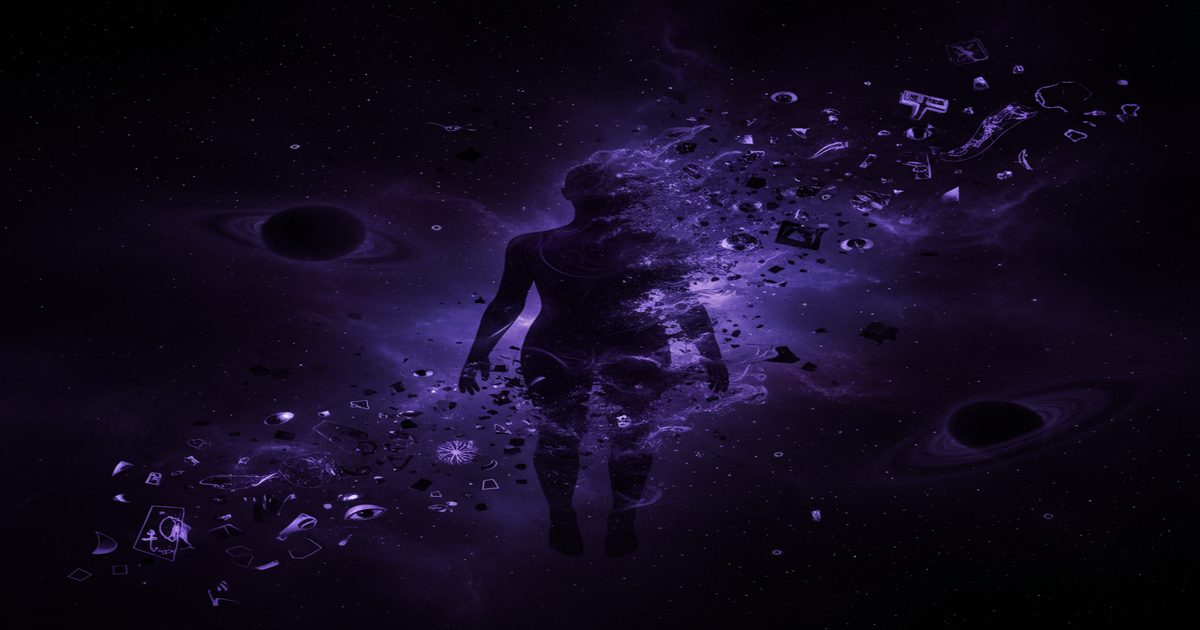
The Cosmic Double: Xyl’khorrath and Alex’s Dissolution
In The Brothel of Shadows, Xyl’khorrath is not merely a hungry cosmic entity. It is a doppelgänger at universal scale — a being that feeds by absorbing the identities of those it draws to the brothel, gradually replacing original desires with its own.
Alex isn’t simply tempted or corrupted. He is duplicated from within. Each visit leaves less of him and more of something else. The forbidden knowledge he gains has a precise price: the coherence of his own identity over time.
The dreams that call him every night are the cosmic doppelgänger’s mechanism: they don’t touch you while you’re awake, but while you sleep they replace you piece by piece. You wake up slightly different. Then increasingly different. Until the face in the mirror is one you no longer fully recognize.
Hoffmann would have understood immediately. So would Dostoevsky. The monster never comes from outside.
About the author: Jan Willem Koster is the author of The Brothel of Shadows, a gothic horror novel set in 1980s Amsterdam.
It’s not a book. It’s an experience. Whoever enters the Brothel of Shadows leaves changed.
Begin the descent →