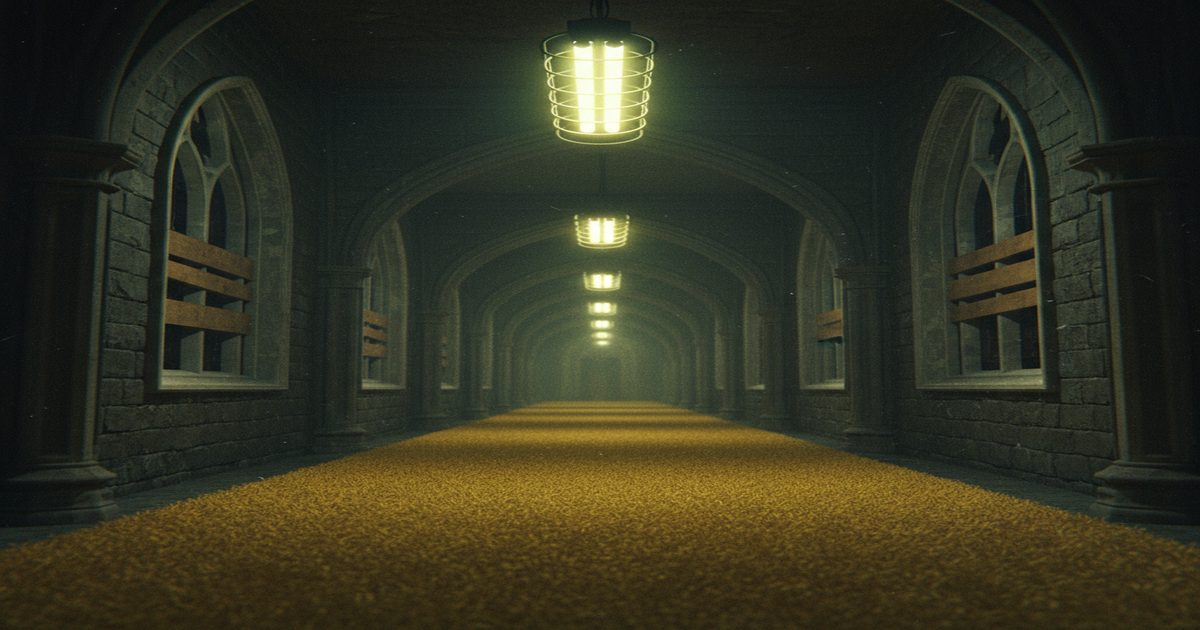
The carpet was yellow. It smelled of damp and old — that particular smell that doesn’t belong to any season or any place.
It was three in the morning. The office wasn’t empty in the usual sense — it was empty as if it had never been inhabited. Fluorescent lights hummed at a frequency you don’t hear with your ears. You feel it in your stomach. Corridors that folded back on themselves. No windows. No visible exit.
This place doesn’t exist. And yet you recognize it.
What you just read is not fiction. It’s the description of the image that, in 2019, sparked one of the most culturally significant horror phenomena of the digital age: the Backrooms. One photograph of a nondescript corridor, a few lines of text, and millions of people shuddered with recognition. The fear of empty space is ancient. The name is brand new.
Non-Places: The Architecture of Wrong
French anthropologist Marc Augé coined the term non-lieu — non-place — in 1992. Highway rest stops, airports, shopping malls on a gray Tuesday afternoon. Transit spaces, not living spaces. No one inhabits them; people pass through.
Augé described them as spaces without identity, history, or relationship. Functional, efficient, and profoundly alien to human psychology. Drain them of people, cut the noise, dim the lights slightly — and watch what happens to your nervous system.
Cognitive psychology has a name for it: the uncanny valley of architecture. Your brain recognizes the materials — carpet, drywall, fluorescent tubes — as domestic. But it finds no trace of human presence. This mismatch produces an immediate alarm response. No visible threat. Just the absence.
The most effective psychological horror works on exactly this principle: don’t show the monster, show the space the monster might emerge from. Undefined threat outpaces concrete threat every time. The Backrooms don’t need creatures in the conventional sense. They have corridors that never end.
Liminal, from the Latin limen: threshold. A liminal space is a transitional space — a place designed to be crossed, not inhabited. Locker rooms, hospital hallways, basement parking structures at midnight, service staircases nobody uses. Spaces that reveal their true nature the moment human noise stops filling them.
The Backrooms: When One Image Becomes Mythology
In May 2019, someone posted a photograph on 4chan. An anonymous corridor. Stained yellow carpet, butter-colored walls, white fluorescent lights humming without variation. No clue as to location. No windows. No named doors.
Below the image: If you’re not careful and you noclip out of reality in the wrong areas, you’ll end up in the Backrooms. Approximately six hundred million rooms. Have fun surviving. The smell of wet carpet. The hum. Nothing else.
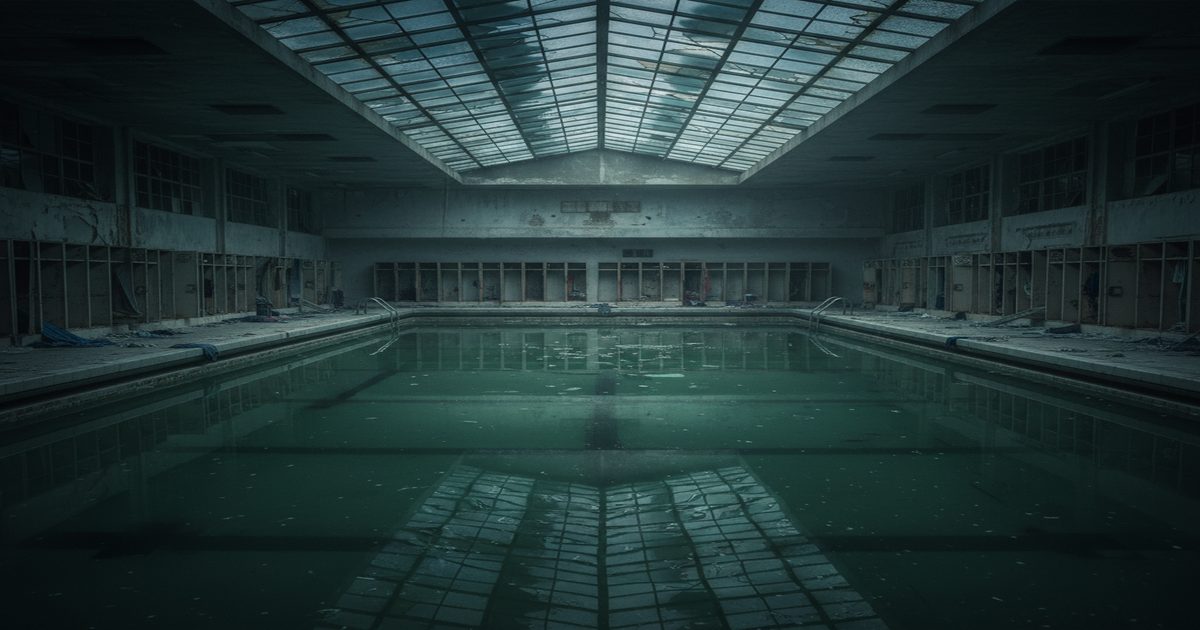
Within weeks, a complete wiki mythology had grown around it. Levels numbered zero to infinity, each with different physical laws and catalogued danger ratings. Level 0 was the original corridor. Level 37 was an empty indoor swimming pool at 3 a.m., the still water smelling of chlorine and something else. Level 94 was a forest at night with no stars.
The catalogued entities — Smiler, Hound, The Thing in the Walls — weren’t creatures of flesh in the traditional sense. They were presences that existed because the space existed. Manifestations of the architecture itself.
“You are at Level 0. The only way out is forward. The only thing worse than moving is stopping.” — The Backrooms Wiki, Level 0
In 2022, seventeen-year-old Kane Pixels uploaded a found footage short film set in the Backrooms. Twenty million views in a week. The handheld camera, the footsteps on that carpet, the unbroken hum — it was indistinguishable from the texture of a real nightmare. A24 acquired the rights. The feature film arrives in May 2026.
Digital folklore was born differently here. No author, no tradition, no singular transmission. Just one shared image and the collective recognition of a common fear. Millions of people said: yes, I know that place — and that response was more unsettling than the image itself.
The Literature of Wrong Geometry
Mark Z. Danielewski published House of Leaves in 2000. A novel about a house that contains more space than is physically possible. Corridors lengthen overnight. A door appears where there was none. The space breathes like a living thing.
The terror isn’t the creature inside the corridors. It’s that the corridors change. The measurements don’t add up. The darkness is darker than darkness should be. Danielewski builds psychological horror with no identifiable antagonist — just geometry that refuses to obey and the dread of a space that decides, on its own, where it ends.
Jeff VanderMeer did the same with Annihilation (2014). Area X is a territory where physical laws behave differently. The underground tower grows downward. Words written on its walls pulse as if alive. No one who enters Area X comes back unchanged — not because something attacks them, but because the space is the change.
Kafka knew non-places too. The Castle is unreachable not because it’s distant, but because the village’s topography simply doesn’t allow arrival. The office corridors in The Trial are identical to Backrooms Level 0: long, poorly lit, filled with numbered doors that correspond to no comprehensible logic.
The horror of forbidden spaces has always understood that places can be more terrifying than creatures. A building that won’t let you leave. A room that only appears at 3:07 a.m. Space as antagonist is the most honest kind: no motivations, no weaknesses, no possibility of being reasoned with.
The Cinema of Empty: Kubrick to the Digital Age
Kubrick understood it first. The Overlook Hotel in The Shining (1980) is an impossible maze. The interior geometry doesn’t add up — some windows face courtyards that can’t exist given the building’s exterior, corridors seem longer than they should be.
This isn’t a production error. Kubrick deliberately built the sets with subtly wrong proportions. The viewer can’t identify what’s off — they feel it in the body. Mild nausea. Disorientation. The sensation of a space that refuses to play by its own rules.
Found footage became liminal horror’s natural medium. The handheld camera, the absence of a non-diegetic score, the grain of amateur video — everything amplifies the sense of a real space that shouldn’t be this way. The A24 Backrooms film, arriving May 2026, is the genre’s mainstream coronation.
The Brothel Between Dimensions: Cosmic Liminal Space
In The Brothel of Shadows, Alex doesn’t walk toward anything. He falls between things.
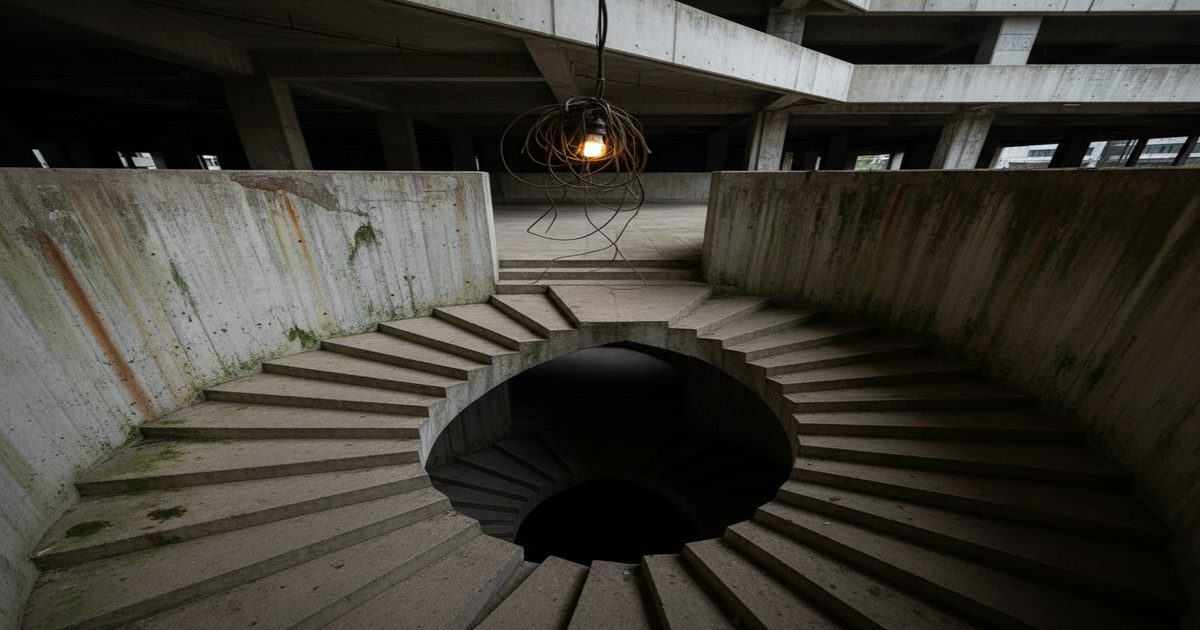
The brothel that appears in his dreams has no geographic coordinates. It exists in the gap between his 1983 Amsterdam and something enormously older. The corridors shift between visits. Light comes from sources that can never be located. The smell is burnt wax, decay, and something floral that shouldn’t be in the same room as the other two.
This is what makes it pure terror: not the brothel’s contents, but the fact that a place like this can exist. Xyl’khorrath isn’t a creature inhabiting a space — it’s a space that became a creature. The cosmic hunger doesn’t devour from outside. It lives in the architecture itself.
Jan Willem Koster understood what the Backrooms creators discovered intuitively: non-places are thresholds toward things without names. Not because the names don’t exist — but because whoever found them didn’t come back to say them out loud.
The Void Is the Most Honest Monster
Conventional monsters have logic. You can study lycanthropy, learn vampire rules, predict a killer’s pattern. There’s always a system. Against these monsters, defense is at least theoretically possible.
Empty space negotiates with no one. The corridor doesn’t want anything from you. The abandoned pool just sits there — its still water, its silence thick as something biological. The void has no intentions. And this absence of intention is exactly what the human brain cannot tolerate, wired as it is to find agents and causes everywhere it looks.
The Backrooms frighten us because they suggest the world has cracks. Gaps between levels, between rooms, between dimensions. Places that shouldn’t exist but do — waiting, with the infinite patience of something that has no need to act, for someone to noclip in the wrong direction.
The yellow carpet is still there. The hum never stops.
Sixty-four chapters of pure cosmic terror. An Amsterdam you won’t forget.
Read the novel →