Every great horror story is, at some level, a story about a place. The Overlook Hotel. Hill House. The house on Ash Tree Lane. Castle Dracula. Before the first ghost appears, before the first drop of blood falls, the setting has already done its work — has already told you, in the language of architecture and atmosphere, that you are somewhere the ordinary rules do not apply. The best horror settings do not merely contain the horror. They generate it. They are the horror, given walls and a roof and a door that locks behind you.
But not all horror settings are created equal. The most powerful are those that carry with them the weight of transgression — places that are forbidden not merely because they are dangerous, but because they represent a crossing of boundaries that society has erected for reasons it prefers not to examine too closely. These are the liminal spaces, the threshold places, the locations that exist at the margins of the acceptable world. And it is in these forbidden places that horror fiction finds its most fertile and unsettling ground.
The theory of liminal spaces
The concept of liminality — from the Latin limen, meaning threshold — refers to the quality of ambiguity that exists at the boundary between two defined states. A doorway is liminal: it is neither inside nor outside. A corridor is liminal: it is a space whose only purpose is to lead to other spaces. An airport terminal at three in the morning, a hospital hallway, an empty swimming pool — these are all liminal spaces, places that exist between fixed points, suspended in a state of permanent transition.
Horror fiction has always been drawn to liminality because the liminal is, by its nature, unstable. In a liminal space, the categories that keep the world ordered — inside and outside, self and other, living and dead — lose their sharpness. Boundaries blur. Things that should stay separate begin to merge. And in that merging, in that dissolution of the familiar structures that keep reality coherent, the monstrous finds room to emerge.
The internet's recent fascination with liminal spaces — those eerie photographs of empty malls, abandoned playgrounds, and fluorescent-lit hallways that lead nowhere — testifies to a widespread recognition that these transitional places carry an inherent charge of unease. Horror writers have known this for centuries. They simply took the unease and gave it a name, a face, a set of teeth.
The asylum: when care becomes captivity
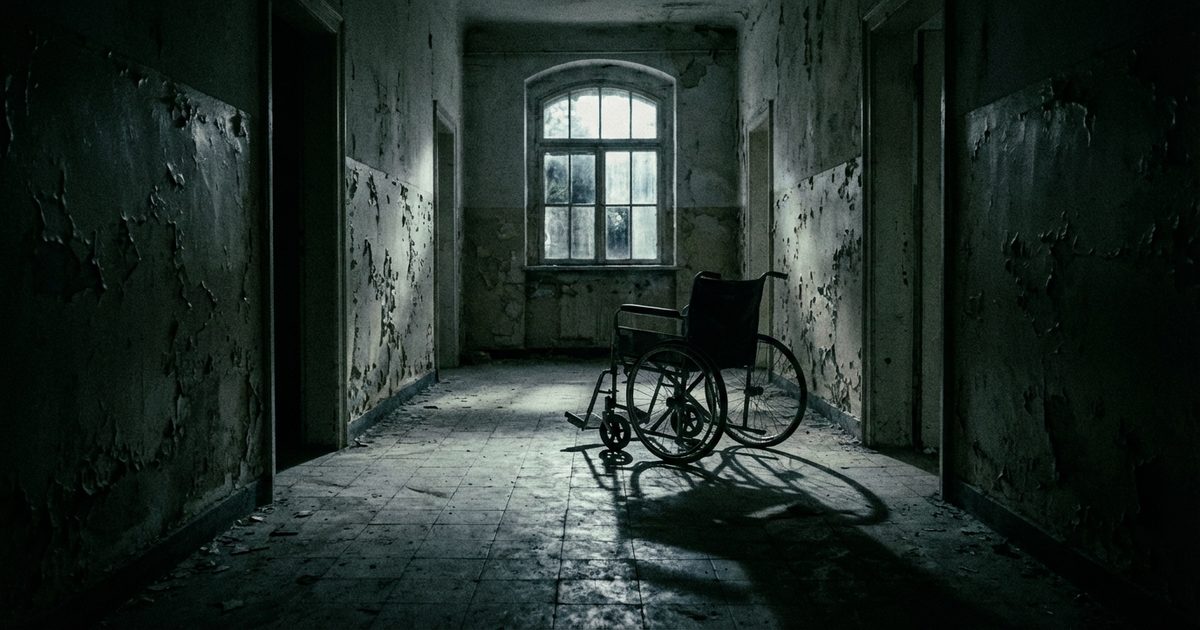
Few forbidden places have served horror fiction as faithfully as the asylum. From the madhouse scenes of gothic literature through the psychiatric hospitals of twentieth-century horror to the abandoned institutions of contemporary fiction, the asylum offers a setting uniquely suited to the genre's needs. It is a place of confinement designed to contain that which society cannot accommodate — a place where the boundary between sanity and madness is both rigidly enforced and perpetually in question.
The horror of the asylum lies in its dual nature. It is ostensibly a place of healing, of care, of benevolent authority. But it is also a place where people are held against their will, where their testimony is automatically discredited, where the distinction between patient and prisoner dissolves. The asylum teaches horror fiction one of its most important lessons: the most frightening places are those that present themselves as safe.
The catacombs: the city beneath the city
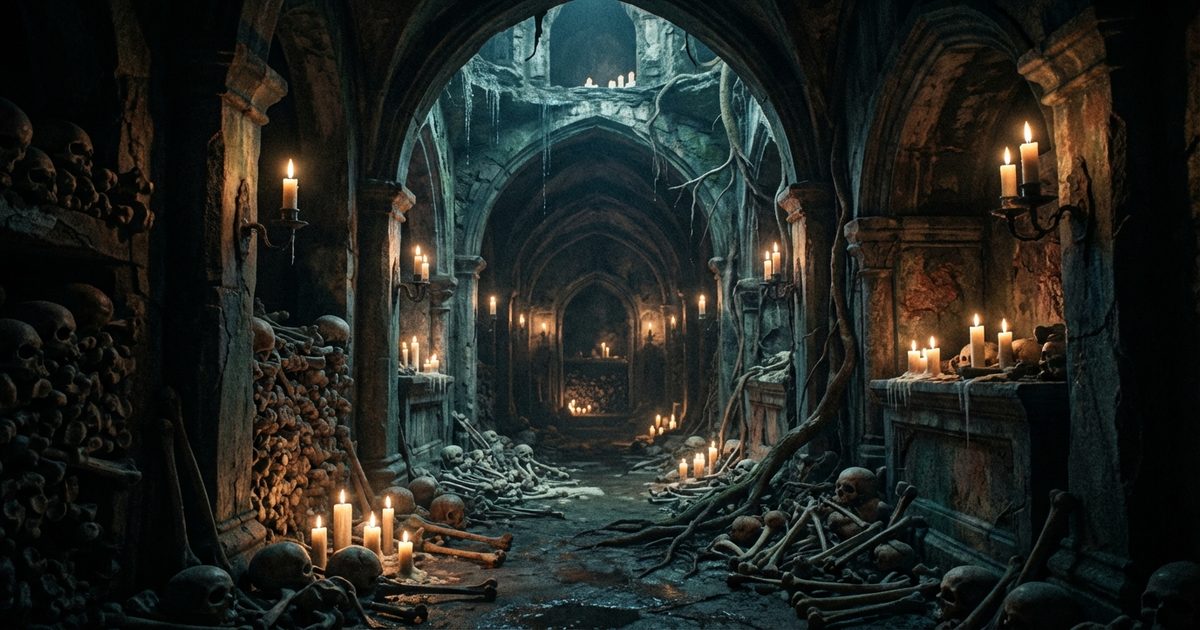
Beneath the streets of Paris, beneath the churches of Rome, beneath the old quarters of cities across Europe, there are spaces where the dead outnumber the living. The catacombs — whether ancient Christian burial sites or the vast ossuaries that store the reorganized remains of centuries of the dead — represent a literalization of the subconscious that few other settings can match. They are what lies beneath: beneath the street, beneath the church, beneath the thin veneer of the present.
For horror fiction, the catacombs offer everything: confinement, darkness, the presence of death, the disorientation of a maze with no reliable map. But their deepest power lies in the way they invert the relationship between surface and depth. On the surface, the city lives and breathes and goes about its business. Below, in the tunnels where the bones are stacked like cordwood, another reality persists — older, slower, infinitely more patient. The knowledge that waits beneath is not comfortable knowledge. It is the knowledge of what all the activity above is trying, and failing, to outrun.
The haunted house: architecture of the unconscious
The haunted house remains horror's foundational setting for a reason that goes beyond tradition. A house is the most intimate of spaces — the place where we sleep, where we are most vulnerable, where we remove the armor of our public selves. When the house turns hostile, the violation is total. There is nowhere left to retreat. The thing that should protect you has become the thing you need protection from.
Shirley Jackson understood this better than anyone. Her Hill House is not merely a building with ghosts in it. It is a building that is, in some fundamental way, alive — a structure whose geometry is subtly wrong, whose angles do not quite add up, whose rooms are not quite the size they should be. The house does not contain the horror. The house is the horror, rendered in plaster and wood and decades of accumulated unhappiness.
Mark Z. Danielewski extended this concept with his labyrinthine narrative of a house whose interior dimensions exceed its exterior — a spatial impossibility that transforms the home from a shelter into a void, an absence masquerading as a presence. In both cases, the horror of the haunted house is the horror of the familiar made strange, the safe made dangerous, the known made unknowable.
The brothel: where masks come off
Among forbidden places, the brothel occupies a unique position. Unlike the asylum or the catacomb, it is a place that people enter willingly, drawn by desire rather than compulsion. Unlike the haunted house, it does not pretend to be safe. It is, by its nature, a place of transaction and transformation, where identities are negotiated and the masks of everyday life are exchanged for other, more revealing masks.
As a horror setting, the brothel offers something that few other locations can match: the guarantee that the protagonist has chosen to be there. In a haunted house, the characters can be trapped by circumstance. In an asylum, they can be held against their will. In a brothel, they walked in of their own accord, driven by a desire they cannot or will not deny. This voluntary entry makes the subsequent horror more devastating, because it implicates the protagonist in their own destruction. They cannot claim innocence. They came seeking something, and they found it.
The brothel is also, by its nature, a space of secrets. What happens within its walls is, by social contract, invisible to the outside world. This invisibility creates a pocket of reality where different rules apply — where the social contract is suspended, where the self can become fluid, where things can happen that the daylight world would refuse to acknowledge. For horror, this is invaluable. The brothel is a place where the world's protective fictions are stripped away, leaving the raw mechanism of desire and fear exposed.
Amsterdam's red-light district: the perfect storm
Amsterdam's red-light district concentrates every element that makes a forbidden place effective in horror fiction. It is liminal: a zone within the city that operates according to its own laws, its own rhythms, its own economy of desire. It is visible yet hidden: the windows display what other cities conceal, yet behind those windows lie rooms that no outsider sees. It is ancient: the district has existed in various forms for centuries, its cobblestones saturated with the accumulated residue of countless transactions, countless encounters, countless secrets.
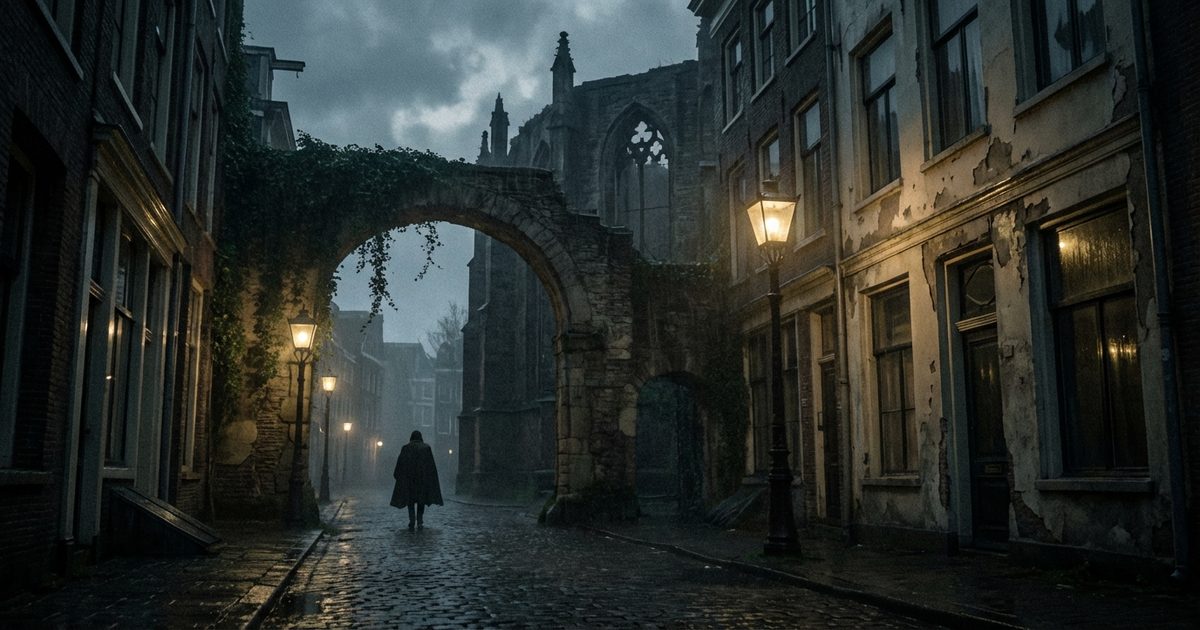
And at the center of the district stands the Oude Kerk, the oldest church in Amsterdam, its medieval stones casting their shadow across the very windows where desire is offered for sale. This juxtaposition — sacred and profane occupying the same physical space, separated by nothing more than a few meters of cobblestone — creates a field of narrative tension that a horror writer could spend a lifetime mining.
The Brothel of Shadows: the setting that breathes
Jan Willem Koster's The Brothel of Shadows takes the brothel-as-horror-setting and pushes it beyond every previous limit. Set in the labyrinthine heart of 1980s Amsterdam, the novel's titular brothel is not merely a building in which supernatural events occur. It is a place that exists at the threshold between realities — a space where the human body and the architecture share the same unsettling fluidity.
In Koster's vision, the brothel's rooms are not fixed. They shift, reconfigure, reveal new chambers that should not be possible within the building's exterior dimensions. The corridors lead to spaces that feel less like rooms and more like states of being. The deeper the protagonist Alex ventures into the brothel, the more apparent it becomes that he is not merely moving through space but through layers of reality, each one stripping away another assumption about what is real, what is possible, what is human.
This is the ultimate expression of the forbidden place in horror fiction: a setting that does not merely house the horror but enacts it, a space that transforms those who enter it not through supernatural violence but through the simple, devastating act of revealing what was always there, hidden behind the reassuring walls of the ordinary world. The brothel, in Koster's hands, becomes the door that every seeker of forbidden knowledge has always been searching for — the door that opens onto everything, and closes behind you forever.
Enter the place where reality bends. Cross the threshold of the forbidden.
Read the Novel →