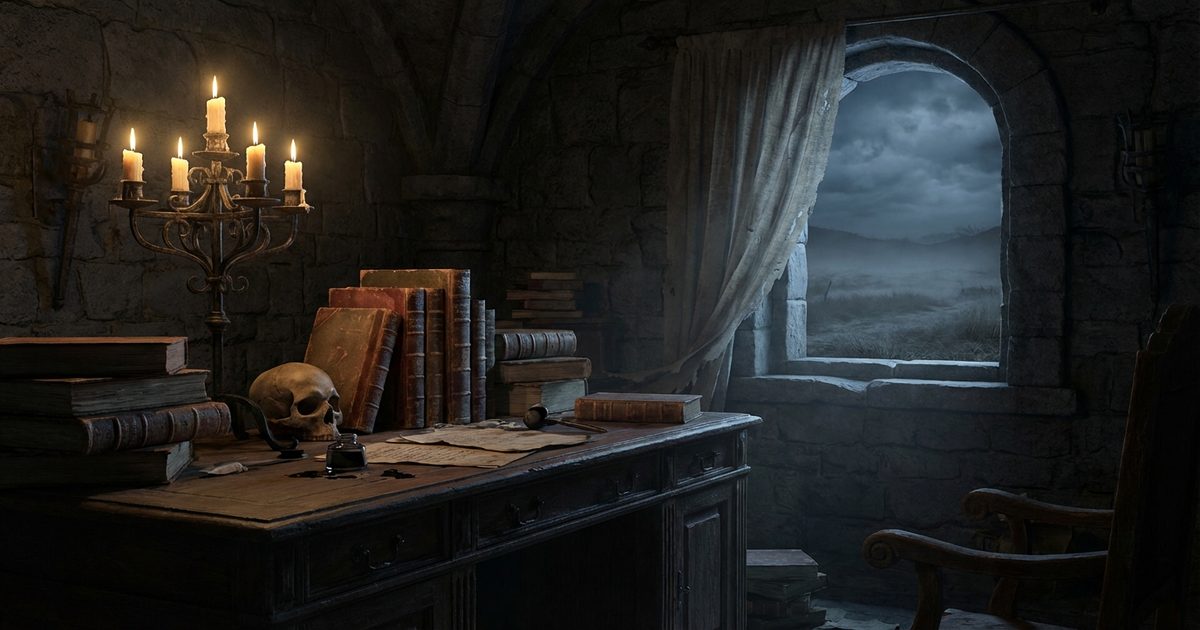
The book was on the table, open halfway, and you couldn’t bring yourself to touch it again. Not because it had frightened you. Because it had convinced you of something you didn’t want to know.
That’s what Thomas Ligotti does. No ghosts, no jump scares, no gothic atmosphere as mere decoration. He uses logic — cold, precise, relentless — to dismantle the one thing that gets you out of bed each morning: the idea that existing means something.
The Philosopher Who Refused Comfort
Thomas Ligotti was born in 1953 in Detroit. You won’t find him on bestseller lists. He doesn’t give interviews, doesn’t appear in public, doesn’t court readers. His work — short stories, essays, verse — is the output of someone who turned chronic illness into aesthetic system.
He has suffered from severe anxiety and depression for decades, a fact he’s acknowledged in the few statements he’s ever released. That suffering didn’t stay private. It became the raw material for one of the most coherent and disturbing visions in contemporary American literature.
His 2010 essay The Conspiracy Against the Human Race is the founding text of modern cosmic pessimism. Not a novel — a formal indictment against existence itself. Drawing on Schopenhauer, Cioran, Zapffe, and Benatar, Ligotti argues that human consciousness is an evolutionary mistake. A poisoned gift. An aberration that condemns us to suffer without any genuine possibility of relief.
“Nature has cursed us with enough consciousness to feel our suffering, but not enough to escape it.”
— Thomas Ligotti, The Conspiracy Against the Human Race
When Consciousness Becomes the Monster
Ordinary horror targets survival. You’re afraid because you might die, because the sound is coming from under the bed, because the door is locked but the handle moves. It’s fear of immediate, concrete danger.
Cosmic pessimism works on a different plane — deeper, more insidious. It doesn’t threaten the body. It dissolves the self. The premise: suffering is not an accident of life but its load-bearing structure. The marrow, not the surface. Every moment of happiness is a temporary distraction, an evolutionary miscalculation designed to keep us moving toward reproduction.
In Ligotti’s stories, this translates into a peculiar narrative architecture. In The Frolic, a psychopathic criminal describes his imaginary universe with such lyrical precision that the reader begins to wonder if he’s the sane one. In The Shadows at the Bottom of the World, the autumn shadows aren’t romantic metaphors — they have their own agency, and their nature reveals something unbearable about the human condition.
Ligotti builds horror through silent escalation. He doesn’t go from zero to a hundred. He goes from zero to one, then one to two, with a methodical patience that resembles mathematics more than narrative. By the final paragraph, you’re so far from where you started that you no longer know how to return.
The Grammar of Terror: Style and Technique
Ligotti’s sentences look normal. Then they turn on themselves.
“The sky was grey. The grey tasted of something. That something had no name.” Three sentences, sixteen words, an abyss. The brevity isn’t minimalism — it’s a trap. The short sentence closes the reader’s mouth before they can object.
His vocabulary is deliberately doubled. He uses words from everyday life — streets, windows, offices, cafes — and infects them with adjectives that shouldn’t belong there. An office isn’t “gloomy”: it is “aware of its own futility.” A window isn’t “dark”: it is “indifferent to the distinction between inside and outside.”
- Escalation through accumulation, never through climax
- Characters with no names, or names stripped of history
- Urban environments as landscapes of alienation
- Open endings that aren’t unresolved — simply interrupted
This lexical estrangement produces a precise physical effect: the sensation of a floor giving way half an inch underfoot. You don’t fall. But you know something has shifted.
Ligotti, Lovecraft, and the Difference That Changes Everything
The comparison with Lovecraft is inevitable but imprecise. Lovecraft was obsessed with the external: cosmic entities arrive from space, from the ocean, from dimensions beyond human comprehension. The horror is out there, and madness is the price of having looked at it.
Ligotti inverts the geometry. His horrors are born inside. They don’t arrive from cosmic dimensions — they emerge from the structure of consciousness itself. The outside — the city, the night, the people passing by — is merely a mirror in which the narrator sees his own dissolution reflected.
This also separates Ligotti from the weird fiction tradition. Jeff VanderMeer takes horror into physical territory — Area X is a place. China Miéville radicalizes it in political terms. Mark Fisher, in The Weird and the Eerie, builds on Ligotti a critical vocabulary for the horror of contemporary modernity.
But Ligotti is the fixed point. The grammar everything else derives from. Without him, there would be no language to describe what the others write.
Cosmic Pessimism as a Reading Practice
How do you read Ligotti without drowning? The question isn’t rhetorical. His worldview is coherent and relentless — follow it all the way down and there’s no logical exit. It’s a philosophically airtight trap.
The answer is to read the way you’d look at a Beksiński painting: with the awareness that the abyss is real inside the work, not outside it. Cosmic pessimism functions because it externalizes something that already exists in the reader’s unconscious. It doesn’t install new fear — it names the old kind.
Start with Songs of a Dead Dreamer and Grimscribe (the 2015 Penguin edition collects his best stories). Then, only if you want the philosophy to follow the fiction, The Conspiracy Against the Human Race. Don’t read everything back to back. Each story needs three days of silence around it.
This same tension — between forbidden knowledge and psychic survival — runs through Jan Willem Koster’s The Brothel of Shadows: Cosmic Interception. Alex isn’t simply attacked: he’s understood by Xyl’khorrath, an entity whose cosmic hunger mirrors the void Ligotti describes as the universe’s architecture. Both authors begin from the same premise: that full comprehension of reality is more devastating than any physical death. For more on this lineage, explore cosmic horror’s roots or the theme of forbidden knowledge in horror.
Ligotti offers no solutions. No heroes, no redemptions, no endings that let you close the book and return to normal.
The only consolation is clarity. At least you know what you’re looking at.
And strangely — for those with the constitution to read him — that clarity has an almost calming effect. Knowing that suffering isn’t your personal failure, but the structure of the cosmos, reduces the specific weight of every individual pain.
Almost.
The book is still open on the table. The ceiling is white in the dark. And that white — you notice now — knows something you don’t know yet.
Cross the threshold of forbidden knowledge. Enter the brothel.
Read the novel →