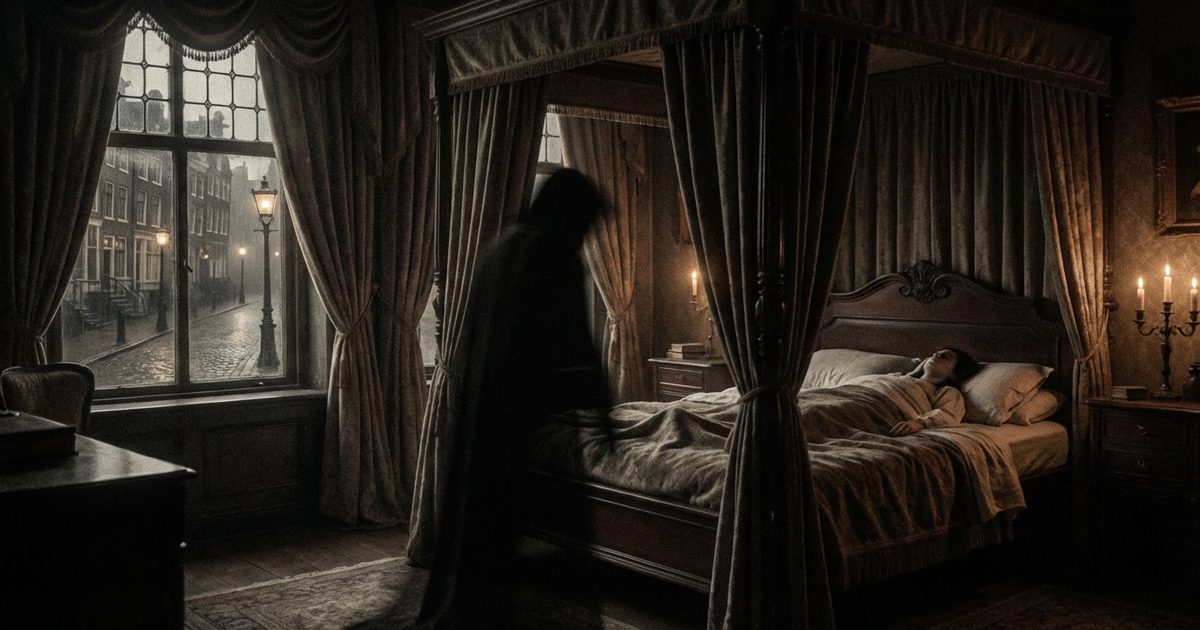
You wake up. Or think you do. Same room, same shadows, same stale warmth. But your body refuses to move. Your arms are concrete.
An ancient weight crushes your chest. Something crouches there — calm, deliberate, invisible. At the edge of your vision, where light never quite reaches, a presence stands. It does not move. It waits.
Then the body returns. Muscles obey. Breath steadies. The presence is gone — if it was ever there. What stays is a bone-deep certainty: something stood in that room, knew you were watching, and will come back.
This is sleep paralysis. Humanity has known it for millennia.
The phenomenon no culture has ignored
Your mind surfaces from REM sleep before your motor system catches up. Brain awake, body still paralyzed. An evolutionary safeguard — it stops you from acting out dreams. Lasts seconds, sometimes minutes. And it can drag hallucinations with it: sounds, pressure, dark figures at the foot of the bed.
Neuroscience has an explanation. But before neuroscience, every civilization had its own.
The consistency is staggering. The figure on the chest. The weight. The inability to move. The shadow in the corner. As if the brain, caught in that specific twilight, always produces the same archetypal hallucination. And every culture built a mythology around it.
“The dream is not only what you see while sleeping. It is what follows you back.”
The Old Hag: witchcraft and the weight on your chest
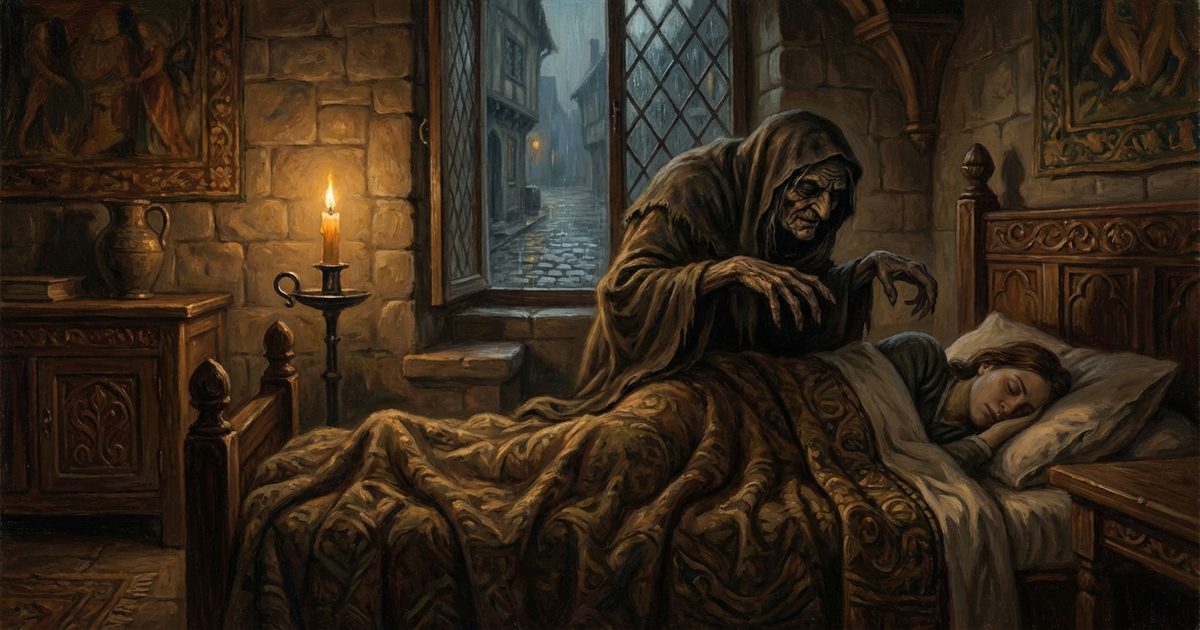
In Newfoundland and rural England, they called it hag-riding. A witch sat on your chest, drained your life force. You woke exhausted, the rancid smell of fear still clinging to your skin. This was no metaphor. It was literal belief, centuries deep.
The image saturates medieval Europe. In Germany she was the Nachtmahr — the crushing female spirit that gave English the word nightmare. In Scandinavia, the mare slipped into stables and braided horses' manes into impossible knots.
In southern Italy, the Monaciello and the Pantasima pressed down on sleeping bodies. In Sicily, the Ficarra. Different names, identical experience: the weight, the paralysis, the presence.
The demon beyond Europe
In Japan they call it kanashibari: bound with metal chains. Vengeful spirits cause it — ghosts who died with grudges intact. The onryō, female spectres heavy with hate, fed an entire cinematic tradition. Ringu. Ju-on. The roots go deep.
In the Arab world, the nocturnal visitor is the karabasan, or the djinn who seize sleeping bodies. Medieval Islamic physicians distinguished the physical from the spiritual with clinical precision. In China it is gui ya: ghost pressing. It rises through the floor.
Mexico has the muerto that visits the living at night. Ethiopia has the Dukak. The Hmong of Southeast Asia have the Dab Tsog — blamed for the mysterious Sudden Nocturnal Death Syndrome of the 1980s. Every latitude, the same terror.
Shadow people: mythology born from forums
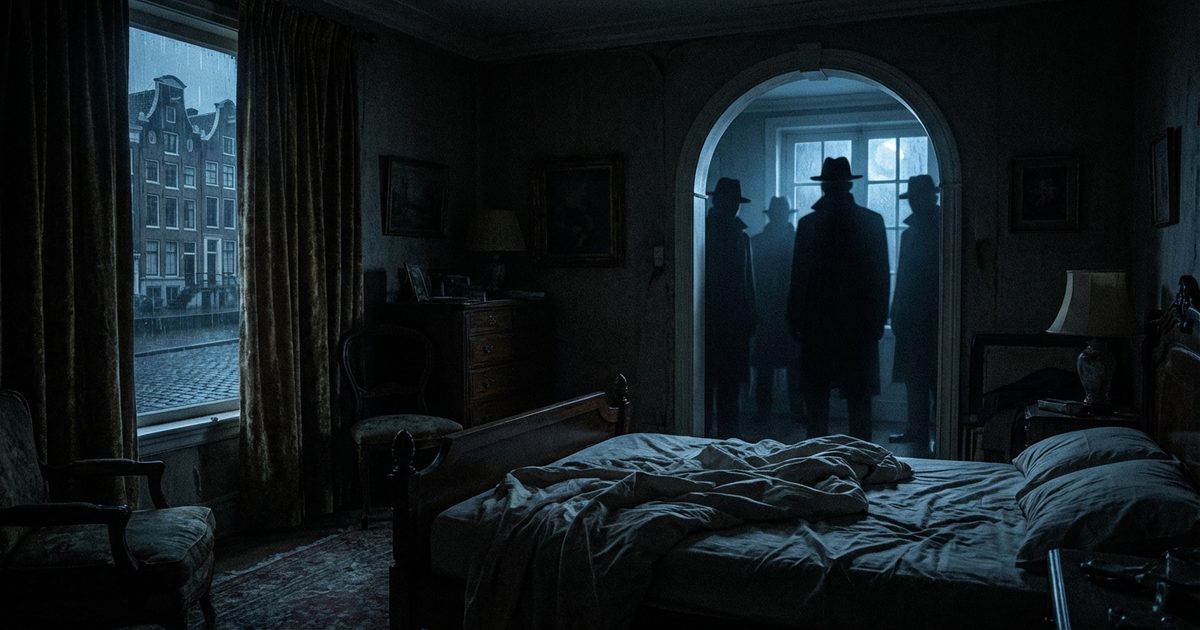
Late 1990s. The internet explodes. Paranormal forums fill with identical accounts: tall, featureless, dark figures. Standing by the bed. Framed in the doorway. Always during paralysis.
They are called shadow people now. No name. No gender. No readable intent. Pure presence, pure observation. Some accounts describe a wide-brimmed hat — the so-called Hat Man — reported by thousands of strangers across different countries and decades.
The disturbing part is not the experience itself. It is the uniformity. If the brain reliably produces the same hallucination in that state, we are looking at something hardwired into the species. A terror not learned but built in.
This connects directly with nightmares in horror fiction. From dreams as portals to the entities that inhabit them, the line between neurology and myth has always been thin.
When paralysis enters literature
Henry Fuseli understood in 1781. His The Nightmare shows a woman splayed on a bed, a demon crouched on her chest, a white-eyed horse lurking behind the curtain. The painting became famous because viewers recognized it. Not imagination. Memory.
Poe filled his stories with half-waking states where dream and consciousness blur. Lovecraft — who suffered recurring nightmares — built his poetics on the idea that sleep opens doors to alien dimensions, territory we explore in the piece on cosmic horror from Lovecraft onward.
But it is in weird horror that paralysis found its sharpest language. Being watched by something that refuses to be seen. Held by a nameless force. Trapped in the liminal space between waking and something else entirely.
In Jan Willem Koster’s The Brothel of Shadows, the dream-call that drags Alex past the threshold carries this exact flavor. Xyl’khorrath does not arrive with thunder. It approaches through shadow, settles on the chest of reality, and waits for resistance to crumble.
When folklore becomes clinical data
The numbers are clear. Between 7.6% and 40% of people experience at least one episode. The rate climbs with anxiety, PTSD, narcolepsy. Sleeping on your back, chronic sleep loss, high stress: all documented risk factors.
But numbers do not explain the hallucinations. Why always a presence. Why always the weight. Why that cold certainty of being watched — an intent you cannot decode but feel in your gut, rising through your stomach.
Evolutionary theories suggest the shadow figure triggers predator-detection circuits. The immobilized brain projects the threat outward. Maybe. But the projection always takes the same shape — humanoid, dark, standing, watching.
Not an animal. Not a recognizable danger. A presence. As if humanity's oldest fear is not darkness itself, but what watches from inside it. The best psychological horror novels transform exactly this terror into narrative.
Amsterdam, the night, and doors that should not open
Black canals hold double reflections. Facades lean inward. Alleys narrow without warning. Amsterdam feels built on a threshold — a place where the boundary between ordinary and other runs structurally thin.
Dutch folklore teems with canal spirits and nocturnal creatures. Alex, the protagonist of The Brothel of Shadows, is called at night by something at the edge of his dreams. His experience carries the hallmarks of paralysis: the absolute certainty that something stands in the dark, patient the way only ancient things can be.
The brothel between dimensions appears on no map. But anyone who has lain frozen while a figure watched from the corner of the room already knows where the entrance is.
Every night, the dream returns. Every night, the brothel calls.
Enter the dream →