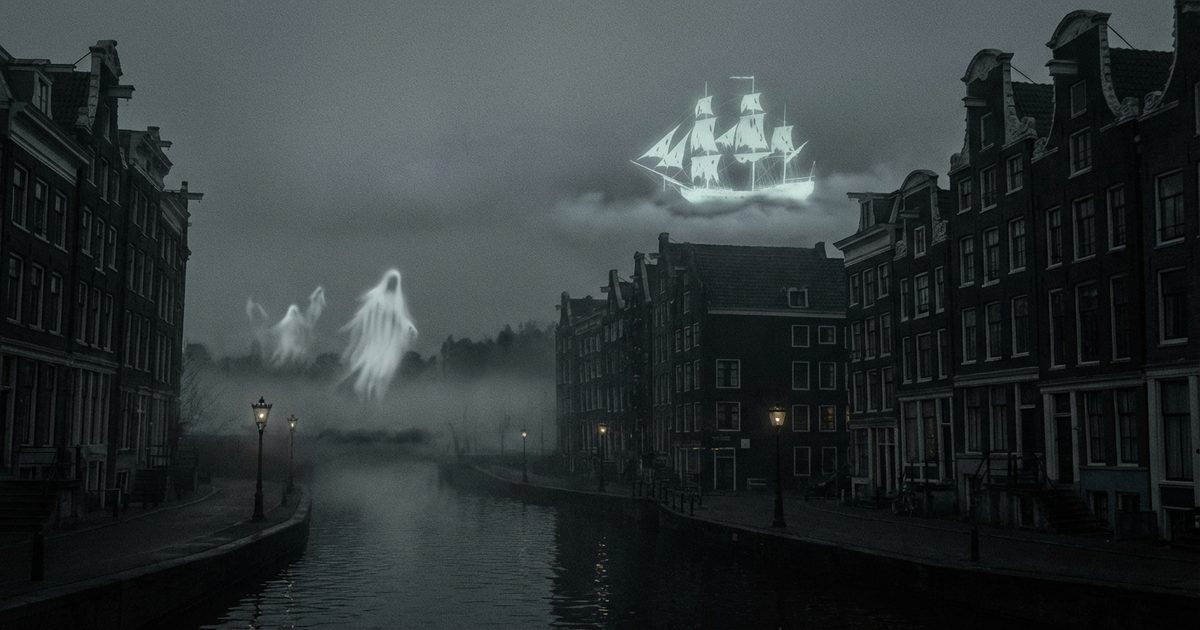
The Netherlands is flat, famously so. The horizon is always visible, the sky enormous, the land reclaimed from water that would gladly take it back. It is a landscape built on negotiation with forces larger than human will — and landscapes like that breed folklore with weight in it. The creatures of Dutch mythology are not decorative. They belong to a place where the ground is soft, where the mist comes quickly, where the canals at night are the colour of old iron.
This is the country whose dark traditions quietly shaped the world of The Brothel of Shadows. To read the novel is to move through a city that carries its folklore in its foundations.
The Flying Dutchman: the curse that sails forever
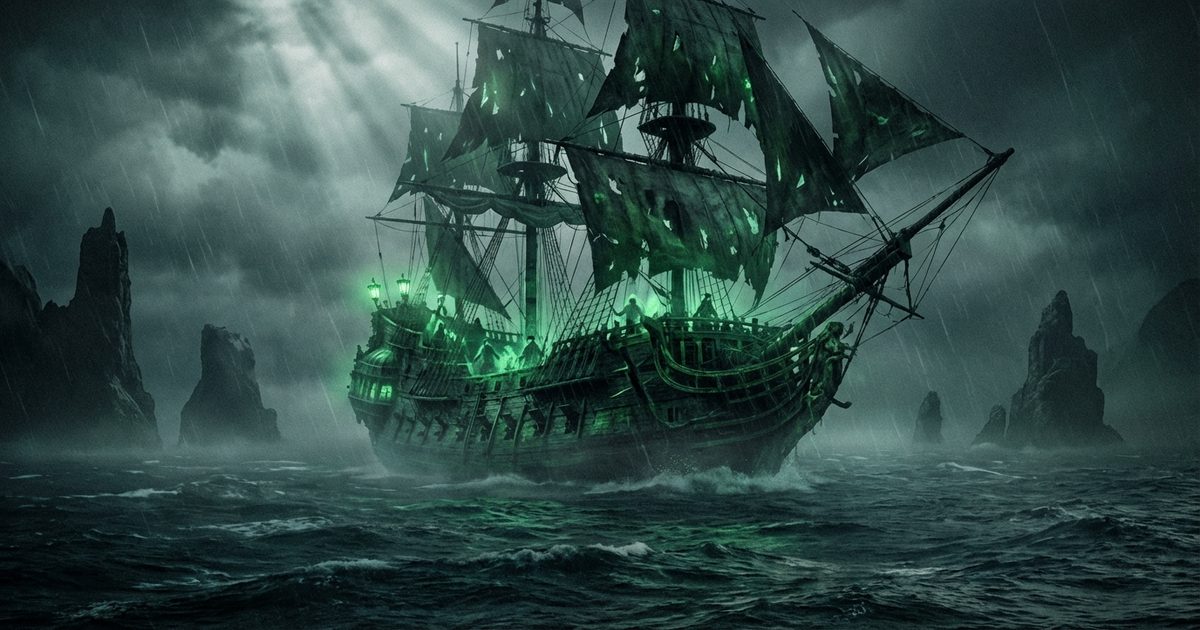
The most internationally famous Dutch legend is a ship. The Vliegende Hollander — the Flying Dutchman — is a ghost vessel doomed to sail the seas for eternity, never reaching port, crewed by men who cannot die and cannot rest. The legend has several origin stories, most involving a captain who blasphemed God during a storm and was cursed for his defiance. The ship appears to sailors as an omen of disaster: spotting it means death is close.
Wagner made it an opera. Coleridge's Ancient Mariner carries the same curse in English form. But the Dutch original is bleaker than either. The captain in the oldest versions does not suffer dramatically — he simply continues, grey and purposeless, across water that has no destination. That particular texture of damnation — not punishment but perpetual motion without meaning — is very Dutch in its horror.
“The water gives nothing back. It holds what sinks into it, silent, below the dark surface, until the right night.”
The Witte Wieven: white women in the marsh
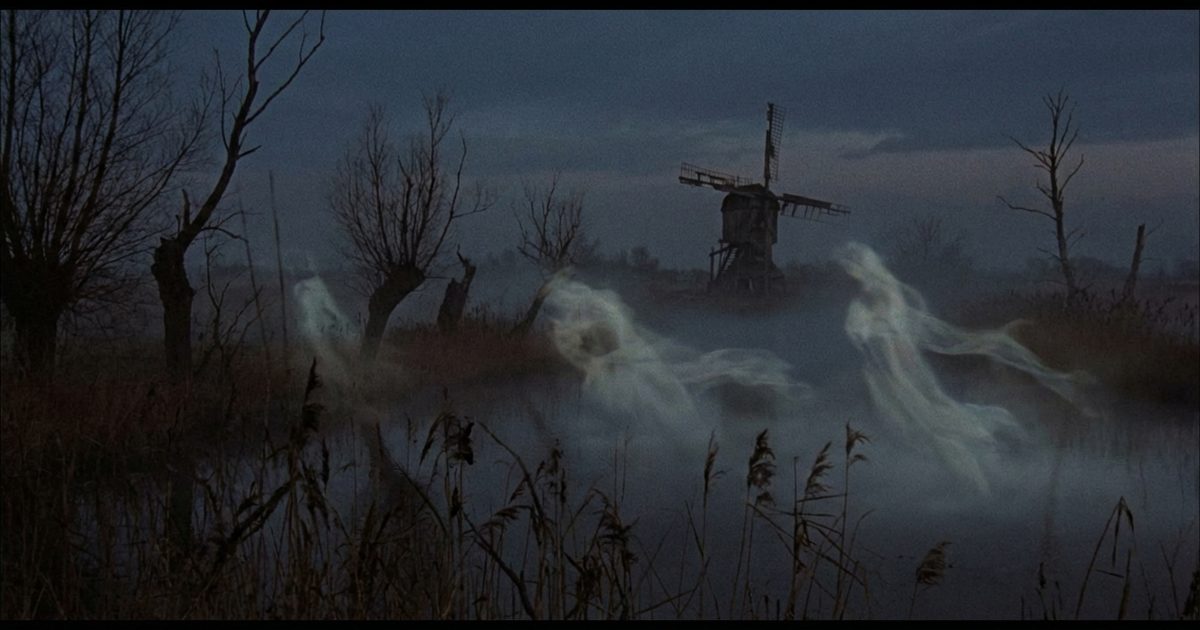
Walk into a Dutch polder on a foggy night and you understand the Witte Wieven immediately. The name means "white women," and they are the spirits of wise women — healers, herbalists, the village women who knew too much — who died and refused to fully depart. They gather in the mist, particularly over marshland and old burial grounds. Their appearance is that of white shapes moving with unnatural fluidity through fog that smells of wet earth and standing water.
Unlike many European female supernatural figures, the Witte Wieven are ambivalent rather than simply malevolent. They can heal, or they can harm. They can answer questions, or they can lead travelers deeper into the marsh until morning finds them cold and drowned in a foot of black water. The deciding factor is respect. They are treated as what they were in life — wise women whose knowledge the community needed and feared in equal measure.
This ambivalence runs through the gothic imagination of Amsterdam: the city itself is built on piles driven into swamp, and its relationship with water has always carried that same combination of dependency and dread.
Kabouters: the dark side of the little people
Dutch schoolchildren learn about Kabouters as helpful woodland spirits — small, bearded, good-natured helpers who fix things and tend gardens. This is the sanitized version. The older folklore is considerably less comfortable. Kabouters live underground, in the roots of trees or beneath the foundations of old houses, and their relationship with humans is transactional at best and predatory at worst. They steal children. They replace healthy infants with sickly changelings. They lead adults underground and keep them for a year and a day, returning them to a world that has moved on without them.
The domestic Kabouter — the friendly helper — is a relatively recent construction. Beneath it, in the older layers of folk belief, is something that lives in the dark earth and regards human beings with the cold assessment of a species that has been here much longer.
The canals of Amsterdam: water with memory
Amsterdam's canal system is the city's most distinctive feature, and it is saturated with folklore. The history of the city has deposited centuries of objects, stories, and bodies into the canal water. Medieval execution grounds stood at the edges of what is now the tourist center. Suicides, accidents, and murders have fed the canals for eight hundred years. The water, traditionally, remembers.
Local folk belief held that the canals at night were not safe, not because of criminals — though those were real — but because of the things that moved below the surface. Water spirits in Dutch folklore are rarely benign. The watergeest — water ghost — was an explanation for drownings that happened too suddenly, in too little water, with no rational account.
This is the canal city that Jan Willem Koster chose as the setting for The Brothel of Shadows. Alex walks streets above water that has absorbed centuries of human darkness. The bordello he finds is not supernatural in the way of imported mythology — it belongs to this specific geography, this particular quality of darkness that Amsterdam's water generates on a November night.
Peat bogs and the bodies that surface
The Netherlands has its bog bodies, ancient and extraordinarily preserved. The Yde Girl, the Weerdinge Couple, the various unnamed figures pulled from Dutch peat over centuries — they emerge from the earth looking almost alive, their skin tanned dark by the acid, their faces set in expressions that suggest not peace but something interrupted. They were placed in the bog deliberately, ritually, in a period when the boundary between the human world and whatever existed beneath it required regular negotiation through sacrifice.
The Dutch landscape is full of this kind of presence. The land that was reclaimed from the sea still carries the memory of being underwater, of being the domain of forces that human engineering holds at bay but has not defeated. Dutch folklore about the night, about sleep, about what happens when human vigilance lapses, has the texture of a people who have always known they are outnumbered by their landscape.
Dutch folklore and the contemporary dark imagination
This tradition does not end with the pre-modern period. Dutch horror fiction — a small but serious body of work — draws directly on these figures and on the particular atmosphere of landscape that produces them. The flat horizon. The enormous sky. The water that is everywhere and that has a quality of patience, of waiting.
The Brothel of Shadows sits within this tradition while expanding it. The entities that inhabit the bordello between dimensions are not Kabouters or Witte Wieven — they are stranger than that, older, less interested in human negotiation. But they breathe the same air as the Dutch supernatural, and they share its fundamental premise: that the human world is a surface, and beneath every surface is something that has been there longer, that moves differently, and that surfaces on its own terms.
The mist over the canals carries more than atmosphere. Enter the Brothel and discover what moves beneath the surface of Amsterdam.
Read the Novel →