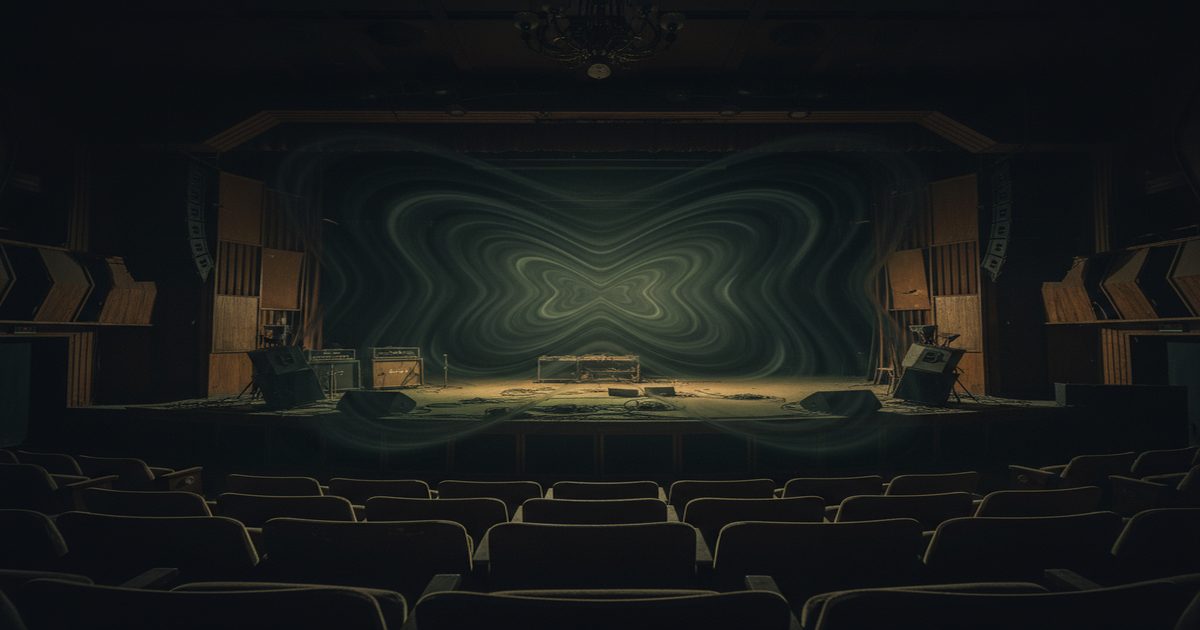
At 19 Hz, the human eyeball resonates. That's not metaphor — it's physics. That frequency, right at the edge of the audible range, triggers peripheral visions, sudden anxiety, and a sense of invisible presence. The brain interprets imperceptible vibrations as supernatural threat.
At 19 Hz, the Eye Sees Ghosts
In 1998, researcher Vic Tandy was working in a laboratory in Coventry when he began seeing figures at the edges of his visual field. Colleagues reported diffuse anxiety, physical discomfort, a persistent sensation of being watched. The culprit: an industrial fan producing infrasound at 18.98 Hz.
Tandy documented the phenomenon and published his findings in the Journal of the Society for Psychical Research. He'd found the scientific explanation for "haunted places" — not ghosts, but frequencies. Horror doesn't come from the beyond. It comes from the physics of the environment.
Infrasound is sound below 20 Hz, beneath the threshold of conscious hearing. You don't hear it with your ears. You feel it in your chest, your stomach, the subtle pressure that tells you something is wrong with this room.
That doesn't make it less terrifying. It makes it more terrifying than anything you can see.
How Horror Cinema Discovered Infrasound
Goblin, recording the score for Argento's Deep Red in 1975, noticed something odd: certain low chords created physical discomfort in studio colleagues. They didn't know the scientific reason. They used it by artistic instinct.
Years later, Ennio Morricone admitted he deliberately calibrated the low registers of his horror scores to pass through cinema walls. The sound reached the stomach before it reached the ears. Audiences felt something wrong before they saw anything wrong.
The soundtracks of Italian horror cinema weren't decoration — they were psychological architecture. Every low note was a tactical decision about how to alter the physiological state of listeners.
"Sound doesn't accompany fear. Sound is fear, before the film even begins."
In contemporary horror, this knowledge has become codified technique. Horror trailers systematically deploy the bass drop — a sudden plunge into low frequencies — as a signal that the threat has arrived. The brain responds before the rational mind has processed the visual.

Why Can't the Brain Distinguish Sound from Terror?
The amygdala processes sounds before the conscious brain does. An acoustic stimulus reaches the limbic system in 12 milliseconds — five times faster than the prefrontal cortex that would analyze it rationally. Fear arrives before understanding.
This shortcut evolved for predators: the rustle in the grass must trigger flight before thought. Horror cinema knows this well. Jump scares work roughly 70% through the sound that precedes them, not the image that constitutes them.
Freud's uncanny operates through familiarity becoming strange. Horror sound does the same with frequencies: takes natural sounds — breath, heartbeat, wind — and distorts them by a few Hz. The brain recognizes and doesn't recognize. That fracture produces terror.
There's the opposite case too: absolute silence. Anechoic chambers, engineered to eliminate all sound reflection, become unbearable within minutes. Without external sounds, the body starts hearing itself — blood in the veins, joints clicking, one's own heartbeat too close. Perfect silence is the most disturbing sound that exists.
The Tesla Case and the Frequency of Horror
Nikola Tesla experimented with mechanical vibrations at very low frequencies in the late nineteenth century. Legend holds that a device built in his Manhattan laboratory, activated during a demonstration, caused panic throughout the surrounding neighborhood. Authorities intervened. Tesla stopped. Or so he claimed.
Whether the story is historically accurate or amplified by time, it captures something real: the possibility that certain frequencies act on the human nervous system in ways we don't consciously control. Nikola Tesla's 19Hz, the film streaming in April 2026, explores this boundary — between invention and madness, between physics and institutionalized terror.
The title itself is a manifesto: 19 Hz as the encoded frequency of horror. Not the monster, not the ghost. The vibration the body interprets as presence before the mind has formulated the question.
The horror cinema of the 1980s grasped this intuitively. Large theaters with powerful audio systems weren't just audience comfort — they were instruments of psychological manipulation. The director controlled not just what you saw. They controlled your autonomic nervous system.

The Horror You Can't Hear or Ignore
Akira Yamaoka's work on Silent Hill is the perfect case study in acoustic horror for games. The score alternates distorted industrial noise, near-total silence, and familiar melodies slowed to the point of deformation. There is no moment when the player's nervous system can truly relax.
Yamaoka had studied industrial music and ambient horror. He understood that a nervous system in constant alertness fatigues differently from a brain frightened by a single event. Chronic dread — produced by frequencies and noises you can't classify — is more wearing and more memorable than a single shock.
Horror ASMR — a subgenre that emerged in recent years — works exactly at the opposite edge: takes normally relaxing sounds (whispers, gentle friction, ticking) and distorts them just enough to make them unsettling. The line between comfort and dread proves razor thin. A matter of a few hertz.
Xyl'khorrath and the Frequency of Cosmic Presence
In The Brothel of Shadows, Xyl'khorrath announces itself not through visions or apparitions. It makes itself felt first. A low continuous drone in Alex's gut, a pressure that occupies physical space before revealing itself visually. Like Tandy's infrasound: present, real, impossible to attribute to any identifiable cause.
This is the phenomenology of cosmic terror in its most accurate form — not the incomprehensible appearing before you. The frequency you feel in your chest without knowing where it comes from. The sound that occupies the space before you recognize that something is there to produce it.
As with the dreams and nightmares of horror literature, presence announces itself through channels that bypass consciousness. The amygdala has already responded. The rest of the brain is still stuck on the question: what am I feeling?
About the author: Jan Willem Koster is the author of The Brothel of Shadows: Cosmic Interception, a gothic horror novel set in 1980s Amsterdam. Available on Amazon.
Next time you feel uneasy in an apparently silent space, don't look for the ghost. Look for the frequency.
You probably won't find it. That's the point.
Gothic horror, cosmic eroticism, 1980s Amsterdam. Not your usual horror novel.
Discover the Brothel →