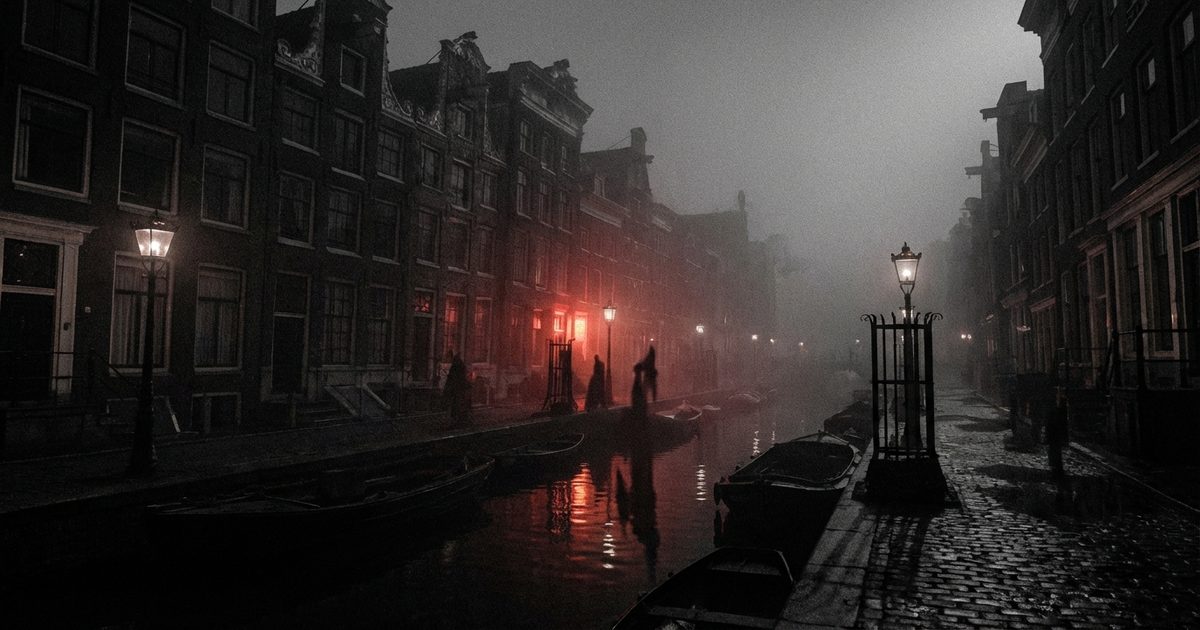
There is a precise moment when Amsterdam changes its face. It happens when the last tourist boat returns to its mooring and the fog rises from the canals like a breath held too long. The facades of the patrician houses — leaning toward one another like conspirators — become ambiguous silhouettes, and the lit windows take on the look of half-shut eyes watching anyone who walks alone along the deserted bridges. It is in that suspended hour that the city reveals its true nature: that of a natural stage for gothic horror.
A city built on ambiguity
Amsterdam is a city that thrives on contradictions. Its reputation as an open and liberal place coexists with a medieval urban fabric of narrow alleyways, hidden courtyards, and passages that lead where you least expect. The historic center, with its more than four hundred years of layered history, holds corners where time seems to have stopped — or worse, where it seems to flow in a direction entirely different from the usual one.
The houses tilting along the main canals, intentionally built with a slight lean toward the street to make it easier to hoist goods via the pulleys on the gables, create an unsettling visual effect: the constant impression that the buildings are about to collapse on top of you, that the entire city is slowly sliding into the black water of its canals. For a gothic horror writer, this oblique architecture is a perfect metaphor for a world that bends, that loses its equilibrium.
The Red Light District: sacred and profane
Few places on earth embody the gothic duality quite like Amsterdam's red-light district. On one side, transgression laid bare, commercialized, lit in neon. On the other, just steps away, the Oude Kerk — the oldest church in the city, founded in 1213 — standing at the exact center of the district like a silent warning, or perhaps a knowing accomplice.
This juxtaposition of the sacred and the profane, of prayer and desire, of gothic spires and crimson light, generates a field of narrative tension that few novelists know how to harness. The district is not simply a place of sin: it is a space where moral categories that remain separate elsewhere merge, blur, and lose their meaning. And it is precisely in these uncertain territories that the gothic thrives.
Black water and the distorted reflection
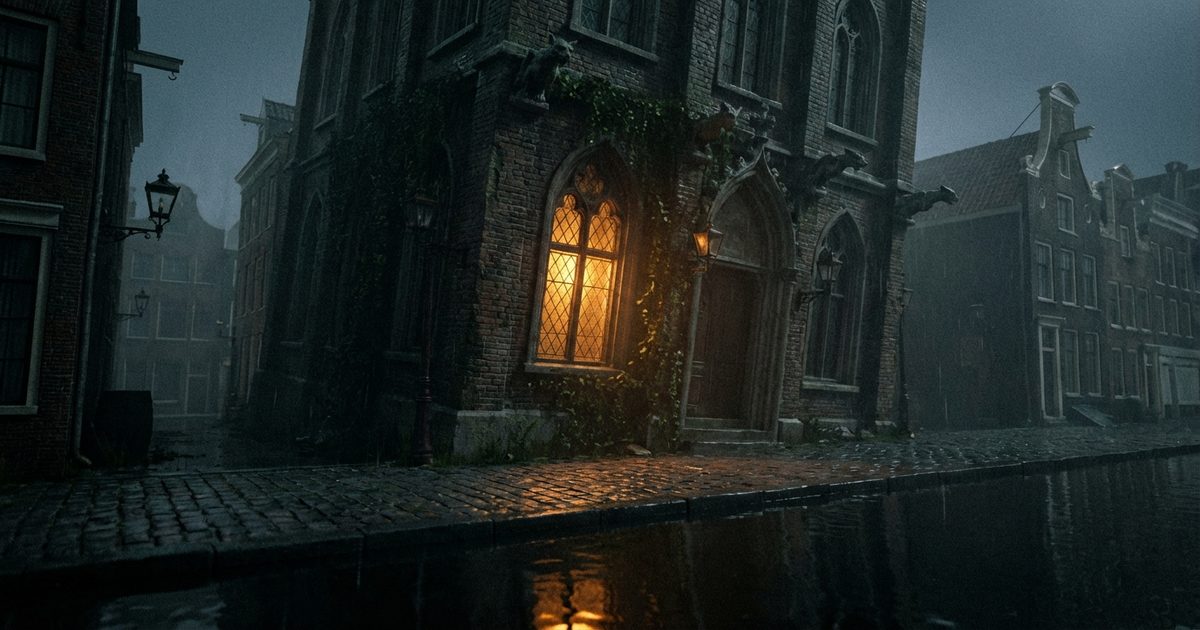
Amsterdam's canals are not mere waterways. At night, their surface becomes a dark mirror that duplicates the city, creating an inverted, subterranean Amsterdam where lights tremble like will-o'-the-wisps and tree silhouettes become hands reaching downward. In the gothic tradition, the mirror has always been a potent symbol: the double, the reverse, the world on the other side. Amsterdam, with its one hundred and sixty canals, is a city that contains its own dark reflection at every moment.
Walking along the Herengracht or the Prinsengracht after midnight means walking simultaneously in two cities: the one above, made of bricks and certainties, and the one below, made of water and possibilities. The boundary between the two is as thin as the black film of canal water. One misstep is all it takes to pass from one to the other.
Underground Amsterdam: cellars, shelters, and secrets
Below canal level stretches another Amsterdam, less known but just as real. The cellars of the patrician houses, often submerged or damp, hold traces of centuries of trade, of lawful and illicit dealings, of hidden lives. During the Occupation, many of these cellars served as clandestine shelters. Before that, during the Golden Age, they stored spices, silk, and other treasures of the Dutch East India Company.
These underground spaces — with their low ceilings, moisture-seeping walls, and steep stairs descending into darkness — are the natural territory of the gothic tale. They represent the repressed of the city, what has been buried but never extinguished, what waits beneath the orderly surface of facades and tulips.
Fog as a character
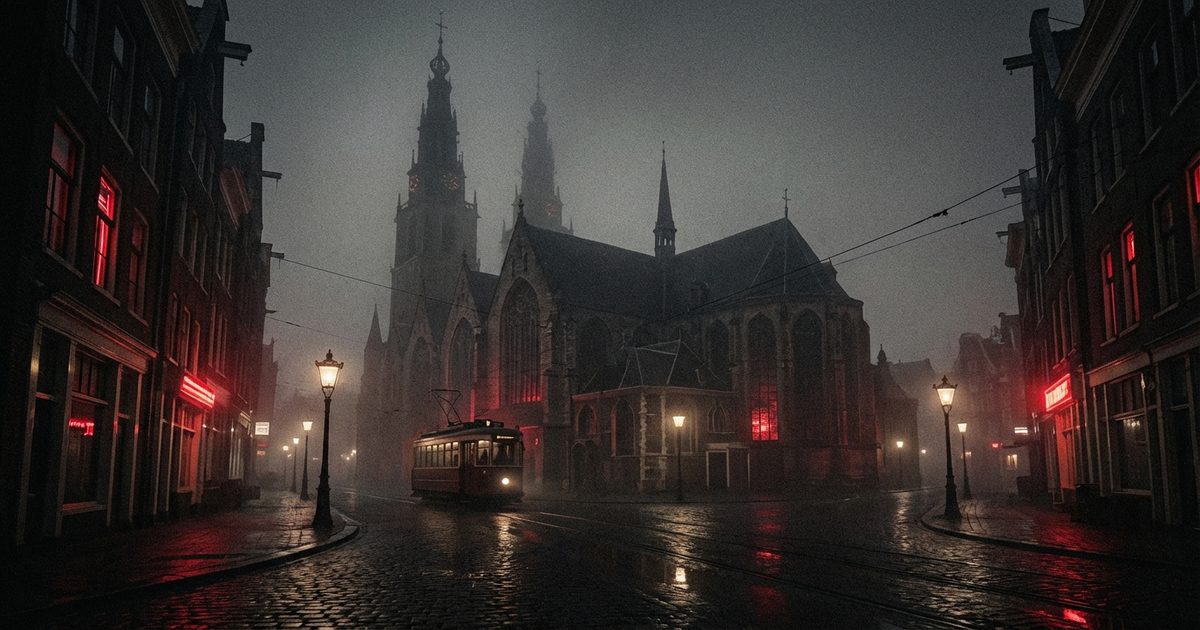
Anyone who has lived in Amsterdam knows the peculiar fog that rises from the canals on autumn and winter evenings. It is not the thick, solid fog of the Po Valley, nor the light mist of the Tuscan hills. It is a selective, capricious fog that wraps one bridge and spares the next, that erases the upper half of a building while leaving the ground floor visible, that transforms streetlights into floating halos without an apparent source.
This fog is not a mere atmospheric phenomenon: it is a dramaturgical element. It redraws the city each evening in a different way, creating ephemeral stage sets that no set designer could replicate. For horror fiction, it is the perfect tool to dissolve the boundaries between the visible and the invisible, between what is real and what might not be.
The Brothel of Shadows: when Amsterdam becomes nightmare
All of these elements — the nocturnal canals, the tilting facades, the duality of the red-light district, the fog that redesigns the world, the underground spaces holding unspeakable memories — converge in The Brothel of Shadows, the novel by Jan Willem Koster set in 1980s Amsterdam.
The novel uses the city's real topography as the foundation for a narrative that pushes beyond the boundaries of the visible. The streets the protagonist Alex walks are real; the canals he traverses at night are the same ones anyone can visit. But the brothel that gives the book its title belongs to a different Amsterdam — the one glimpsed only from the corner of your eye, the one that exists in the distorted reflection of the black canal water.
This is a novel that does not merely use Amsterdam as a decorative backdrop. The city is a living organism in the narrative, a presence that breathes, that attracts, that entraps. Koster's gothic horror sinks its roots into the physical and historical reality of the places, then transcends it into a dimension where architecture itself seems to obey laws different from those of Euclidean geometry.
Why the gothic needs Amsterdam
The tradition of the gothic novel has always been tied to specific places: Scottish castles, Venetian palaces, ruined English abbeys. Amsterdam represents a unique variation in this landscape: it is not an abandoned or decadent place, but a living, functioning, everyday city that nonetheless harbors within its urban fabric all the ingredients of the dark narrative. Its apparent normality is what makes it more unsettling than any crumbling castle.
Because true gothic horror does not dwell in obviously sinister places. It dwells in spaces that seem safe, familiar, ordinary — until the moment they cease to be. And Amsterdam, with its open smile and its dark waters, is a master of this kind of deception.
Discover the Amsterdam you will not find in any travel guide.
Read The Brothel of Shadows