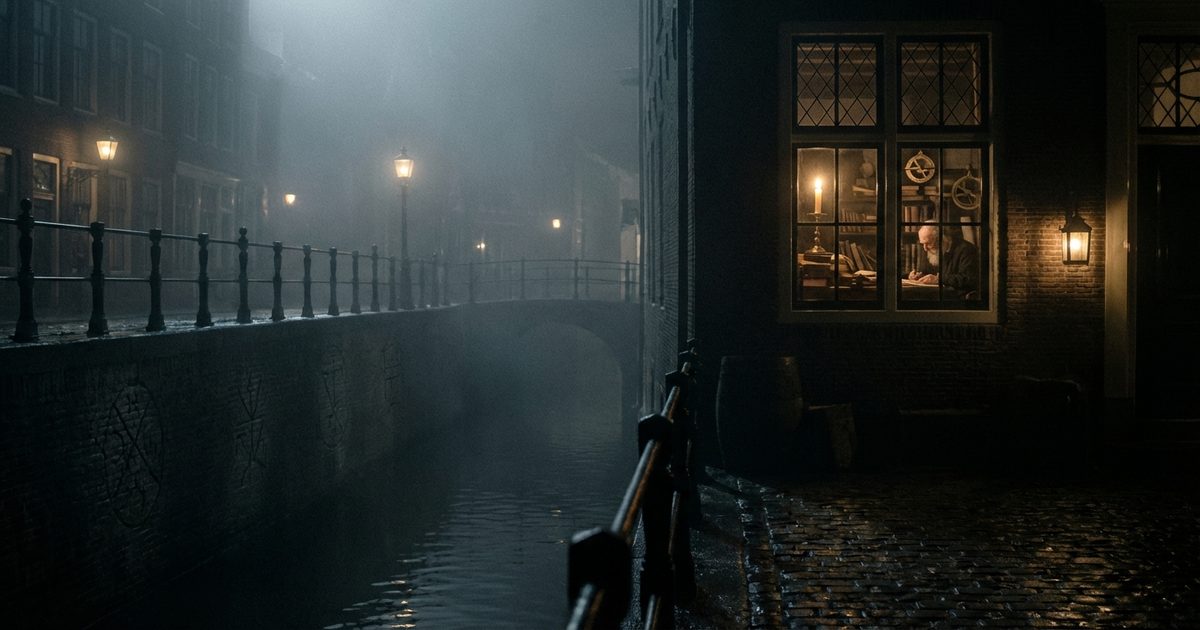
1683 has a particular smell. Burnt wax, fermenting ink, and that sharp acid smell that rises when a mind begins to break.
Coenraad van Beuningen had been mayor of Amsterdam, ambassador to the greatest courts of Europe, one of the sharpest intellects in the Dutch Republic. Then he began covering the walls of his home with Kabbalistic symbols. With blood, according to witnesses.
The Diplomat of a Thousand Secrets
Born in 1622 into a patrician Amsterdam family, van Beuningen walked every corridor of continental power. He negotiated trade agreements with Louis XIV, represented the Republic at the courts of London and Paris, managed diplomatic crises with the cold precision of someone who knows the exact cost of every word. He was the kind of man that courts both respected and feared.
But alongside his public career he cultivated something else. His library overflowed with alchemical manuscripts, hermetic texts, Kabbalistic treatises purchased from booksellers on the Nieuwmarkt. He corresponded with theologians, mathematicians, philosophers at the edges of orthodoxy. There was in him that hunger that power never quite satisfies — a thirst for a deeper order hidden beneath the surface of the visible world.
Amsterdam in the 1680s was the right place for that hunger. Spinoza had lived and written there. The markets carried forbidden books alongside oriental spices. The Dutch East India Company didn’t just trade in cloth: it imported ideas, cults, and knowledge that the rest of Europe was still burning at the stake. Dutch tolerance was also, inevitably, a tolerance for one’s own abysses.
Van Beuningen absorbed it all. For some time he maintained his balance — that precarious equilibrium between public life and secret life that many seventeenth-century intellectuals knew well. Then the balance broke. The documents of the period point to no precise moment, no triggering event. They show only the final result.
His correspondence from the 1670s and 1680s traces the evolution. Early letters are lucid, political, brilliant. Later ones veer toward increasingly cryptic territory — obscure references to “imminent revelations”, astronomical calculations tied to end times, visions received in the night. His colleagues ignore them. They have known the man too long to take them seriously.
When Amsterdam Stopped Making Sense
The first signs came as unusual behavior during municipal sessions. Van Beuningen appeared distracted, interrupted colleagues with lateral observations, stared at ceilings in the middle of urgent votes. His contemporaries attributed this to the weight of years, family bereavements, the toll of diplomatic work. All reasonable explanations. All ways of not looking harder.
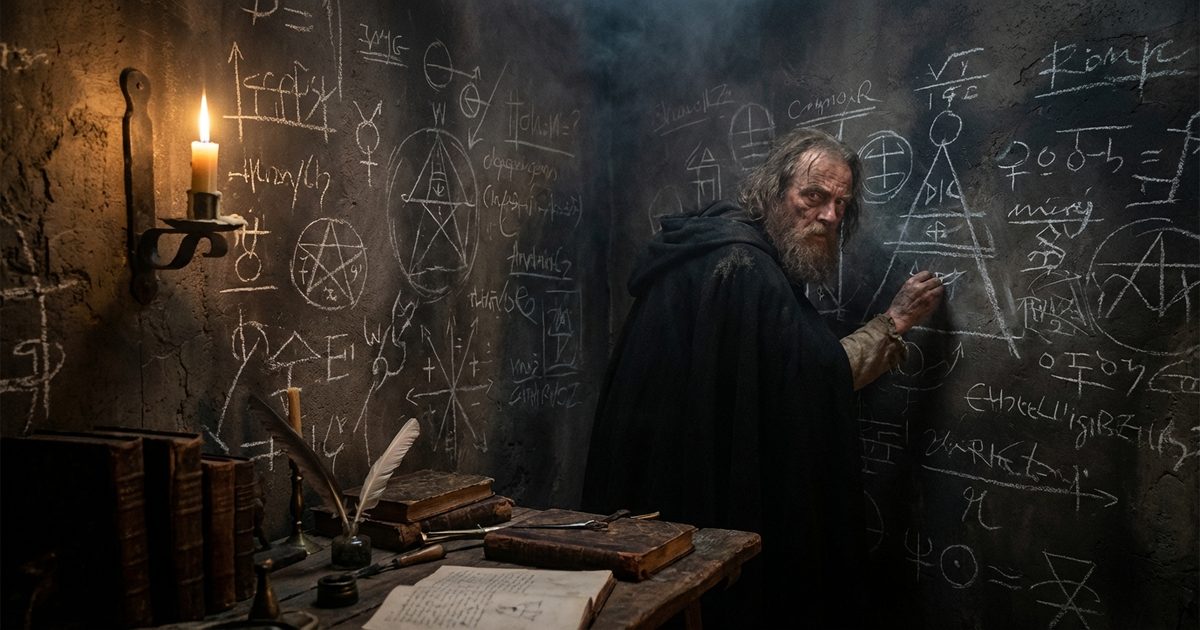
The writings appeared in the summer of 1683. On the walls of his home, in every room, van Beuningen traced signs that no one could interpret. Symbols from Lurianic Kabbalah mixed with hermetic formulas, geometric figures, sequences of letters in alphabets no one could name. As if he were taking dictation from an invisible, urgent source — transcribing, not inventing.
Neighbors reported the detail about blood. Whether historically accurate or not, the image stuck in the accounts: Amsterdam’s mayor kneeling on marble floors, writing furiously, his hands leaving dark traces on white walls. He wasn’t screaming. He wasn’t destroying anything. He was writing.
With the methodical calm of someone completing an essential task who cannot afford mistakes.
Kabbalah, Alchemy, and the Madman’s Code
What exactly was he looking for? The surviving fragments of his correspondence suggest a precise obsession: the true name of God. Kabbalistic tradition called this the Tetragrammaton — the four letters from which creation springs. Van Beuningen believed he was close. The walls were his map. Each line was a step toward the source.
Lurianic Kabbalah — developed by Isaac Luria in sixteenth-century Safed — taught that the cosmos had shattered at the moment of creation. Divine sparks had become trapped in matter, and humanity’s task was to gather them through prayer, study, and ritual action. Van Beuningen had read everything. Perhaps he had understood too much. Or believed he had.
Alchemy added another layer. Not the metaphorical kind about spiritual transformation, but the practical kind of seventeenth-century Dutch laboratories: distillations, astronomical calculations, the search for the philosopher’s stone. For van Beuningen, the two traditions — Kabbalistic mysticism and hermetic science — were describing the same object in different languages. He just needed to find the common tongue.
Amsterdam was, for this, a unique laboratory. The Sephardic Jewish community brought living Kabbalistic tradition with them. Spice merchants brought Egyptian papyri and amulets of obscure provenance. Clandestine printing houses published Paracelsus and Agrippa alongside Bibles. Van Beuningen never needed to leave the city to find what he was looking for. The city came to him.
A contemporary who visited his home in 1684 left a brief note, later cited by nineteenth-century Dutch historians:
“I entered and saw the walls covered on every side with characters and figures. Mr. van Beuningen told me he was receiving messages from above. His eyes were clear and steady. He did not seem mad. He seemed like someone who knows something you do not.”
That clarity in the eyes is the detail that won’t let you sleep. Not agitated madness, not visible delirium. The calm of someone who has crossed a threshold and settled on the other side. It’s exactly the kind of madness that horror literature knows intimately.
A City That Consumes Its Visionaries
Amsterdam carries a paradox in its DNA. It is the most tolerant city in Europe, and at the same time the one that most ruthlessly culls those who cannot survive its embrace. It sheltered Rembrandt while letting him die insolvent. It published Spinoza while his synagogue excommunicated him. It built its global fortune while its canals accumulated a sediment of nameless dead.
The Dutch Golden Age — that celebration of light and tulips that still fills museums — had a shadow side that gets less exhibition space. Trade with the East brought not just spices but psychoactive substances, cults, ecstatic practices. Sailors returning from long VOC voyages came back changed in ways difficult to explain to their families.
Van Beuningen had never traveled far. But Amsterdam came to him. Manuscripts from Baghdad, Egyptian amulets, books printed clandestinely in Geneva: everything moved through those canals. The library of a great diplomat was also a map of what the human mind cannot metabolize without consequences.
He died in 1693, a decade after the collapse. The city recorded the date with the same commercial efficiency it used for everything else. No official note on the state of his walls. Someone had already repainted them white, presumably. The white that covers certain things holds for less time than expected.
Van Beuningen as Horror Archetype
Van Beuningen’s story is not an isolated case. It is the archetype of something that horror literature has explored systematically since Poe: the brilliant mind that touches knowledge too large to be contained. Not madness as illness. Madness as a rational response to something irrational. A wrong response, perhaps. But a comprehensible one.
Lovecraft called this cosmic horror — the terror that comes not from physical threat but from the awareness that the universe is vaster and more indifferent than the human mind can endure. Van Beuningen hadn’t read Lovecraft. But he was living that same experience three centuries earlier, in the canals of Amsterdam, with a brush in his hand instead of a pen.
The structure is always the same, in novels as in history: the intellectual who seeks. The crack in reality. The partial revelation that cannot be left incomplete. The writing on the walls as the only form of communication that remains. Forbidden knowledge doesn’t punish those who seek it — it transforms them into something the world can no longer read.
The great writers of psychological horror understand that the line between visionary and madman is thin as paper. Van Beuningen was first one, then the other, then perhaps both at once. We don’t know what he actually saw on those walls. We only know he never stopped writing.
The parallels run through all the horror fiction we love. Thomas Ligotti’s characters — navigators of a pessimistic cosmos — are often intellectuals who have looked too deep. Like van Beuningen, they never quite return. Like van Beuningen, their madness always has an internal logic the reader can follow — up to a point. Then the reader stops too.
The Brothel Knows Its Names
Alex, the protagonist of The Brothel of Shadows, arrives in dream at a structure between dimensions. He doesn’t paint walls. But he recognizes that same pull: something you shouldn’t understand calls you in your own language, offers answers in exchange for everything else. Jan Willem Koster found the modern name for what van Beuningen was searching for.
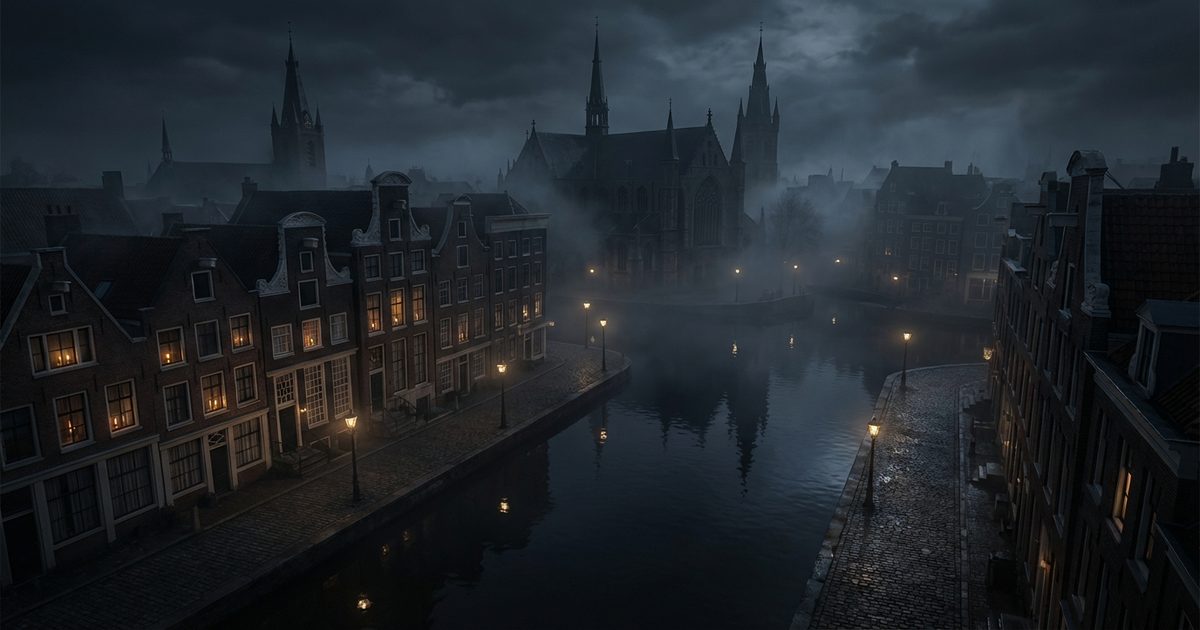
The novel unfolds in 1980s Amsterdam — the same city that three centuries earlier produced the van Beuningen case. This is not geographical coincidence. It’s coherence. Something in those canals, in that flat light on grey water, invites the mind toward the margins. Toward doors that should stay closed.
The difference between Alex and van Beuningen is slim. The mayor sought the name of God in manuscripts and walls. Alex finds it in the corridors of an impossible brothel, in the creatures of Xyl’khorrath, in desire that transforms into something else entirely. Both cross the same threshold. Both discover that return is only possible if you change what you are.
Van Beuningen never found the name of God. He found something vaster and emptier. The witnesses who entered his home left quickly, without explaining what they had seen. Some revelations don’t translate. Some Amsterdams never stop calling you — even after you have stopped hearing the difference between your own voice and the voice of the abyss.
Sixty-four chapters of pure cosmic terror. An Amsterdam you won’t forget.
Read the novel →