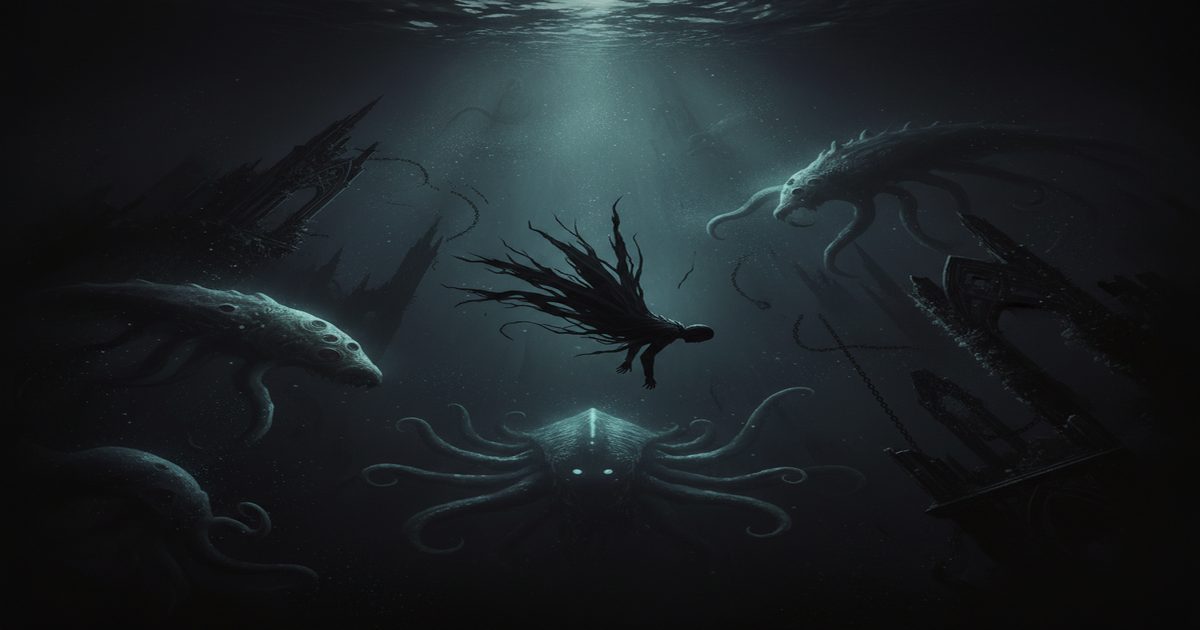
At 11,000 meters down, pressure crushes metal like paper. No sunlight reaches there. No familiar sound. Only darkness, cold, and creatures that evolved in the total absence of anything we would recognize as life.
Thalassophobia — the fear of deep water — is not irrational at all. It is a reasonable response to something objectively unknown. The ocean covers 71% of Earth’s surface. We have explored less than 20% of its floor. The abyss is literally more unexplored than nearby space.
Horror literature has known this for over a century.
What is thalassophobia in horror fiction?
Thalassophobia in narrative is not simply about the sea. It’s about what the sea represents: the absolute boundary of human knowledge. The abyss is the space where the rules change, where the body is no longer adequate, where perception warps under the pressure of the unknown.
This distinguishes it from the fear of drowning. The swimmer fears suffocation. The thalassophobic fears depth itself: the vertical extension of the unknown, the darkness that begins just meters below the surface. Maritime horror uses both fears, but the deeper one is always more powerful.
The most precise definition: literary thalassophobia is not the terror of drowning. It is the terror of discovering what lives down there.
Lovecraft and the roots of oceanic dread
H.P. Lovecraft understood before anyone else that the ocean is the perfect setting for cosmic horror. Not because it is inherently frightening, but because it is the place where human laws simply do not apply.
In “The Call of Cthulhu” (1928), the sunken city of R’lyeh has non-Euclidean geometry: the angles don’t add up, staircases seem to ascend and descend simultaneously, the smell of mold and brine soaks every page. The sea is not the danger — it is the veil concealing the danger.
“Ph’nglui mglw’nafh Cthulhu R’lyeh wgah’nagl fhtagn. In his house at R’lyeh, dead Cthulhu waits dreaming.”
The crucial word is waits. Not dead. Not absent. Waiting. The ocean floor is where terrible things sleep. The water above them is the only thing separating us from their waking.
With “The Shadow over Innsmouth” (1931), Lovecraft adds the dimension of body horror: the Deep Ones are not external creatures but internal transformations. The protagonist discovers he has Innsmouth blood in his veins. The sea is not only out there — it is inside him. The final metamorphosis is not defeat. It is a homecoming.
The body under pressure: body horror at 11,000 meters
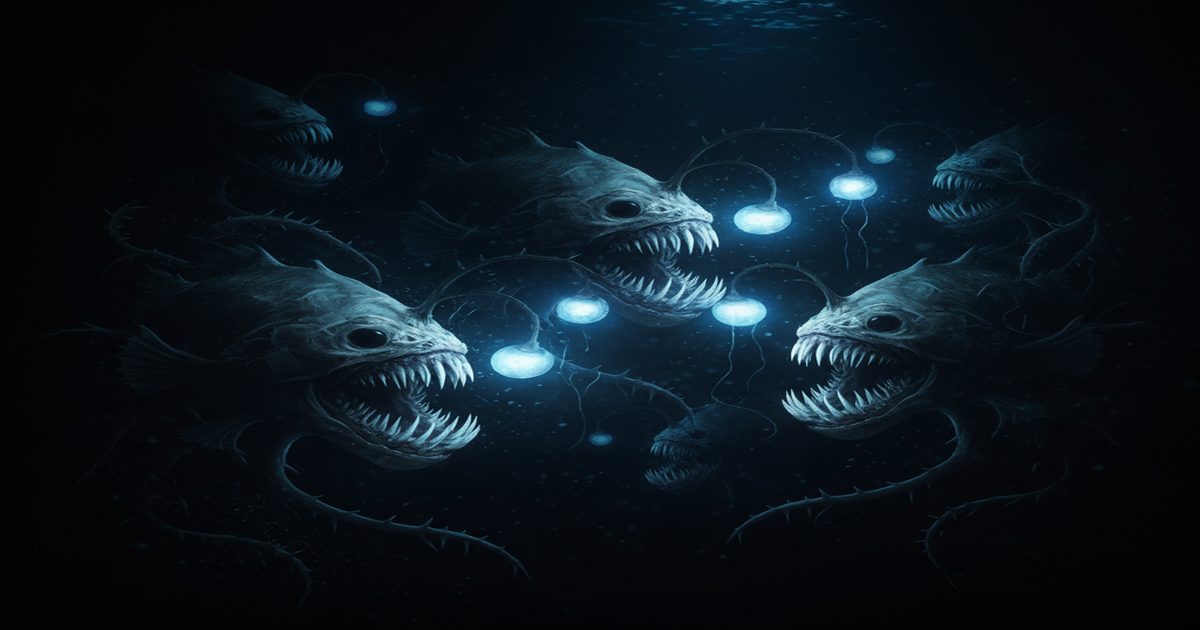
At depth, the human body does terrible things. Nitrogen narcosis produces euphoria followed by hallucinations. High-pressure oxygen causes seizures. Decompression sickness literally dissolves nitrogen into the blood, forming bubbles inside the vessels.
Nick Cutter’s The Deep (2015) uses this physiological reality as its narrative engine. The descent into the Mariana Trench is not merely geographical — it is the descent into the protagonist’s mind. The deeper he goes, the more his memories deform. Pressure doesn’t just crush metal: it warps memory, identity, the ability to distinguish the real from hallucination.
Water as dissolution of self: this is the core of maritime body horror. Not the tooth that tears, but the slow pressure that reshapes everything. The cold that numbs not just the fingers, but the border between self and abyss.
Our Wives Under the Sea: grief at the bottom of the world
Julia Armfield’s Our Wives Under the Sea (2022) redefined the genre for a new generation. Leah has returned from a deep-sea mission, but hasn’t truly returned. Something in the abyss kept part of her — an invisible, unrecoverable portion of who she was.
Armfield deploys grief horror as her primary register, but distorts it through marine biology. Leah drinks tap water and finds it salty. She wakes with wet hands. She never cries — she simply loses liquid from her eyes, without human tears.
The novel never explains what happened below. This is its most precise choice: what the abyss does to a person has no human-scale explanation. As weird fiction teaches us, full comprehension is itself already a form of horror.
Why is the ocean horror’s deepest metaphor in 2026?
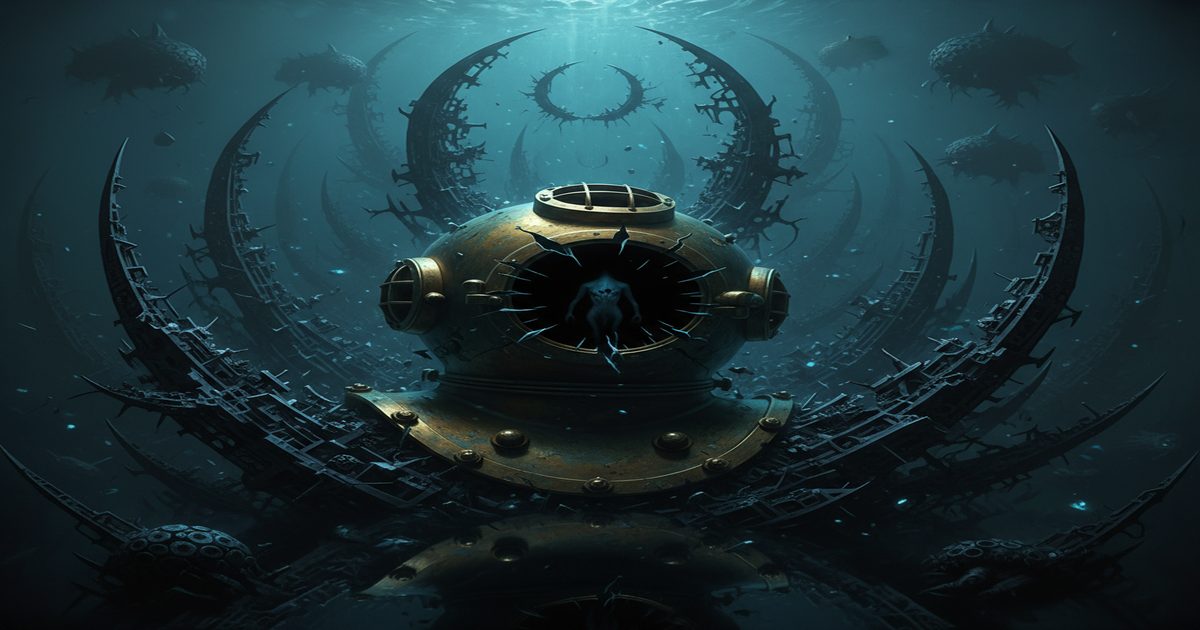
Space horror and maritime horror share the same emotional architecture: the human being outside their domain, surrounded by indifferent forces, in an environment not designed to tolerate our presence.
But in 2026, the ocean beats outer space as a metaphor. Because it’s here, beneath us, theoretically accessible — yet remains as mysterious as Mars. Warming oceans are bringing surface creatures that shouldn’t be at the surface. The abyss is rising.
Search trends confirm this pull: “deep sea horror” and “thalassophobia” are among the fastest-growing horror keywords on TikTok and Reddit in early 2026. This isn’t nostalgia for a genre. It’s a response to something people sense drawing closer.
Xyl’khorrath and the abyss without a name
In The Brothel of Shadows, Xyl’khorrath is never described visually. This is Jan Willem Koster’s most precise choice: like the deep ocean, the cosmic entity has no form the human mind can hold.
Alex approaches it the way a falling body approaches the ocean surface. He feels the pressure building. Feels the cold rising from his stomach to his throat. Feels something that existed before he was born — a memory that doesn’t belong to his species — awakening in the darkest places of his body.
The brothel is the Mariana Trench of desire. And like the deep sea, the creatures that inhabit that darkness evolved specifically to draw light downward.
Not toward the surface. Toward the bottom.
About the author: Jan Willem Koster is the author of The Brothel of Shadows: Cosmic Interception, a Gothic horror novel set in 1980s Amsterdam. Available on Amazon.
Italian horror literature has a new dark masterpiece. Have you read it yet?
Read the novel →