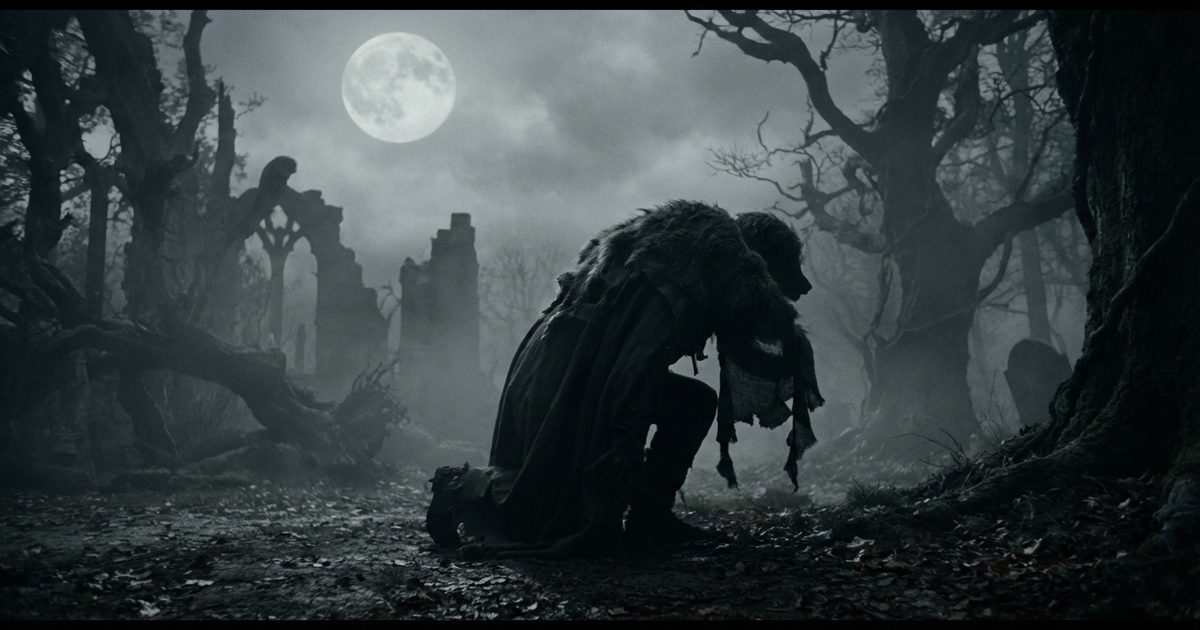
The werewolf isn’t a monster. It’s a mirror. Robert Eggers knows this — and Werwulf opens Christmas Day 2026 to prove it.
Seven centuries of literature reach the same conclusion. Lycanthropy isn’t about beasts — it’s about the thing inside us that yields to something older, buried under the skin. Seven works to understand why.
1. Werwulf (2026): Eggers’ medieval beast
Set in 13th-century England, Werwulf follows a creature — perhaps a man, perhaps something that once was — stalking villages and fog-bound forests. Aaron Taylor-Johnson leads the cast, with Willem Dafoe and Lily-Rose Depp joining him. Eggers co-wrote the screenplay with Sjón, his collaborator on The Northman.
Eggers has called this script “the darkest thing I’ve ever written.” He’s shooting on 35mm in a 1.37:1 aspect ratio — the same compressed frame as The Lighthouse (2019), where tight space becomes psychological pressure. The choice isn’t decorative. Eggers builds the cage before he puts the monster inside.
The December 25th release date isn’t accidental either. In the medieval liturgical calendar, the Twelve Nights after Christmas were considered dangerous — a liminal stretch when the beasts of folklore roamed. Germanic and Norse traditions held that the winter solstice belonged to wolves. Eggers knows the calendar. He knows what those nights meant.
After Nosferatu (2024) redefined the vampire for contemporary cinema, Werwulf aims to do the same for the werewolf: strip it from the slasher tradition of the 1980s, return it to the mud and cold from which it came.
2. Ovid, Metamorphoses: the tyrant who becomes wolf
In Book I of the Metamorphoses, Jupiter transforms King Lycaon into a wolf. Not for savagery — for arrogance. For serving human flesh at the table, thinking he could fool the gods. The first lycanthrope in Western literature is an exposed tyrant.
The name itself tells the story: Lycaon, king of Arcadia, becomes a wolf because he was already behaving like a predator. Ovid doesn’t describe the transformation as punishment. He describes it as revelation. The form you assume is the form you always were. The body tells the truth the palace concealed.
“He tries to speak, but voice fails him; his very throat/Foams with the lust of blood.” — Ovid, Metamorphoses, I
This logic runs through all subsequent lycanthropic fiction. The transformation doesn’t create the beast — it reveals it. Hidden under the toga, the coat, the uniform. Among the many forms forbidden knowledge takes in horror, lycanthropy is the most physical.
Ovid wrote when real tyrants were close and dangerous. The myth of Lycaon was legible to anyone who had lived under Augustus. The horror fable said what couldn’t be said openly: power corrupts the form.
3. The Werewolf of Paris by Guy Endore (1933)
Published in 1933, this is still the definitive novel of the genre. Garou is born on Christmas Day 1870, during the Prussian siege of Paris — the birth moment already announces everything. His lycanthropy grows against the backdrop of the 1871 Paris Commune: weeks of civil war, mass executions, concentrated urban hatred.
Endore uses the werewolf as a distorting lens on collective violence. The beast’s atrocities become indistinguishable from those of men. When thousands slaughter each other for ideology, who is really the monster? The novel offers no answer — but it keeps tightening the question. Every chapter draws the noose a little closer.
The structure mimics bureaucratic record-keeping: diaries, depositions, trial transcripts. Endore builds horror through paperwork, which is the most effective way to make it credible. The monster doesn’t roar — it gets filed, classified, forgotten. Stephen King cited it as a foundational influence in Danse Macabre.
Hard to find in English outside the used market — the original Farrar & Rinehart edition is the one to hunt. Worth every effort.
4. The Fly (1986): Cronenberg rewrites body horror
The Fly is not a film about insects. It’s a film about lycanthropy. Seth Brundle watches his own transformation with scientific curiosity and growing dread — the man witnessing the monster he’s becoming. No full moon. No curse. Just biology going catastrophically wrong.
The difference from classical werewolf narratives is that Cronenberg removes periodicity. The body betrays without warning, without rhythm. The metamorphosis is continuous, irreversible, intimate. Brundle keeps a journal of his own decomposition. That journal is the film’s most horrifying scene — not the fingernail falling off, but the voice recording it.
The body horror genre finds its modern archetype here. Every subsequent novel about corporeal transformation — from Jeff VanderMeer’s Annihilation to Clive Barker’s visceral fiction — carries this fingerprint. Cronenberg changed how literature thinks about the changing body.
The film also mirrors the AIDS crisis of 1986. A body transforming beyond control, provoking revulsion in those you love, carrying you toward something inhuman — audiences understood this viscerally. Lycanthropy is always contemporary. It always finds the right wound.
5. The Wolf’s Hour by Robert R. McCammon (1989)
McCammon inverts the formula. Michael Gallatin is an Allied agent in World War II — and a werewolf. The transformation isn’t a curse. It’s a weapon. A man who has learned to live with the monster inside him and use it when needed.
This inversion has a precise philosophical consequence. If you can choose when to become the beast, who are you really? McCammon’s answer: the wolf is more honest than the man at war. The predator doesn’t hide behind uniforms. Doesn’t sign execution orders in neat handwriting. At least not always.
The novel is adventure, spy thriller, horror — but never shallow. The third act enters a Nazi facility conducting experiments on the werewolf, taking the genre somewhere 1980s horror cinema had only grazed. McCammon is asking a serious question dressed in pulp clothing, which is the best kind of horror.
Difficult to find in print now. Worth hunting the used market. Among werewolf novels of the 1980s, this one ages best — because the question it asks still has no comfortable answer.
6. Mongrels by Stephen Graham Jones (2016)
Jones is the writer the genre was missing. Mongrels is a road novel about American poverty — narrated by a teenager growing up in a nomadic family of werewolves, always running, always on the edge. No castle. No enchanted forest. Just motels and federal highways.
Lycanthropy here is inherited, social, intimate. You don’t transform because of a curse — you transform because it’s what you are, what your mother was, what your uncle is. The body’s change isn’t a shock: it’s a puberty. Jones makes the werewolf a metaphor for Indigenous American marginality without ever becoming didactic.
The novel has a rare quality: the horror emerges from tenderness. You love these characters before you fully understand what they are. When the transformation arrives, it carries a sense of belonging — you’re finally part of something. Even if that something is terrifying.
Jones became one of the most important voices in contemporary horror with The Only Good Indians (2020) and The Indian Lake Trilogy. The folk horror rooted in land and bodies has in Jones one of its most lucid interpreters. Mongrels remains his most personal text.
7. The Brothel of Shadows: when transformation goes cosmic
In The Brothel of Shadows: Cosmic Interception by Jan Willem Koster, the transformation is of a different order. Alex doesn’t become a wolf. He becomes something for which no name exists in the taxonomy of human fears — something that cosmic horror had glimpsed but never reached with this degree of bodily intimacy.
The brothel between dimensions doesn’t change the body — it changes what the body contains. Xyl’khorrath doesn’t want flesh: it wants consciousness, desire, identity itself. This is cosmic lycanthropy. Not the beast emerging from the man — the human dissolving into something vaster, hungrier, older.
Ovid described the tyrant revealed as a beast. McCammon described the agent who wielded the beast. Koster describes something more disturbing: a man who surrenders to transformation because he cannot stop wanting it. Alex isn’t dragged in. He goes. And that choice is what he cannot explain to himself in the morning, when the light returns.
Those who loved Mongrels for its bodily intimacy, who loved The Fly for its biological inevitability, will find in this novel their darkest synthesis.
Every night, the dream returns. Every night, the brothel calls.
Enter the dream →None of these seven works closes the question lycanthropy poses. They stay open, as they should. Because the question — “what are we, really, when the facade gives way?” — has no comfortable answer. Only the night. And at 2 a.m., the night is still long.