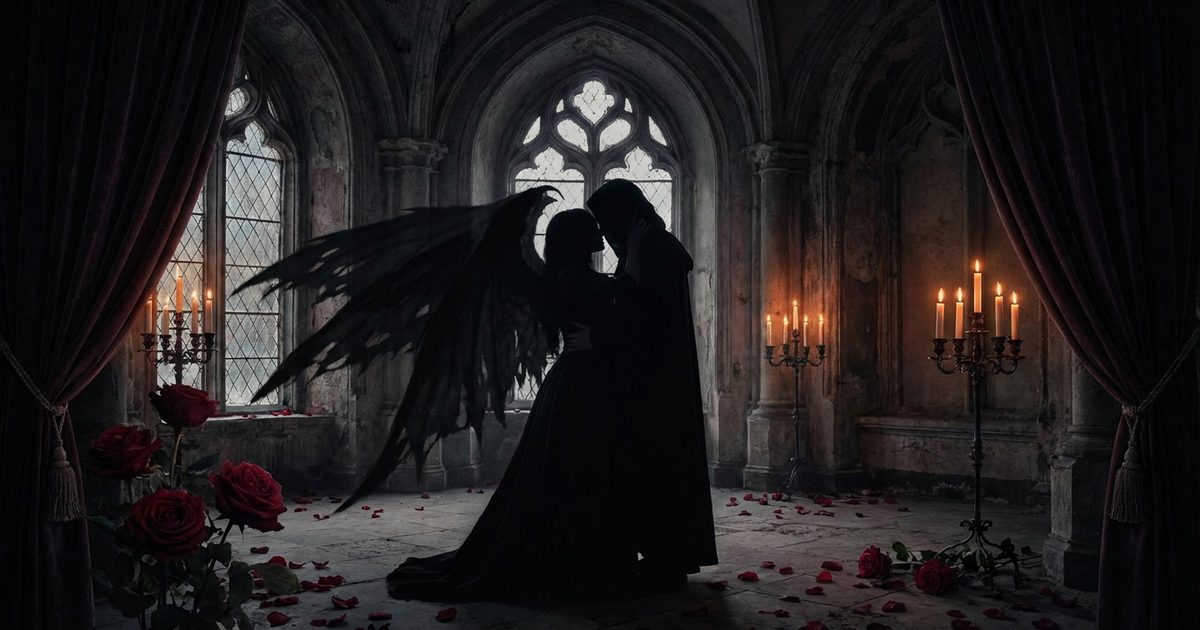
You don't know if you want to run or stay. The candle has burned down to a trembling stub. Something cold grazes your wrist in the dark — and your pulse surges with fear and want in the same electric beat.
That is the horrormance moment. It lives in your chest before your brain names it. Dread and desire arrive together, inseparable, wearing the same face.
This guide is for readers who already know that feeling and want to find more of it — and for writers who want to understand exactly what makes the genre work at the nerve level, not just the surface.
1. What Horrormance Actually Is (And Isn't)
Horrormance is not dark romance with a monster on the cover. It is not a paranormal romance with higher stakes. The word has circulated on BookTok since 2024, but the form is far older — and the distinction matters.
The defining feature is structural inseparability: the source of horror and the object of desire are the same entity. Remove the dread, and the love story collapses. Remove the love, and the horror loses its teeth. The two drives feed each other, and neither can exist alone without destroying what makes the story work.
This separates horrormance from paranormal romance, where the supernatural element is a setting or an obstacle rather than the core tension. In paranormal romance, love solves the problem. In horrormance, love is the problem — the most dangerous one the protagonist faces. Romantasy, for its part, leans toward wonder and adventure. Horrormance leans toward contamination, transformation, and the irreversible.
Isabel Cañas crystallized the current wave with The Hacienda (2023). Her work — gothic, colonial, deeply physical — showed a generation of readers what the genre could do when it trusted its own darkness. BookTok did the rest. By 2025, horrormance had become one of the most-searched fiction subgenres online, with dedicated recommendation threads running into the thousands. But the roots go back two centuries.
Explore how this tradition fits into the broader landscape of gothic erotic literature — the lineage is longer and stranger than most readers expect.
2. The Gothic Roots: Blood Before BookTok
John Polidori published The Vampyre in 1819 — the same summer that produced Frankenstein, at the same Swiss villa, during the same rainstorm. Lord Ruthven is charming, cold, and lethal. His victims are drawn to him before they understand what he is. That pull-before-comprehension is the horrormance engine, and Polidori built it first.
Sheridan Le Fanu's Carmilla (1872) went further. Carmilla arrives pale and beautiful at the narrator Laura's isolated estate. She smells of flowers and something underneath the flowers — sweet and wrong at once. She speaks in a low murmur. She touches Laura's hair while she sleeps. The horror and the intimacy are wound so tightly together that separating them would destroy both. Carmilla is queer, dangerous, and formally perfect — the original horrormance, and still one of the best.
Angela Carter's The Bloody Chamber (1979) reforged the gothic fairy tale as a weapon. In Carter's hands, desire is never passive. Her heroines want things — transgressive, carnivorous things — and the horror emerges directly from that wanting. Carter refused the safety of allegory. Her stories mean what they say, and what they say is that desire and annihilation share a grammar.
"Desire and dread do not occupy different rooms in the body. They run on the same nerve — and in horrormance, the author learns to play that nerve like a string."
3. How It Works: The Mechanics of Attractive Terror
The monster-as-love-interest requires something specific: the monster must choose the protagonist. Not stalk them randomly. Not threaten them as collateral. Choose them, in a way that feels particular and knowing. That specificity of selection is what converts threat into intimacy.
Transgression must be structural, not decorative. In successful horrormance, the romance itself is the act of transgression — crossing a threshold that cannot be uncrossed, accepting a knowledge that cannot be unfelt. The relationship changes the protagonist at the level of identity. They become someone their previous self would not recognize.
The ending is dark or bittersweet by necessity. A safe, warm resolution would retroactively drain the tension from everything that preceded it. If the reader knows the danger was never real, the shivers were never real either. The best horrormance endings leave something open — a wound, a hunger, a door that didn't quite close.
Pacing matters more than in almost any other genre. The approach must be slow. The horror and the desire must arrive in alternating waves, each one amplifying the next. Rush either element and the whole architecture collapses.
The body horror dimension of transformation is often central — the protagonist's flesh changes because of contact with the monstrous beloved, and that physical alteration is the most honest expression of what the relationship has done to them.
4. Five Novels That Define the Genre
These are not ranked. They are arranged chronologically, because the lineage is part of the meaning.
1. Carmilla by Sheridan Le Fanu (1872)
The template. Every horrormance written since carries Carmilla's fingerprints — the intimacy of predation, the somatic confusion of desire and dread, the slow understanding that something beloved is also something lethal. Read the original before anything else. It is shorter than you expect and more unsettling than you remember.
2. The Bloody Chamber by Angela Carter (1979)
Carter weaponizes desire. Her retellings of fairy tales strip the safety from the originals and leave only the cutting edge. The title story is a masterclass in using physical sensation — the smell of lilies, the cold of a ring, the sound of a key turning — to build a dread that is indistinguishable from arousal. Desire as weapon, wielded by both parties.
3. Interview with the Vampire by Anne Rice (1976)
Louis belongs nowhere. His relationship with Lestat is the definition of toxic intimacy — magnetic, annihilating, and apparently inescapable. Rice understood that the seduction of horrormance is partly the seduction of belonging to something outside ordinary human time and consequence. The dread is existential. The desire is, too.
4. Mexican Gothic by Silvia Moreno-Garcia (2020)
Horrormance as postcolonial critique. The house itself is the monstrous lover here — breathing, feeding, wanting. Moreno-Garcia uses the gothic conventions to examine what colonialism does to bodies and memory. The horror is systemic. The desire is for a past that the house will not relinquish. One of the most intelligent entries in the genre.
5. The Hacienda by Isabel Cañas (2023)
The novel that defined the current wave. Beatriz marries into a haunted house and a haunted man, and both relationships develop with the same suffocating slowness, the same alternation of warmth and cold. Cañas knows how to make a room feel dangerous. She knows how to make danger feel like shelter. That double knowledge is the horrormance gift.
5. How to Read (and Survive) Horrormance
The first question to ask of any candidate text: is the horror and the desire sourced from the same place? If the monster threatens the protagonist but a human love interest provides emotional safety, you are reading paranormal romance. Fine genre. Wrong category.
Watch for the somatic signals. In genuine horrormance, the author describes the body's confusion explicitly — a cold touch that feels warm, a voice that soothes while it threatens, a scent that draws and repels simultaneously. The body knows before the mind does. If the physical writing is clean and unambiguous, the genre machinery isn't running.
The pacing test: does desire grow in proportion to danger? In diluted versions, the horror plateaus early to make room for romantic comfort. In the real thing, the two elements escalate together. The more dangerous the beloved becomes, the more necessary. That escalation should feel uncomfortable — it should make the reader question their own reactions.
Be suspicious of endings that resolve cleanly. The monstrous beloved does not become safe. They may become known, accepted, even cherished — but the danger doesn't evaporate. A horrormance that ends with all threat removed was never really horrormance at all.
For readers approaching the gothic strand specifically, dark academia horror in 2026 has produced a related but distinct current — worth knowing how the two overlap and where they diverge.
And the female gothic tradition from Frankenstein's Bride onward provides essential context for understanding why horrormance so often centers female desire and female danger in the same breath.
6. The Brothel of Shadows: Cosmic Horrormance
Jan Willem Koster's The Brothel of Shadows takes the horrormance structure to its logical extreme — not a gothic house, not a vampire, but something that predates the concept of love entirely.
Xyl'khorrath exists at a register of reality that human language was not built to describe. Ancient. Plural. Present in the red-light alleyways of Amsterdam the way radiation is present in stone — invisible, pervasive, transformative. Alex does not simply desire Xyl'khorrath. Alex is selected. That specificity — that sense of having been chosen by something that has existed for longer than the city itself — is the novel's central horror and its central seduction.
The brothel functions as the mise-en-scène that makes this fusion possible. It is a space already built for the overlap of transaction and intimacy, of performance and vulnerability, of flesh and something that uses flesh as a language. Desire for forbidden knowledge and desire for contact run the same current through Alex's body. They cannot be separated. The novel does not try.
This is gothic horror rooted in Amsterdam's specific geography — the canals, the light, the centuries of commerce in human need — and it uses that setting to ask what the horrormance structure looks like when the monstrous beloved is not merely dangerous but cosmically indifferent to human survival. The answer is: more honest. Stripped of the comfort that at least the monster wants you to live, what remains is the desire in its purest form.
That is the furthest the genre reaches. Beyond it, there is only the dark.
Horrormance does not offer safety. It offers something rarer — the fiction of understanding your own capacity for want in the presence of something that could end you. The genre keeps growing because the question it asks is permanent: what do you do when the thing you are most drawn to is also the thing most likely to consume you? Not metaphorically. Not safely. For real, in the dark, with the candle guttering low and the cold pressing in from every wall.
You stay. Of course you stay. That's what the genre already knew about you.
Every night, the dream returns. Every night, the brothel calls.
Enter the dream →