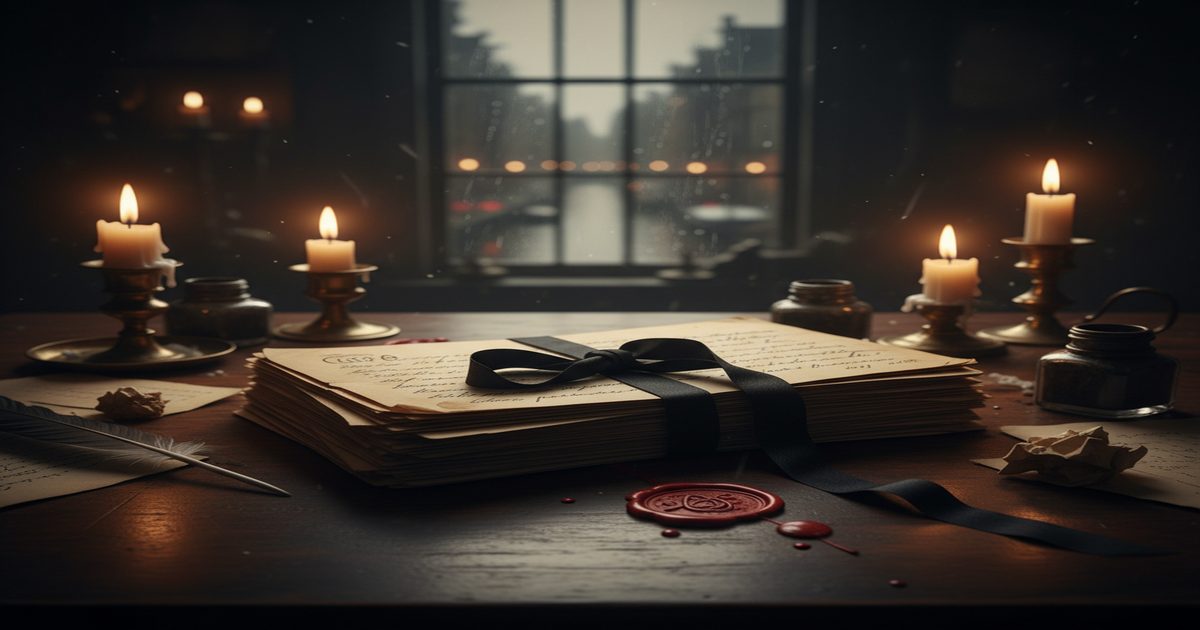
She found the letters in a drawer she didn’t know she had.
Three yellowed envelopes, sealed with cracked red wax. The handwriting on the outside was her own — but she had never written them. The first one began: “If you’re reading this, you’ve already entered. You cannot leave the way you came in.” The other two were still sealed. She held all three for an hour before opening the second one.
This is the promise of epistolary horror: the terror doesn’t come from outside. It comes from the page you’re holding.
Why does a found document frighten us more than any monster?
Epistolary horror is the only genre that puts the reader in the position of the investigator. You are not a spectator watching from a safe distance: you are the one who found the letters, the transcripts, the audio files. You decide whether to keep reading.
This identification is impossible to achieve in third person. The fiction of authentic chronicle — these words were written by someone who then disappeared — triggers something primitive. Not abstract fear. The concrete fear of someone holding evidence in their hands.
Mark Z. Danielewski called this technique “the fiction of authentic testimony.” The more the document feels real, the more visceral the terror. Postal stamps, signatures, faded ink — these aren’t decoration. They are the machinery of the genre.
From Dracula to House of Leaves: a history of first-person dread
Bram Stoker understood everything in 1897. Dracula is not a third-person novel — it’s a dossier. Diaries, letters, telegrams, phonograph notes. The vampire never appears as a narrator; he exists only in the documents that describe him. This absence builds more terror than any direct presence could.
“The most terrifying thing about Dracula is not the Count. It’s the fact that Jonathan Harker is writing these lines while he is still a prisoner in the castle.”
Mary Shelley had already experimented with the form in Frankenstein (1818), structured as letters from a polar explorer. The epistolary frame creates temporal distance: the events have already happened. The narrator is already dead, insane, or transformed. Reading becomes a kind of autopsy.
The quantum leap arrives in 1999 with Danielewski’s House of Leaves. No more letters — footnotes, appendices, manuscripts within manuscripts. The reader never knows which level of reality they occupy. The house grows, expands, devours the white space on the page itself. The book’s form becomes inseparable from its content.
In 2026, Dead Letters: Episodes of Epistolary Horror (Crystal Lake Publishing) gathers 21 original stories updating the form: emails, SMS threads, Reddit posts, podcast transcripts. Terror adapts to the medium. The medium adapts to terror. For a broader look at the genre’s formal innovations, see our guide to weird fiction and the new strange.
When can’t you trust the narrator?
Epistolary horror depends on a precise mechanism: the involuntary unreliable narrator. Not a conscious liar — something subtler. Someone describing horror in the language of the ordinary, because they have no other tools available to them.
In Charlotte Perkins Gilman’s “The Yellow Wallpaper” (1892), the protagonist writes increasingly fragmented diary entries as her mind dissolves. The reader sees the deterioration before she acknowledges it herself. The epistolary form becomes a mirror the writer cannot see. The reader sees it with terrifying clarity.
This creates what narratologists call epistolary dramatic irony: the reader knows more than the narrator. You know the witness is unreliable. You don’t yet know in which direction they’re lying. That not-knowing is the genre’s engine.
Suspense here isn’t about what will happen. It’s about how much of what’s happening I can actually trust. These mechanisms run parallel to psychological horror, where the narrator’s mind is the true terrain of terror.
Why is epistolary horror surging in 2026?
The answer is simple: we already live inside documents. Emails, screenshots, threads. Our daily lives have already taken the shape of the epistolary archive. When a horror story uses that structure, it dissolves the barrier between fiction and reality in ways no other genre can manage.
The found footage boom in cinema — from The Blair Witch Project to A24’s upcoming Backrooms — is the same mechanism applied to video. Horror is most frightening when it resembles an authentic document abandoned by someone before they vanished.
Contemporary fiction is pushing further: text messages from missing people. Security footage of rooms that shouldn’t exist. Synthetic voices calling the phone numbers of the dead. The border between classical epistolary and surveillance horror is dissolving in real time — because the technology to make it feel real already exists.
The Brothel of Shadows: dream as impossible transmission
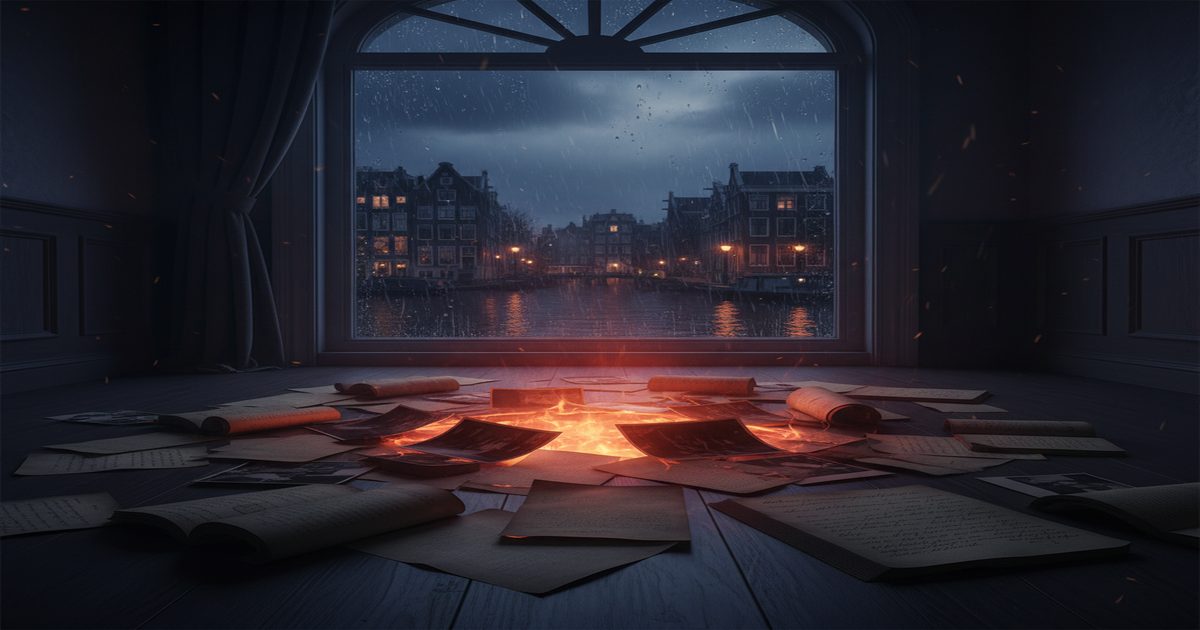
It’s no accident that Jan Willem Koster’s The Brothel of Shadows functions as a form of cosmic transmission. Alex doesn’t choose to receive the message — the message finds him. Like all truly dangerous epistolary letters.
The dream as found document: a narrative technology Koster deploys with surgical precision. Alex reads the brothel the way you read letters in this genre — one line at a time, one door at a time, never knowing how many rooms remain. It resonates with the oneiric as narrative portal, a thread running through horror literature since the Gothic era.
Xyl’khorrath doesn’t scream. It whispers in the margins, like a sender who already knows the recipient will open the envelope.
Some letters, once opened, cannot be sealed again.
About the author: Jan Willem Koster is the author of The Brothel of Shadows: Cosmic Interception, a Gothic horror novel set in 1980s Amsterdam. Available on Amazon.
Some doors should never be opened. Alex opened the wrong one.
Read what he found →