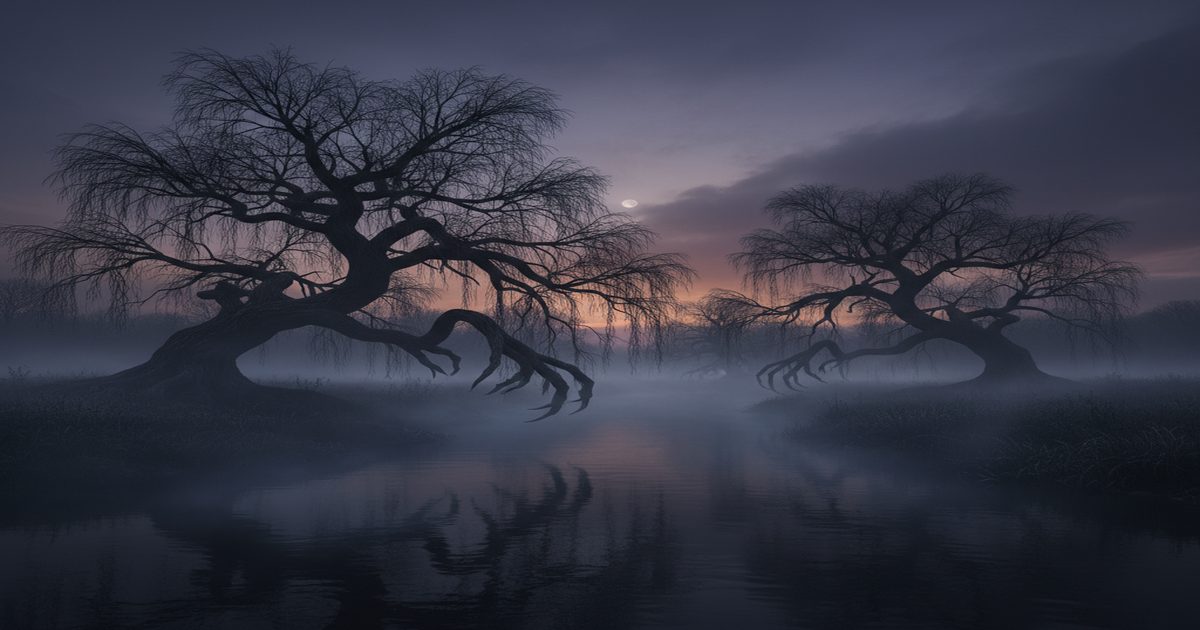
The forest is not watching you. That is the thing that truly frightens. No eyes. No intent. And yet it keeps growing.
Botanical horror is one of the oldest and least celebrated strains of terror literature. From Algernon Blackwood in 1907 to T. Kingfisher in 2026, plants as a source of dread share a single premise: nature does not need to hate us to destroy us.
Blackwood 1907: The Willows and the Terror Without a Face
Algernon Blackwood published The Willows in 1907. Two men on a canoe, drifting down the Danube. An island of willows in the current. Nothing else.
There is no antagonist. No monster with teeth and claws. There is wind moving through branches in a sound too close to breathing. There is the smell of damp earth and exposed roots. There is a feeling—growing, impossible to shake—that the willows are aware.
H.P. Lovecraft called The Willows the greatest horror tale written in English. Not for its explicit terror, but for what it never says: the suggestion that plant life obeys logics entirely alien to human thought. The trees are not cruel. They simply do not include us in their calculations.
Plants grow slowly, patiently, without urgency. They have no schedule. They have all the time in the world.
“They did not seem like trees. They seemed like creatures pretending to be trees.” — Algernon Blackwood, The Willows (1907)
Kingfisher 2026: Wolf Worm and the Body as Soil
Nearly a hundred and nineteen years after Blackwood, T. Kingfisher publishes Wolf Worm. The register shifts completely: from the cosmic to the visceral, from suggestion to the tactile and explicit.
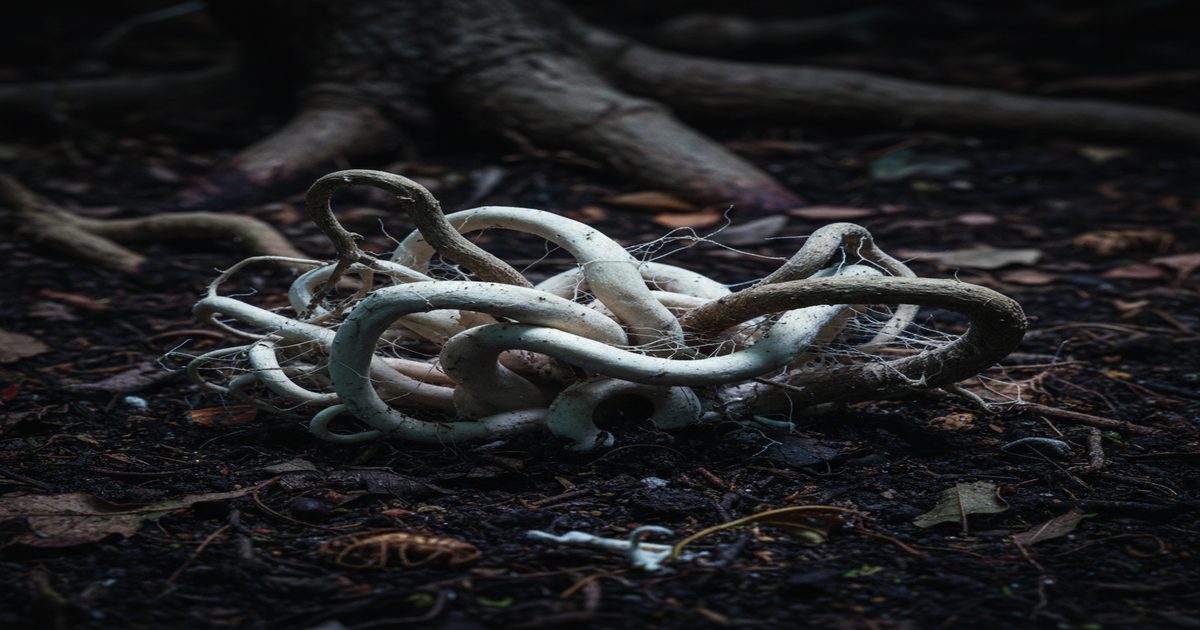
Wolf Worm is botanical-entomological horror. Insects nesting in flesh. Plant parasites using the human body as a growth substrate. The smell of humus and camphor rising from the skin before the host understands what is happening inside them.
The leap from Blackwood’s riverbank to Kingfisher’s flesh is the leap body horror has made in the twenty-first century: the external landscape becomes internal. The forest enters. Roots grow through you rather than around you.
Kingfisher brings to the surface something Blackwood kept off-page: the physical contact between plant and human is not metaphorical. It is literal, tactile, impossible to un-feel once imagined.
What Separates Them, What Binds Them
The difference between Blackwood and Kingfisher is one of distance. Blackwood keeps the terror outside: the threat lives in the landscape, in the air, in the inexplicable pressure of being watched by something with no eyes. Kingfisher collapses that distance with force.
And yet both share the same foundational premise: nature is not hostile. It feels nothing toward human beings. It simply uses them—as substrate, as warmth, as a medium for continued growth. Lovecraft’s cosmic indifference takes botanical form here.
Both writers also refuse anthropomorphism. Blackwood’s willows do not “want” anything. Kingfisher’s parasite does not “hate” its host. That is what makes them so hard to confront: you cannot negotiate with something that has no intentions.
For readers exploring weird fiction and its boundaries, botanical horror is one of the genre’s most productive laboratories. Remove the conscious antagonist. Leave only the process—growth, transformation, slow and inevitable colonization.
The Forbidden Garden: Hawthorne and Knowledge That Grows
Before Blackwood, there is Nathaniel Hawthorne. In 1844, Rappaccini’s Daughter presents a garden of poisonous plants cultivated by an obsessed scientist. His daughter, raised among toxic flowers, has become poison herself.
Hawthorne introduces the theme that runs through all botanical horror afterward: knowledge of the vegetal as corruption. Rappaccini’s garden is not a place of peace. It is a laboratory of transformation, where the line between medicine and venom dissolves.
The scent of Rappaccini’s flowers is sweet and lethal at once. Those who approach too closely do not die immediately: they change, slowly, into something that can no longer survive in the ordinary world. Exactly as the entities of cosmic weird fiction leave in their witnesses a knowledge that renders normal life impossible.
The Brothel of Shadows and the Cosmic Shoot
Botanical horror shares with The Brothel of Shadows a core structure: something alien growing through a human being, using desire as its channel.
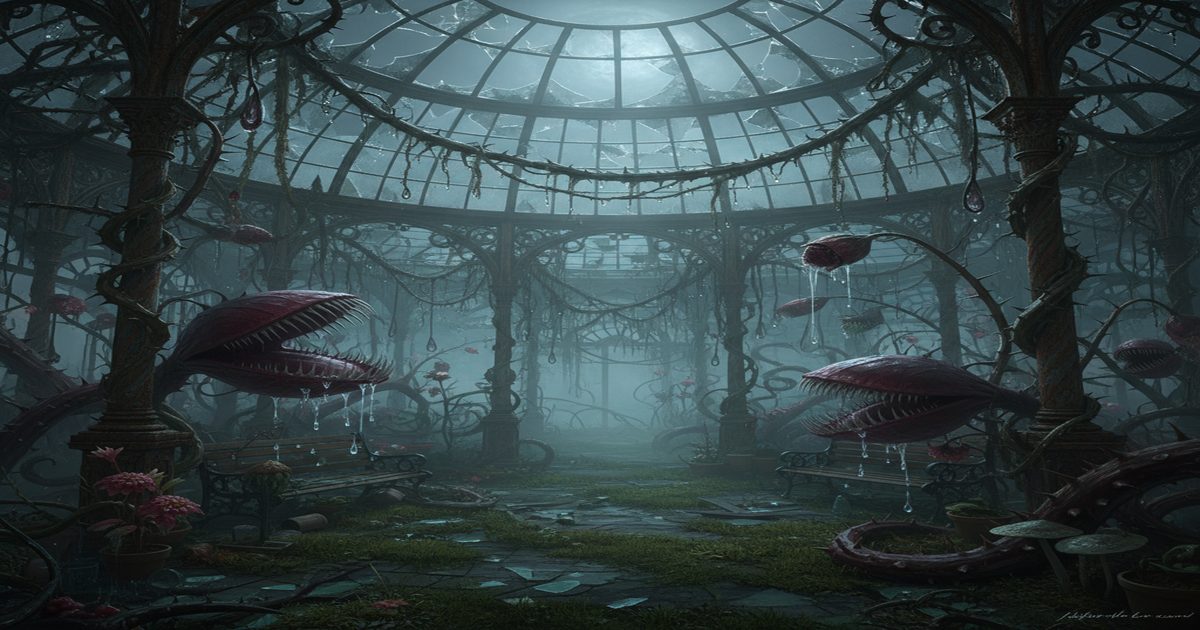
Xyl’khorrath is not a plant. But it operates like one—patient, slow, rooted in something far older than humanity. Alex is not attacked. He is colonized: gradually, through dreams, through the brothel that opens in the dimension of sleep like a carnivorous flower. Come close enough to admire it, and it has already closed around you.
The link between ecological folk horror and forbidden knowledge runs here too: nature—botanical or cosmic—always offers something precious in exchange for something that cannot be recovered.
The Root That Cannot Be Pulled
What Blackwood and Kingfisher teach us, a century apart, is the same thing: botanical horror is never really about plants. It is about indifference. About the fact that the world keeps growing, germinating, colonizing—with or without us, through us, because of us.
Blackwood’s willow bends in the wind. Kingfisher’s parasite finds a warm host. The brothel of shadows opens its doors every night. None of them ask permission.
The subtlest terror is always the things that grow while you sleep.
The cosmic hunger of Xyl’khorrath is never satisfied. And the brothel is its favorite dish.
Read the novel →