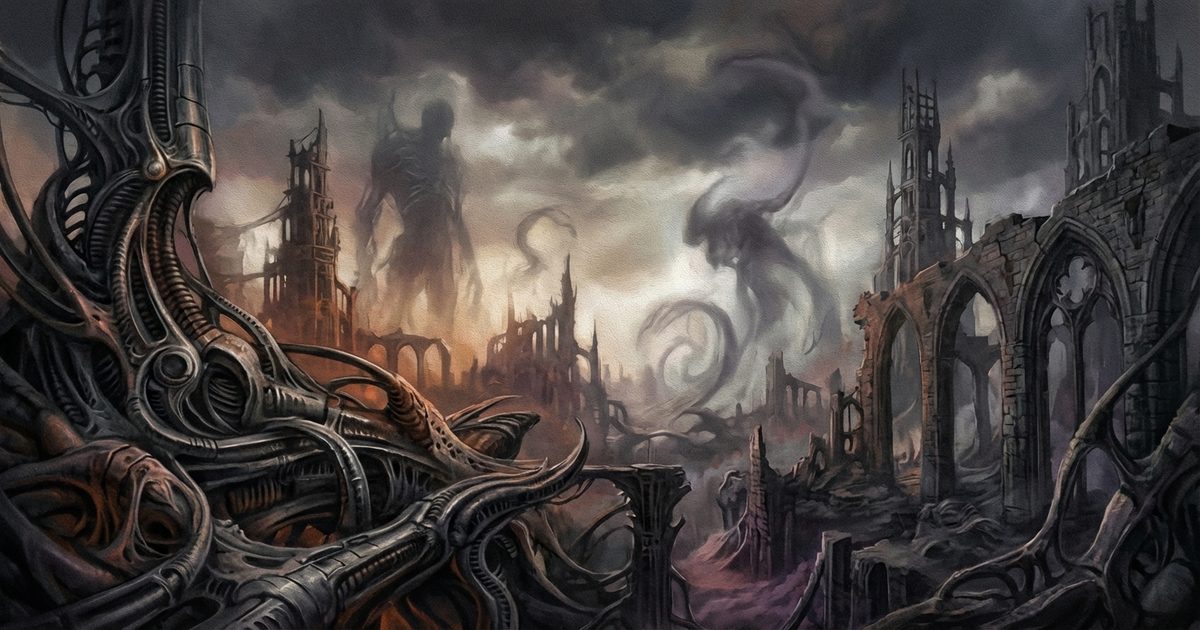
Steel tubes fused with human vertebrae. Skies the colour of bone dust. Two artists painted the horror you carry inside — and never stopped.
Macabre art doesn’t chase beauty. It hunts the truth you find at 3 AM, when every defence falls. Giger and Bekiński are its absolute prophets.
Skeletons dancing with kings: where the macabre began
The Danse Macabre was born from plague. Skeletons seized popes, peasants, prostitutes — no one exempt. The woodcuts reeked of ink and mass graves.
Dürer engraved a knight flanked by Death and the Devil. Holbein the Younger drew Death as a silent escort. The memento mori became its own genre: skulls beside ripe fruit, guttering candles, flowers already rotting. Art as a mirror of your end.
But medieval macabre warned gently. It taught, not wounded. Modern macabre art changed course with Goya: no longer remember death, but inhabit it.
Goya: when reason births monsters
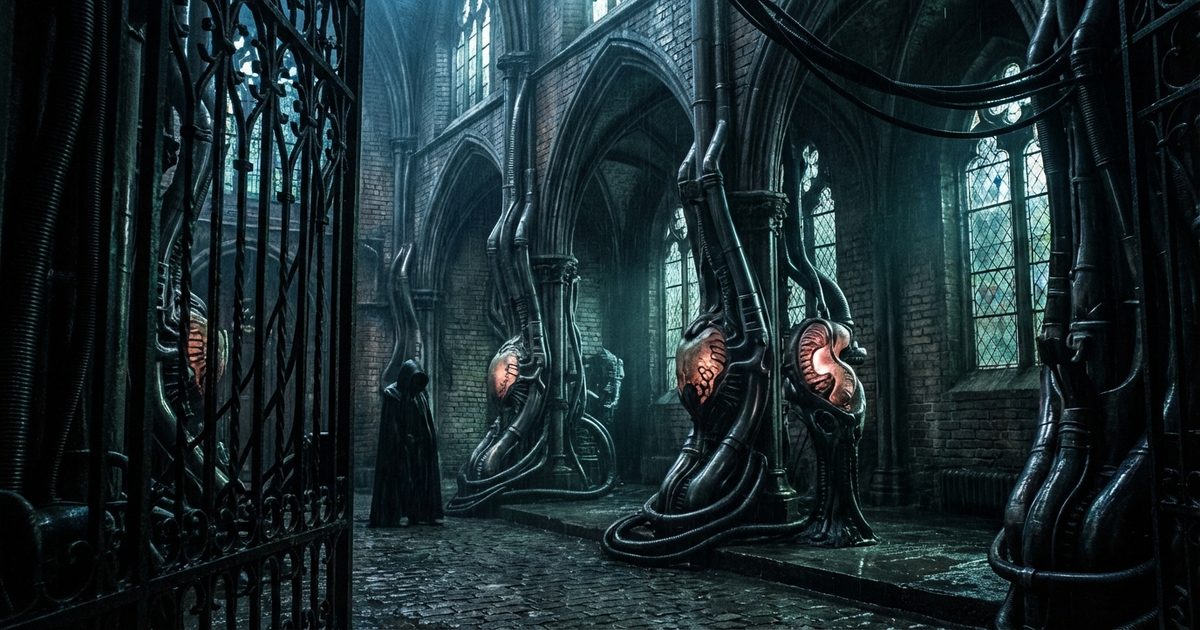
A man sleeps. Owls and bats erupt from his back. A lynx stares with unblinking eyes. This is the most famous plate from the Caprichos: the sleep of reason produces monsters.
The title lies — or says two things at once. Do monsters emerge when reason sleeps? Or when reason dreams too hard?
The Black Paintings leave no doubt. Goya painted them on his own walls, old and deaf. Saturn devours his son with wide-open eyes — not from cruelty, but from a force beyond his will. Forbidden knowledge as abyss: this theme would haunt all macabre art that followed.
H.R. Giger: tubes, vertebrae, and the theology of flesh
Chur, Switzerland, 1940. The boy who would become Giger had recurring nightmares: dark tunnels, bodies merging with gears, landscapes of wet metal. He began painting to exorcise them. He never stopped.
His visual vocabulary is unmistakable. Organic surfaces sheathed in chrome. Creatures both carnal and mechanical at once. Architectures designed by a bodiless intelligence that obsessively imagines having one.
“I don’t like what I paint. It worries me. That’s why I must keep going.” — H.R. Giger
He called it biomechanics. Not monsters in the classic sense: visions of what humans become when the border between flesh and machine collapses. The Necronomicon series, the Li II paintings — corridors opening onto abysses, humanoid figures in endless transition.
In 1979 he won the Oscar for Alien. The Xenomorph is feminine and phallic, maternal and predatory, biological and artificial. One form encoding more fears than any creature in cinema history. Pregnancy as invasion. The parasite as offspring.
His influence on contemporary body horror is vast. Cronenberg, Barker, Junji Ito, the digital underground — all children of Gigeresque biomechanics.
Bekiński: landscapes where everything has already ended
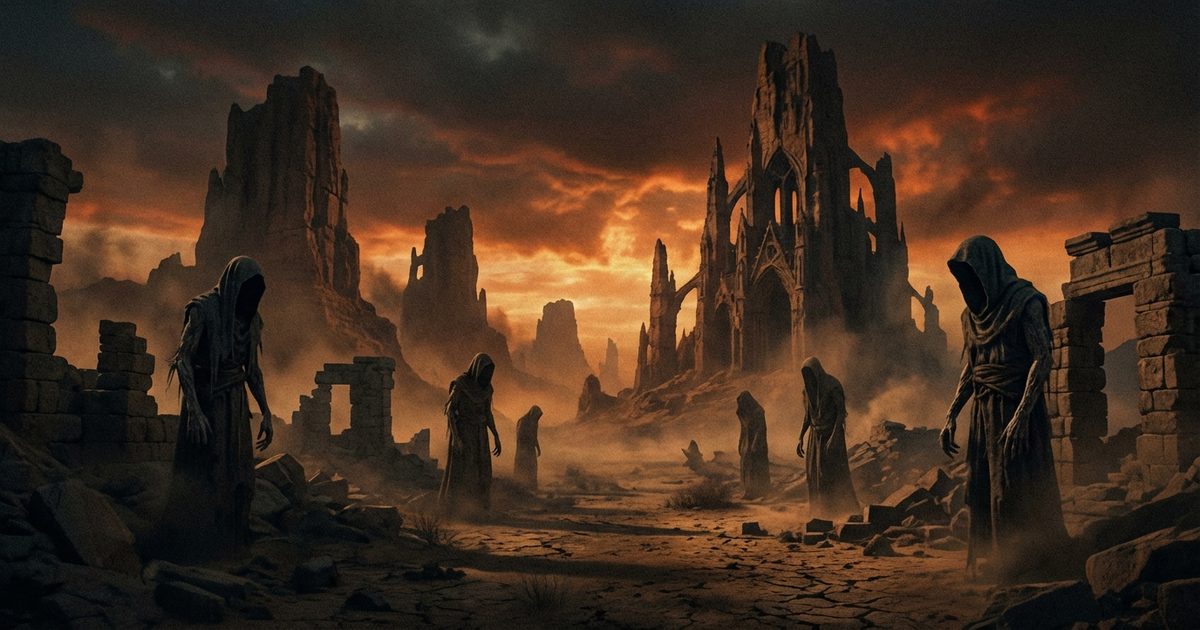
Giger sculpted form. Bekiński painted emptiness. Born in Poland in 1929, he lived under the Cold War in a country built on fresh rubble. He painted in oil with surgical precision: ruins, corroded figures, crucifixes without God.
His human figures are skeletal but not dead. Something consumes them from within — illness, time, a silent cosmic force. His skies hold impossible colours: ferrous reds, bone-dust greys, blacks that swallow the edges.
He never titled his works. Never explained them. He shrugged, laughed, said he only painted what he saw. The artist as medium, not author.
He died in 2005. Seventeen stab wounds in his Warsaw apartment, at the hands of a teenager. Brutal, banal, senseless — exactly what his paintings had always said about the world.
Bacon: the body as sacred slaughterhouse
Francis Bacon spent decades painting figures in dissolution. Popes screaming inside glass cages. Bodies crushed in cubic rooms. Crucifixions without redemption. Every canvas says the same thing: the body is a battleground for forces you will never understand.
His sources were explicit: Muybridge, abattoirs, war photography. The body as meat — vulnerable, perishable. This vision, materialist yet sacred, anticipates cosmic horror in its most physical form.
From eye to page: when macabre art becomes literature
Lovecraft described his creatures in deliberately non-visual terms. Yet his prose generates overpowering images. Giger’s Necronomicon series shares the Lovecraftian grimoire’s name for good reason: same tradition, same abyss.
The liminal spaces of horror — brothels between dimensions, cathedrals in the void, corridors leading elsewhere — recur in art and literature with unsettling consistency. As if both drew from the same archetypal well.
Jan Willem Koster’s brothel lives in that tradition. Spaces both familiar and impossible. Bodies in transition like Bekiński’s figures. Architecture recalling Giger. The Brothel of Shadows looks straight at what you’d rather not see — and finds something irreducibly true.
Macabre art in the age of dreaming machines
Today anyone can generate dark images with software. The flood is enormous. Some works are derivative; others, startling.
What sets Giger and Bekiński apart remains rare: the coherence of an entire vision. Not single brilliant images, but a universe with its own rules, internal logic, something resembling philosophy. The hand didn’t choose — it transcribed what already existed somewhere, waiting to be seen.
It’s not a book. It’s an experience. Whoever enters the Brothel of Shadows leaves changed.
Begin the descent →