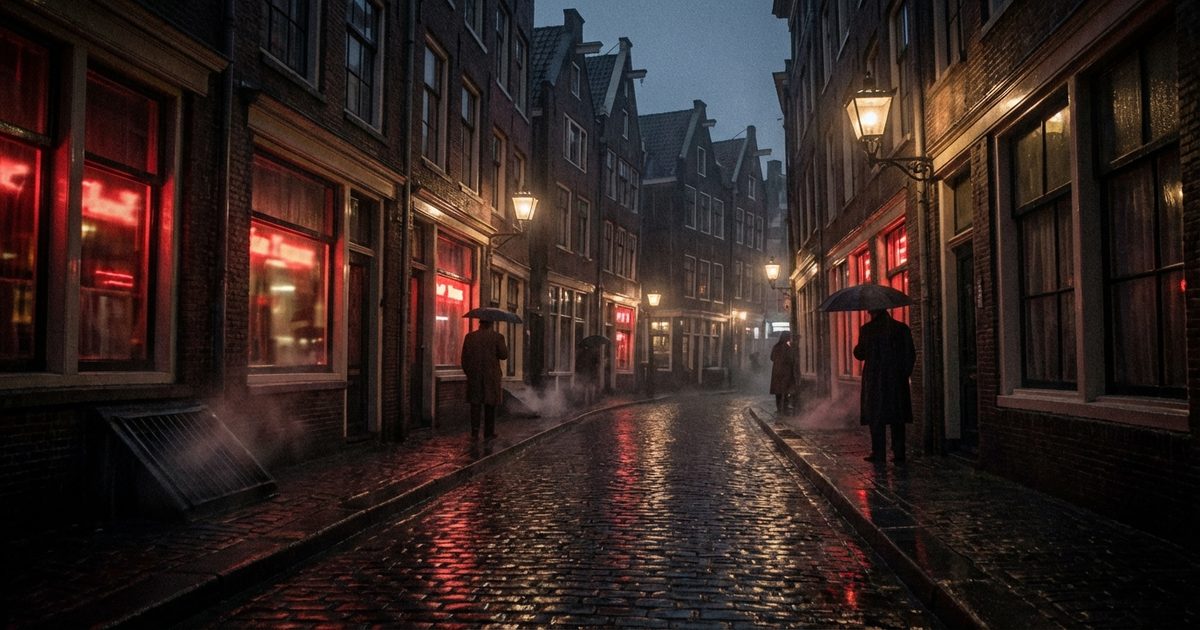
There is a place in the heart of Amsterdam where time does not flow as it does elsewhere. The streets narrow, the canals draw closer, and the light — that red light filtering through hundreds of windows — tints everything in a color that does not entirely belong to the daytime world. De Wallen, the oldest red-light district in Europe, is not simply a corner of the city given over to pleasure: it is a living labyrinth of stories, ghosts, and contradictions that has survived for nearly eight centuries, indifferent to every attempt at normalization.
The medieval origins of De Wallen
The history of Amsterdam's red-light district reaches back to the thirteenth century, when the city was little more than a settlement of fishermen and merchants along the banks of the Amstel. With the construction of the port and the arrival of sailors from every corner of the known world, the streets around the Oude Kerk — the oldest church in the city, consecrated in 1213 — began to fill with inns, taverns, and dwellings where companionship was offered to those returning from the sea.
It was no coincidence that this trade flourished in the very shadow of the church. In the Middle Ages, the proximity of the sacred and the profane was not perceived with the scandal it would provoke today. The church gathered souls and the district gathered bodies, and the two currents intertwined with a naturalness that strikes us now as incomprehensible. This original coexistence imprinted in the district's DNA a duality that persists to this day: the perpetual tension between the light of votive candles and the crimson glow of the windows.
The Golden Age and the shadows of prosperity
During the Dutch Golden Age in the seventeenth century, Amsterdam became the most important commercial hub in the world. The ships of the Dutch East India Company brought back spices, silk, and unimaginable riches, but they also carried sailors who had spent months on the open sea, hungry for every form of earthly consolation. The red-light district expanded, its streets branching out like the veins of an organism that grows by feeding on the desires of others.
But prosperity brought its own shadows. In the alleyways adjacent to the main canals, stories hid that the official records preferred to ignore: unexplained disappearances of young women who had come from the countryside seeking fortune, taverns whose basements held secrets no patron would want to know, and an underground network of passages connecting seemingly unrelated buildings. The wealth on the surface covered the rot in the foundations, just as the elegant facades of the patrician houses concealed cellars where sunlight never reached.
Legends and mysteries of the Red Light District
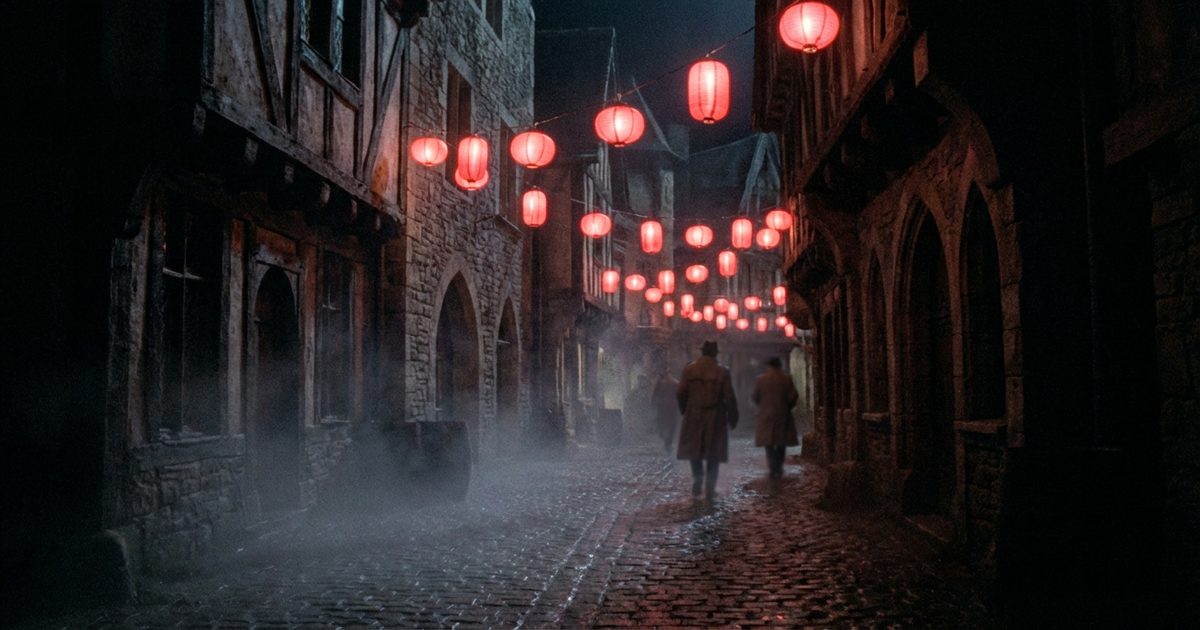
Every old quarter has its legends, but those of De Wallen possess a particular quality: they do not merely frighten, but plant the doubt that the boundary between legend and chronicle is less clear-cut than one would like to believe. There are tales of a brothel that vanished at the end of the nineteenth century, a building that the oldest residents swore they had seen with their own eyes but that appeared on no cadastral map. A place where customers entered but, according to the whispers, did not always leave with the same soul they had brought in.
Then there are the stories tied to the canals themselves. The black water surrounding the district has yielded over the centuries objects that no one could explain: jewelry of unknown craftsmanship, keys that fit no existing lock, fragments of mirrors that, according to the neighborhood washerwomen, reflected images of rooms that could belong to no standing building. Dutch rationality, celebrated the world over, seems to crack when it draws too close to the water of certain canals.
The modern transformation and what remains
Over the course of the twentieth century, the red-light district passed through phases of decline and rebirth, scandal and regulation. The city authorities have attempted repeatedly to shrink it, to domesticate it, to transform it into a harmless tourist attraction. Some windows have been shuttered, replaced by art galleries and artisan coffee shops. But De Wallen resists every attempt at complete rehabilitation, as if the district possessed a will of its own, a determination to preserve its dark essence beneath whatever new facade is imposed upon it.
Those who walk through it at night, away from the rowdy groups and the guides with their raised umbrellas, can still sense something ancient in its stones. The narrowest streets, the ones where tourists do not venture, hold a silence that is not merely the absence of sound but something denser, more intentional. A silence that seems to listen.
The district as literary material
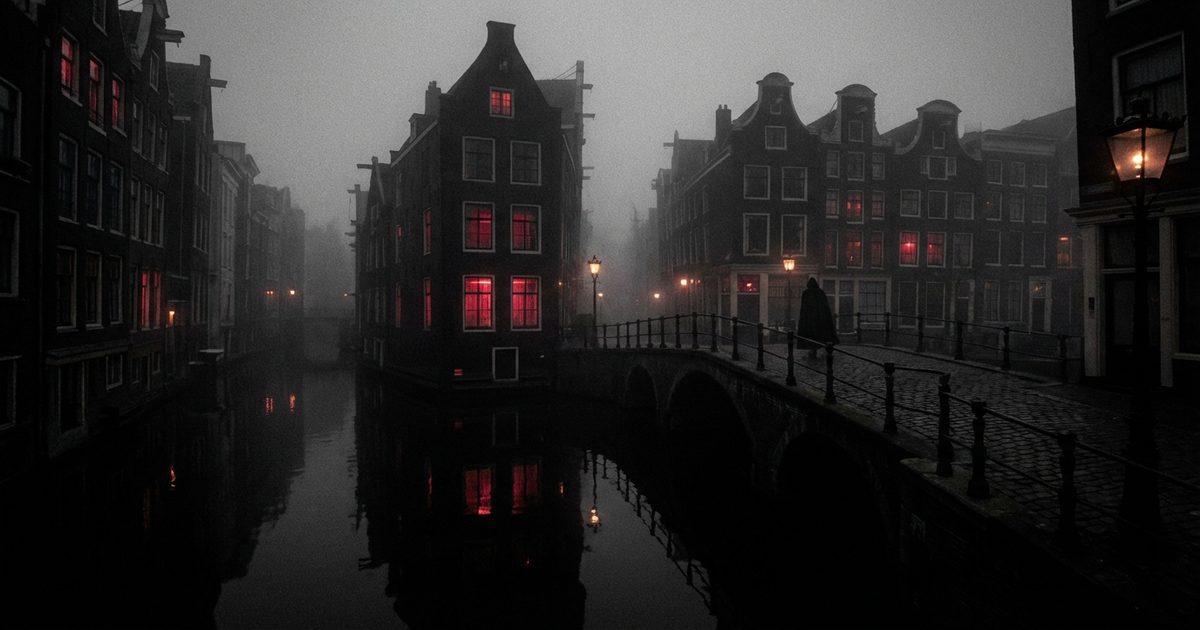
It is no surprise that a place so layered, so steeped in contradictions and untold stories, has always attracted the attention of writers. Amsterdam's red-light district offers literature what few other places can claim: a setting where the rawest realism and the most unsettling supernatural can coexist without requiring the reader to suspend disbelief. Here, the fantastic is not an intrusion into the everyday — it is the everyday itself revealing itself as fantastic, if one observes it long enough.
It is exactly this quality that Jan Willem Koster captured in his novel The Brothel of Shadows. Set in 1980s Amsterdam, the book transforms De Wallen into a literary territory where real streets lead to thresholds that should not exist. The titular brothel occupies a space that ordinary geometry does not account for, hidden among the folds of the district like a secret the city has guarded for centuries, revealing it only to those reckless — or desperate — enough to seek it out.
The protagonist Alex traverses the streets of the red-light district following traces that lead him progressively beyond the visible, toward a truth the district itself seems to want to both protect and reveal at the same time. In this, the novel captures the deepest nature of De Wallen: not a place of simple transgression, but a perpetual boundary between what is shown and what is hidden, between the illuminated surface and the abyss that opens just beneath it.
A place that never stops speaking
Amsterdam's red-light district will continue to transform itself, as it has transformed continuously from the thirteenth century to the present day. Windows will close and others will open, streets will be renamed and facades restored. But the dark core of De Wallen — that tangle of stories, desires, and mysteries that has accumulated over eight centuries of nocturnal life — will survive every urban renewal, as it has survived fires, plagues, occupations, and moral reform.
Because certain places do not belong solely to geography. They belong to the collective imagination, to that penumbral zone of human consciousness where desire and fear can no longer be told apart. And Amsterdam's red-light district, with its red light that turns every face into a mask and every shadow into a promise, is perhaps the place that best embodies this borderland — in reality as in the gothic fiction it continues to inspire.
Cross the threshold of Amsterdam's darkest quarter.
Read The Brothel of Shadows