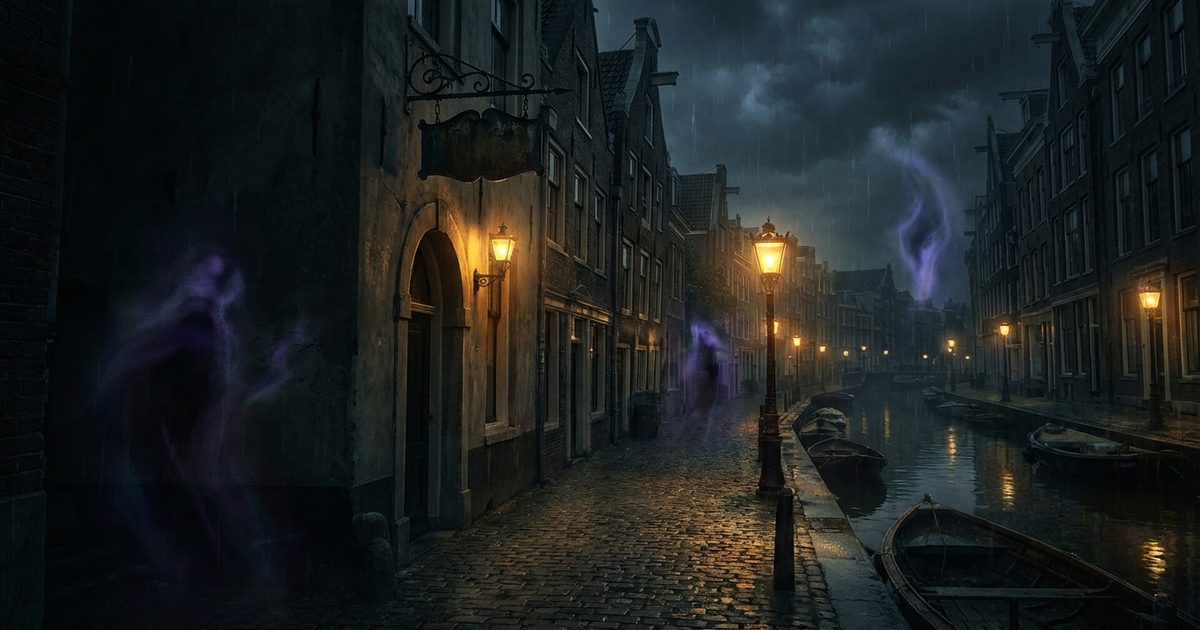
There is a place you will not find on any map of Amsterdam. It has no address, no sign visible from the street, yet those who are called always find their way to it. They reach it in dreams before they even know it exists, drawn by recurring visions that leave on the pillow the scent of ancient incense and the echo of voices whispering in forgotten tongues. This place is the beating heart of The Brothel of Shadows, the novel by Jan Willem Koster that fuses psychological horror, European gothic fiction, and Lovecraftian cosmic dread into a narrative experience unlike anything else in contemporary dark fiction.
The premise: an ordinary man, an extraordinary summons
Amsterdam, the 1980s. Alex leads a life that could be called normal, almost mundane in its predictability. But the nights tell a different story. For weeks, perhaps months, the same dreams keep visiting him with a regularity that defies rational explanation. Corridors cloaked in a reddish half-light. Doors opening onto rooms where the laws of geometry seem to bend. Figures waiting for him with an unsettling familiarity, as though they have known him forever, since before he was born, since before the very concept of birth had meaning.
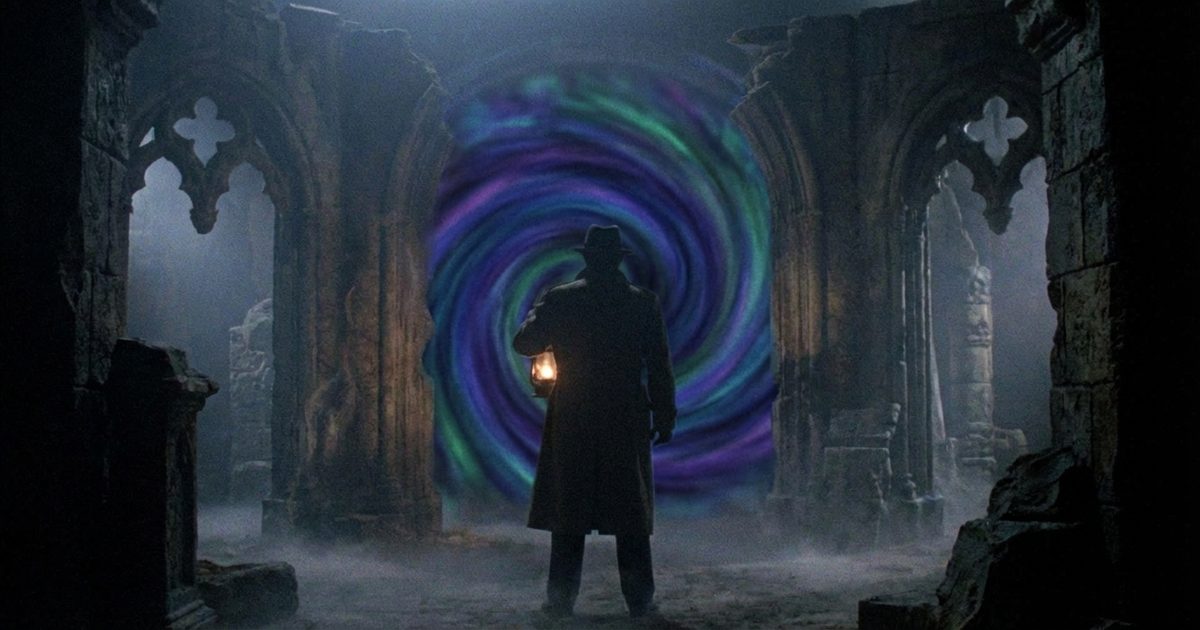
When Alex decides to follow the summons and searches for the brothel in the real fabric of the city, he discovers that the boundary between the world he knew and something immensely vaster has always been thin. The brothel exists, but not in the way ordinary buildings exist. It occupies a liminal space, a fold in the weave of reality where dimensions overlap and human desire becomes a key capable of unlocking doors that should have remained sealed.
Discover the novel that is redefining cosmic horror fiction.
Buy on Amazon Kindle →The themes: cosmic horror meets gothic eroticism
The Brothel of Shadows builds its terror on a fundamental tension: the one between desire and revelation. The brothel does not simply offer physical pleasure. It offers knowledge. Every room, every encounter, every whisper in the darkness is a fragment of a larger mosaic, a cosmic design that the human mind was never built to contain.
The eroticism in the novel is never gratuitous or decorative. It functions as a narrative mechanism through which the characters lower their defenses, opening cracks in consciousness that allow something ancient and unfathomable to seep through. Desire thus becomes the vehicle for a Cosmic Interception: the brothel operates as an antenna, a receiver tuned to frequencies that originate elsewhere, from dimensions where time does not flow and space curves back on itself in impossible geometries.
Forbidden knowledge and the price of knowing
At the heart of the novel pulses a question that runs through all great horror fiction: how much are you willing to sacrifice for the truth? Alex gradually discovers that the brothel guards an ancestral wisdom, an understanding of the nature of the universe that predates every known civilization. But this knowledge comes at a cost. Every revelation erodes a piece of ordinary reality; every door opened makes it harder to return to the life he knew before.
The narrative structure of the novel mirrors this progressive erosion. The opening pages are anchored in recognizable Amsterdam — concrete, made of canals and bicycles and fine rain. As Alex delves deeper into the mystery of the brothel, the language itself transforms, descriptions become more fluid and dreamlike, and the boundaries between chapters grow as permeable as the boundaries between the dimensions the protagonist traverses.
The setting: Amsterdam as threshold
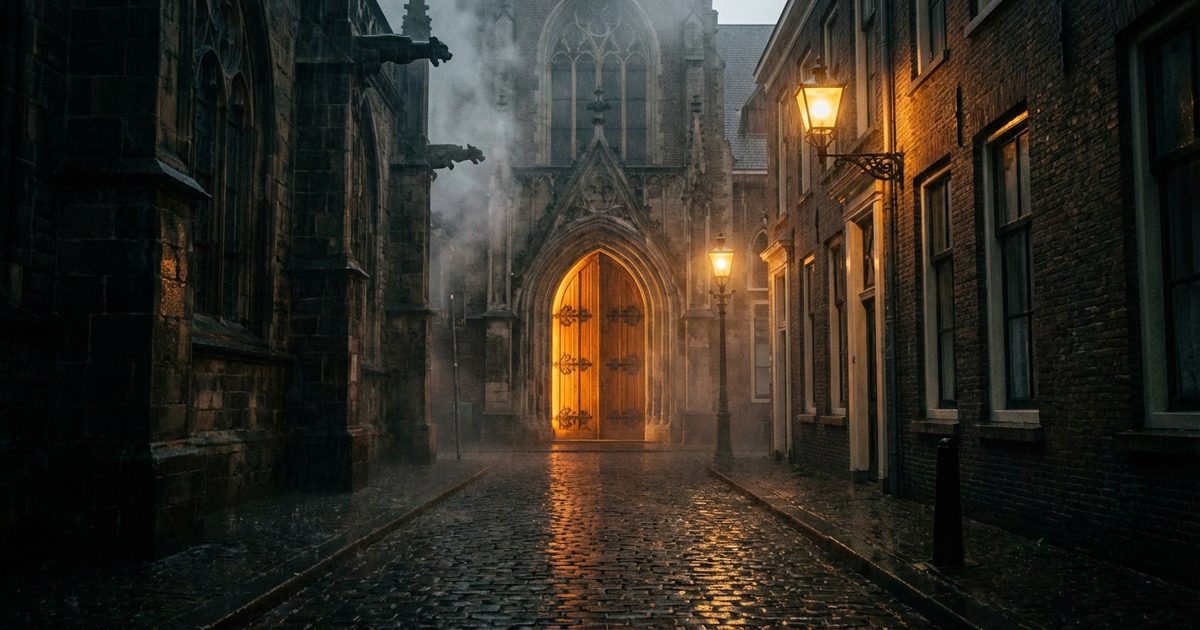
The choice of 1980s Amsterdam is no accident. The city, with its seventeenth-century architecture tilting slowly toward the black canals, with its red-light district where flesh and the sacred have coexisted for centuries in the shadow of the Oude Kerk, is the ideal stage for a narrative that lives on thresholds and passages. Amsterdam is a city built on water, on ground that is never entirely solid, where the boundary between land and sea is negotiated daily. A perfect metaphor for a novel that explores the border between the real and the inconceivable.
The 1980s add another layer of meaning. It is a decade of transition, of subterranean tensions, of a freedom that carries with it new forms of unease. Pre-digital Amsterdam, without cell phones, without GPS, without the safety net of constant connectivity, is a place where getting lost is still possible in the deepest sense of the word. And it is in this possibility of becoming lost that the brothel finds its victims — or perhaps its chosen ones.
Title: The Brothel of Shadows — Cosmic Interception
Author: Jan Willem Koster
Pages: 312
Genre: Gothic cosmic psychological horror
Setting: Amsterdam, 1980s
Format: Amazon Kindle (eBook)
ASIN: B0GMKXDTK4
Why read The Brothel of Shadows
If you loved the sense of cosmic vertigo in Lovecraft but crave something more intimate and psychologically layered, this novel is for you. If you seek psychological horror that does not merely play mind games but opens onto ontological abysses, you will find what you are looking for in these pages. If the idea of a Lovecraftian cosmic horror rooted in European tradition, far from Anglo-Saxon cliches, intrigues you, then the brothel is already calling.
The Brothel of Shadows is not a novel you read. It is a novel you cross, like a threshold. Its 312 pages build an atmosphere of mounting dread that does not seek the immediate shock but works by accumulation, layer upon layer, until the reader realizes they are already inside, that they have crossed a boundary without noticing — just like Alex.
A unique contribution to dark fiction
In the landscape of gothic horror novels, The Brothel of Shadows stands apart for its ability to fuse different narrative traditions into a coherent and original work. European gothic with its decadent atmospheres. Cosmic horror with its unbearable sense of vastness. Psychological thriller with its exploration of mental fragility. Literary eroticism as a tool of revelation rather than titillation. These currents converge in a novel that resembles nothing else in contemporary horror fiction.
The dreams and nightmares that torment Alex are not simple narrative devices. They are the language through which the cosmos communicates with those capable of listening — or perhaps incapable of not listening. The novel explores the idea that human consciousness is a receiver, a biological radio that normally picks up only the frequencies of ordinary reality, but that under certain conditions, in certain places, can tune into transmissions originating from much, much farther away.
True horror does not lie in what hides in the darkness. It lies in the discovery that the darkness has always been watching you, and that it has a name your mouth cannot pronounce.
Will you cross the threshold?
The Brothel of Shadows — Cosmic Interception
312 pages. Gothic cosmic psychological horror. Available now.