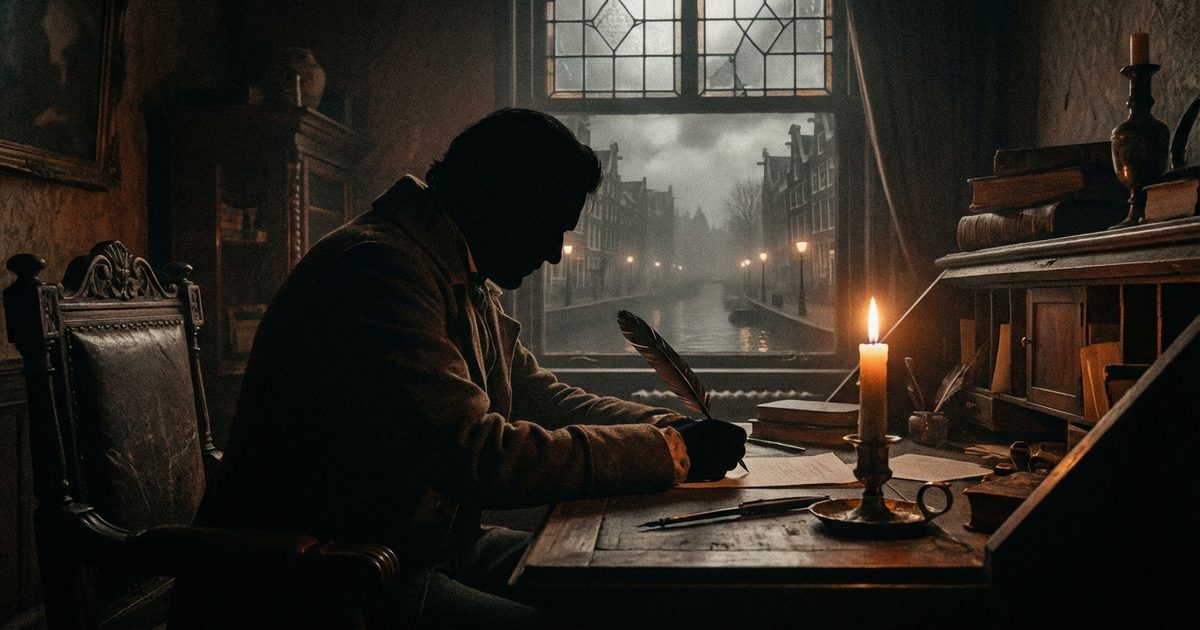
This is a personal declaration on the genesis, the structure, and the vision behind The Brothel of Shadows. I wrote these words for readers who want to know what lies behind the book, and for those who wonder why someone would dedicate four years of their life to a project like this.
Writers are nothing more than people like me — flesh-and-blood individuals who have something to tell and who have sacrificed time and dreams to do so. We worked meticulously for four years, building a narrative system and a world with its own rules and dimensions. What the first book reveals is only a small part of a project I am striving with everything I have to carry forward. I do this because I am the first to believe in it, and only those who truly love something can understand why.
Alex is a protagonist I shaped and reshaped with the help of four minds. Every influence lives within him, coexisting alongside the others. This led us to a ghost-protagonist: Alex has no background. His choices are nothing but freefall into profound darkness. There is no redemption in Alex, nor love in his corruption. When the ending arrives, the dominant theme is hunger — but not the hunger of someone who skipped a meal. His is a primordial hunger, one that dwells in the cosmos hidden beneath his new acquisition.
Time, like the city, fades as the corruption advances. At a certain point, in a faint undercurrent accessible only to the most attentive, fragments out of place can be found.
The shift in perspective is intended to show, through Henrietta's eyes, a defenseless and infinitely small world: the one outside the brothel of shadows.
In the streets, something is wrong. And it is precisely this dystopian sensation — filleted into morsels ready for readers — that will accompany anyone who engages with this saga for a very long time.
— Jan Willem Koster, March 28, 2026
Four years, one narrative system
The first book is not a standalone novel. It is the gateway to a narrative ecosystem built with engineering precision and artistic obsession. The rules of the world, the dimensions that cross through it, the forces that govern it — all of this was designed before a single line of plot was written. What the reader perceives as atmosphere is, in reality, architecture.
The ghost-protagonist
Alex has no past the reader can use as an anchor. There is no traumatic childhood, no clear motivation, no redemption arc. The four minds that influenced his creation produced a character who exists in the absolute present of his choices — and every choice is a fall. This approach deliberately breaks with the tradition of the empathetic protagonist: Alex does not ask to be understood, much less forgiven.
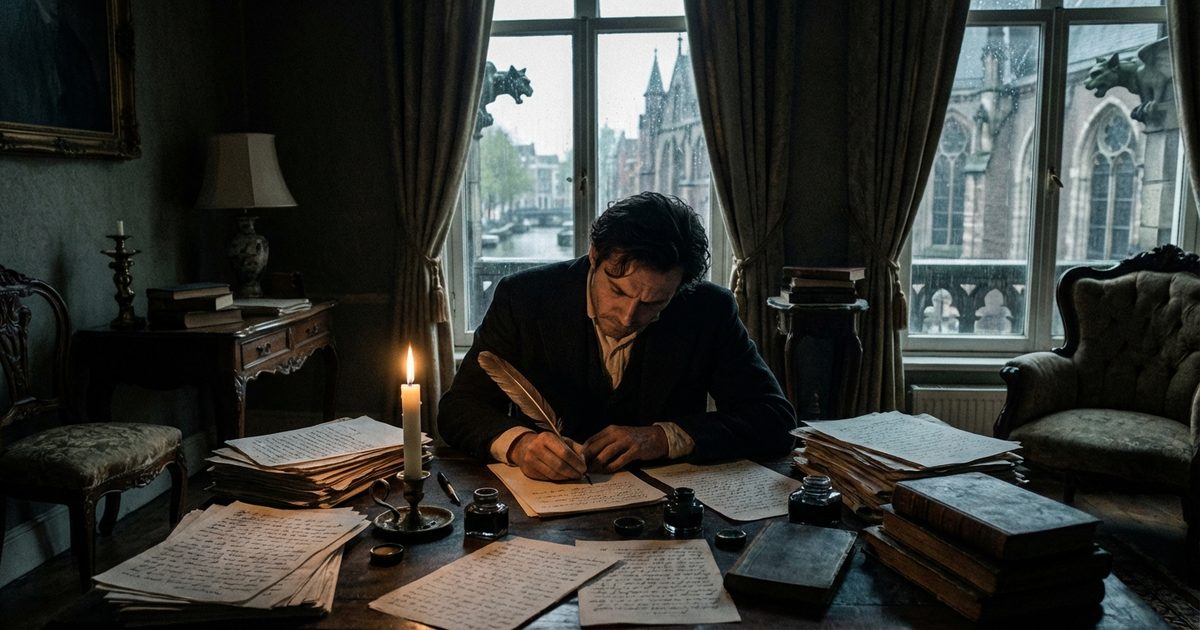
Hunger and corruption
The theme of hunger in the finale is not metaphorical in the conventional sense. It is a cosmic force, something that predates Alex and passes through him without his comprehending its magnitude. The new acquisition — the brothel itself — is not simply a place: it is a vessel for something far more ancient and far more ravenous.
Time dissolving
Attentive readers will notice that the temporal structure of the novel degrades as the corruption advances. The misplaced fragments are not errors: they are clues. The city itself participates in the dissolution, losing coherence as the brothel gains power.

Henrietta and the outside world
The shift in perspective toward Henrietta is not a narrative device: it is a structural necessity. To grasp the full scope of what is happening inside the brothel, one must see it from the outside — from the viewpoint of someone living in a defenseless, infinitely small world, entirely unaware of the corruption closing in.
The saga
This dystopian sensation that pervades the streets — that eerie unease that something is not right — is the thread that will bind every volume of the saga. This is not jump-scare horror: it is the slow terror of realizing that the world has already changed, and no one noticed.
Enter the world of The Brothel of Shadows
Read the Novel →