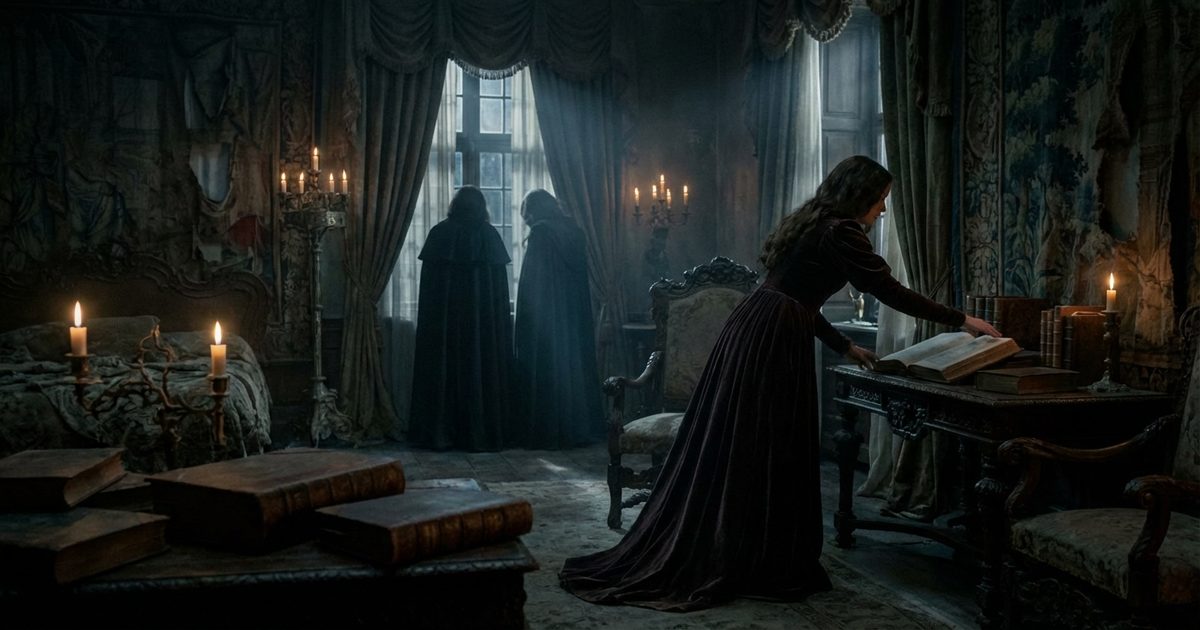
The door between desire and terror has always been unlocked. Push it open and you find a room that Western literature has been decorating for centuries: candlelit, velvet-hung, smelling of something sweet beneath something rotting. Eros and Thanatos share a bed, and the writers who have spent the most time in that room are among the most interesting horror has produced.
Erotic horror is not a niche. It is one of the oldest strands in the tradition — and one of the most honest, because it takes seriously what other horror subgenres often sidestep: that fear and desire activate the same nervous system, that the body cannot always tell the difference between excitement and dread.
Carmilla and the seductive undead
Sheridan Le Fanu published Carmilla in 1872 — twenty-five years before Dracula — and the novella remains the founding document of erotic horror. The relationship between Laura and the mysterious Carmilla is saturated with longing from the first page. Laura's descriptions of her companion have a physical intensity that Victorian propriety could barely contain: the strange warmth of her touch, the weight of her presence in the night, the breathless confusion between affection and fear.
What Le Fanu understood, and what Bram Stoker would shortly exploit in more coded form, is that the vampire is the ideal figure for erotic horror. It arrives uninvited. It takes what it wants. It leaves the victim simultaneously violated and craving more. The transgression is inseparable from the attraction.
“The body knows what the mind refuses to name. Horror that works through desire knows this too.”
Anne Rice: the monster as object of desire
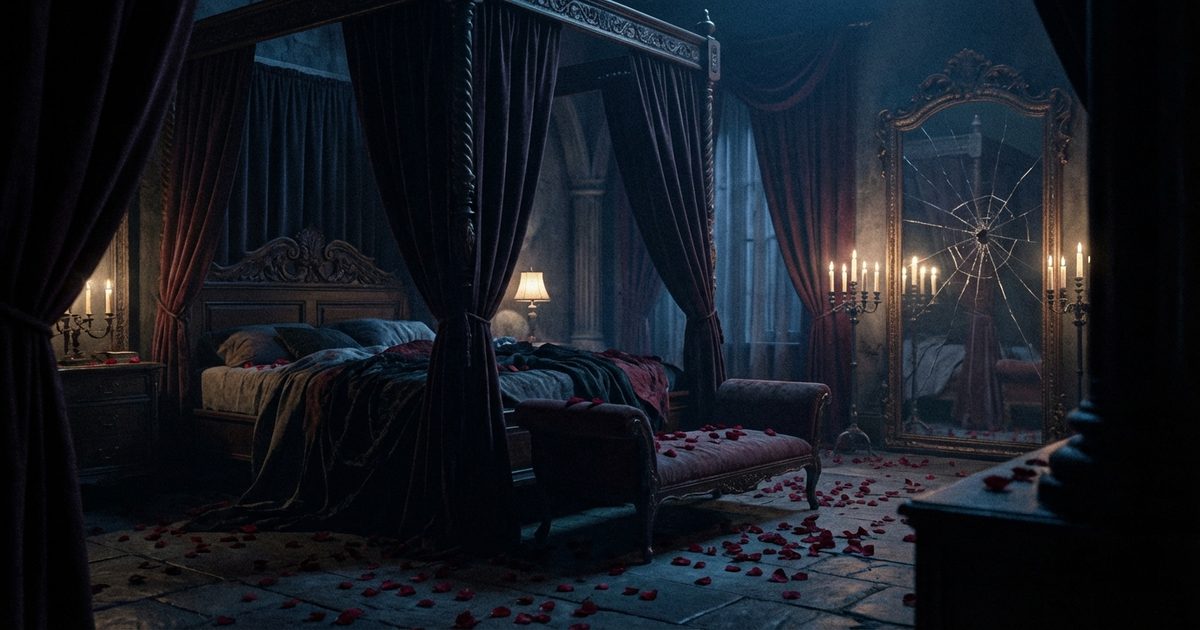
Anne Rice's Interview with the Vampire (1976) changed the terms of the genre. Rice's vampires are not predators to be feared from a safe distance. They are figures of overwhelming beauty and devastating sadness, their immortality a curse that makes human desire look briefly radiant by contrast. Louis and Lestat's relationship is erotic in its power dynamics, its dependency, its violence.
Rice brought something crucial to the genre: interiority. Her monsters think, feel, doubt, and want. The horror is not the creature but the longing — the recognition that the monstrous is also the desirable, and that this says something uncomfortable about desire itself. Her influence runs through nearly every gothic erotic horror novel published in the half-century since.
Clive Barker: beyond the threshold of pleasure
If Rice made monsters beautiful, Clive Barker made beauty monstrous — and did it with a directness that left no room for comfortable ambiguity. The Hellbound Heart (1986), the novella that introduced the Cenobites, is built on the premise that the pursuit of pleasure taken to its absolute limit arrives somewhere indistinguishable from torture.
Barker's Cenobites are not metaphors. They are the literal endpoint of desire. Frank Cotton summons them because he has exhausted every human pleasure and wants more; what they offer is more, taken to a register where flesh becomes something to be rearranged, opened, experienced from the inside. The horror is entirely physical, entirely visceral, and entirely erotic in the most unsettling sense. The hooks enter the skin with the precision of practiced hands.
Female voices: rewriting the body
Tanith Lee, Poppy Z. Brite, and Carmen Maria Machado each brought to erotic horror a perspective that male writers had largely been unable to access: the experience of a body that has been defined by others, that has been the object of desire rather than its subject, and that uses horror to reclaim its own terms.
Tanith Lee's erotic horror stories — collected in volumes like The Gorgon — are lush, mythologically dense, and refuse the male gaze even when writing about seduction. Poppy Z. Brite's early work, particularly Lost Souls, located erotic horror in the queer underground, in bodies that mainstream culture had already monsterfied. Carmen Maria Machado's Her Body and Other Parties performs something more clinical and more devastating: it uses horror to expose the ways in which female bodies are already subject to a kind of continuous low-level violence that the culture calls normal.
These writers transformed erotic horror from a genre about transgression into something more precise: a genre about power, consent, and the politics of who gets to be afraid and who gets to be frightening. Their influence shapes what the best contemporary horror does with the body.
Why we read erotic horror
Horror functions by finding its reader's specific vulnerability and pressing on it. Erotic horror adds a second axis: it presses on desire and fear simultaneously, in the same sentence, with the same image. The reader cannot fully enjoy the attraction without registering the threat, and cannot fully fear the threat without registering the attraction.
This double pressure produces a particular reading experience — more physically immediate than other horror, more intellectually disorienting, harder to dismiss when the book is closed. The images stay. The Cenobites' hooks stay. Carmilla's cold hands stay. They stay because they activated something the reader cannot fully account for, something that lives in the overlap between wanting and dreading.
The Brothel of Shadows by Jan Willem Koster is built in that overlap. The interdimensional brothel at the novel's center is not a metaphor for danger — it is danger wearing desire's face, and the protagonist cannot look away any more than you can. The setting itself becomes the mechanism of seduction and entrapment.
The best erotic horror leaves you slightly changed. Not because it shocked you — shock fades — but because it showed you something true about the relationship between wanting and fearing, and you cannot unsee it. That is what Le Fanu knew. What Rice perfected. What Barker pushed past every limit. What the best writers in the tradition have been doing ever since, in rooms lit by candles that smell of something sweet beneath something wrong.
Desire that becomes horror. Horror that becomes desire. The Brothel awaits.
Enter the Novel →