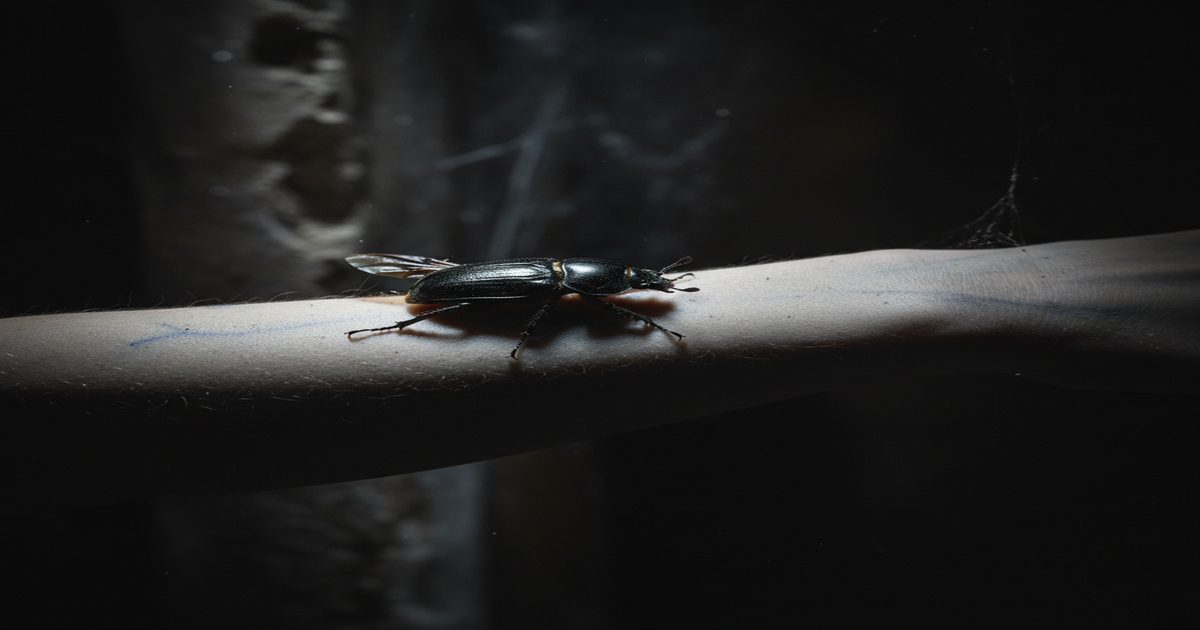
Something moves beneath the skin. Not pain — movement. Insect horror is the subgenre that frightens most in 2026 because it taps a terror that requires no supernatural: the body hosting something that never asked permission.
Not dystopian science fiction. Not classic gothic. Entomology turned into a narrative weapon — and it’s dominating international horror charts right now.
Why Do Insects Frighten Us More Than Any Monster?
Insects break three unwritten rules of the nervous system. They are numerous. They cannot be controlled. And they inhabit spaces we consider ours.
A vampire knocks on the door. A hornet enters through the open window while you sleep. That difference in protocol is already everything.
Entomophobia affects nearly 40% of the world’s population. It isn’t irrational — it’s evolutionary. Our ancestors learned that certain insects carry venom and death. The fear wrote itself into DNA before we had words to name it.
In literature, this archetype becomes narrative gold. A supernatural monster demands suspension of disbelief. A worm emerging from a wound demands nothing.
The Insect Horror Books You Need to Read in 2026
2026 is the year insect horror exploded as a standalone category. Three titles define the genre right now.
Wolf Worm by T. Kingfisher. A botanical illustrator documents a parasitic species that shouldn’t exist. Kingfisher transforms scientific precision into visceral terror — every Latin name carries the weight of a death sentence. Her prose has the accuracy of an entomology manual and the horror of open flesh.
ITCH! by Gemma Amor. The title is onomatopoeic for a reason. Amor is known for horror that strikes where it hurts most: the body as porous boundary, the skin as a barrier yielding under pressure. You scratch just reading the synopsis.
Meat Bees by Dane Erbach. Insects as collective predators. Erbach explores swarm intelligence as a metaphor for the dissolution of identity. When the individual disappears into the horde, what remains of the self? The answer isn’t comforting.
All three share the same root: the insect as an external agent that redefines the body’s boundary. It isn’t the monster that frightens. It’s the invasion protocol.
The genre’s forebears — Shirley Jackson, Daphne du Maurier — had already grasped the mechanism. It was never the single animal that terrified. It was the mass. Multiplicity as absolute horror.
Kafka’s Curse — From Gregor Samsa to the Worms of 2026
“One morning, as Gregor Samsa was waking up from anxious dreams, he discovered that in his bed he had been changed into a monstrous verminous bug.” — Franz Kafka, The Metamorphosis
The first line of The Metamorphosis is the most influential ever written in the genre. Kafka never precisely described the insect — “cockroach” in some translations, “monstrous vermin” in others. The ambiguity was deliberate.
The terror wasn’t in the creature. It was in the family’s response. The transformed body as the loss of personhood — not the monster, but the rejection.
That logic continues today. The best insect horror novels aren’t about the insect. They’re about the human response to the insect: the fear of contagion, invasion, of bodily boundary violated.
2026 has radicalized this intuition. Wolf Worm isn’t a novel about an infesting creature — it’s a novel about what happens when science documents the unacceptable and keeps documenting it, even after realizing it’s already too deep inside.
Body Horror and Insects: Where Does the Skin End?
Classic body horror — Cronenberg, Barker’s Hellbound Heart — speaks of a body mutating from within. Insect horror introduces an external agent. The difference is subtle but crucial.
With pure body horror, you are the monster. With insect horror, you are the habitat. Your body is an apartment someone else has occupied without a lease and with no intention of leaving.
This distinction generates two distinct types of fear. Body horror produces alienation from the self. Insect horror produces violation of the boundary.
If transformation body horror or botanical horror already hit a nerve, insect horror is the next step — more immediate, more physical, harder to metabolize.
Three Techniques That Make Insect Horror Unbearable
The genre’s best authors share three precise narrative tools.
- Scientific precision. Latin names, real life cycles, documented behavior. Entomological realism amplifies the uncanny. It isn’t invented — it’s worse. When Kingfisher describes a parasite’s life cycle with an entomologist’s care, fiction loses its protective distance.
- Reversed perspective. Brief glimpses from the insect’s “point of view” unsettle the reader completely. This inversion, even for just a few sentences, is devastating. Suddenly you are the territory.
- The pause before horror. The best authors delay revelation. They show the innocent details first — the buzz, the itch, the small mark on the wrist. Then comes the close-up. And you cannot look away.
Weird fiction often uses the same technique of delayed revelation. Insect horror brings it into the body, the material, the tangible — which is why it’s harder to dismiss.
What Insect Horror Says About the World Right Now
Every great horror subgenre is a metaphor. The vampire speaks of class and consumption. The ghost speaks of guilt and history. The insect speaks of contamination and bodily boundary.
In 2026, we are obsessed with the body’s edges. Viruses, the microbiome, biotechnology, artificial intelligence that “reads” our data the way a parasite reads a host. Insect horror found the right nerve at the right moment.
Ecological anxiety amplifies everything. The “insect apocalypse” — the collapse of pollinator populations — is documented fact. 2026 has also brought new invasive species, new parasites, new disease vectors. The line between horror fiction and documentary has thinned considerably.
In The Brothel of Shadows, Xyl’khorrath is something older than any six-legged creature. But the mechanism is identical — an entity that inhabits, feeds, transforms from within. Cosmic hunger as universal-scale parasitism. As in cosmic horror, the greatest terror isn’t the monster — it’s realizing you were chosen as host.
Insect horror doesn’t ask you to believe in the supernatural. It only asks you to remember the last time you felt an itch you couldn’t locate. And then asks: are you sure you’re alone?
Jan Willem Koster is the author of The Brothel of Shadows: Cosmic Interception, a gothic cosmic horror novel set in 1980s Amsterdam.
Every night, the dream returns. Every night, the brothel calls.
Enter the dream →