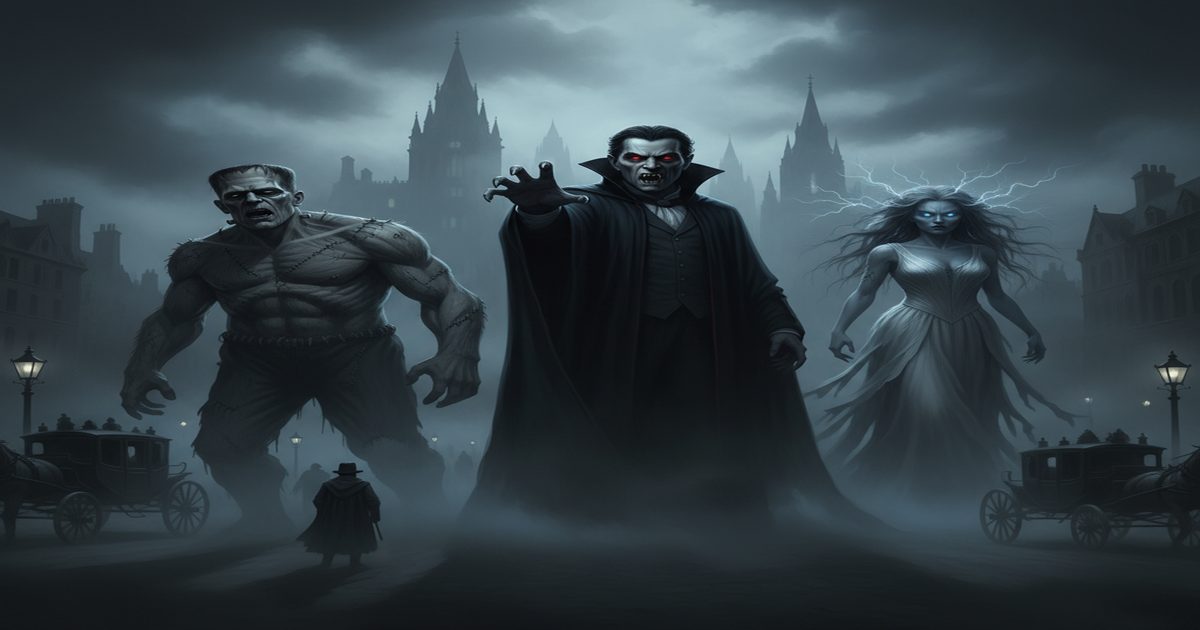
Dracula never dies. Frankenstein always returns. Dorian Gray never stops looking in the mirror. Victorian monsters are immortal — not because we’re nostalgic, but because they speak to something that doesn’t disappear.
The Monster’s Nostalgia: Why 2026 Looks Backward
Every generation reinvents its monsters starting from the same archetypes. This isn’t creative laziness — it’s a cultural necessity. Victorian monsters were metaphors: the vampire for the parasitic class, the golem for industrialization, the cursed artist for bourgeois decadence. The metaphors change. The monsters don’t.
In 2026, this reinvention has taken unexpected proportions. Three films in release use Dracula as their starting point. Two prominent novels revisit the Frankenstein creature from opposing angles. Alma Katsu transforms Dorian Gray into a historical horror novel with thriller undertones. Victorian gothic is everywhere — and it’s no accident.
We live in an era of extreme inequality, of bodies aging while the wealthy purchase longevity, of technological creations that outpace their creators. Victorian monsters couldn’t be more relevant. This isn’t nostalgia — it’s a mirror held up to the present.
What distinguishes 2026 from earlier revivals is perspective. Classic Victorian gothic was told from the point of view of those who suffer the monster. Now the voice belongs to the monster itself — or, more often, to the creature thought secondary who turns out to be the most interesting character in the room.
Dracula Before and After: the Vampire That Never Stops Evolving
Bram Stoker wrote Dracula in 1897 as an epistolary novel: diaries, letters, phonograph transcriptions. The Count almost never speaks in the first person. He’s always filtered through the eyes of those who fear him — and that distance was deliberate. The vampire must remain incomprehensible to be frightening.
2026 inverts this logic. Luc Besson takes Vlad III — the Wallachian warlord Stoker used as partial inspiration — and builds a film that begins with the historical prince, the real man behind the legend. Blood smells different when you understand where the monster comes from.
This humanization of the vampire isn’t new — Anne Rice pursued it for decades, and vampires in contemporary literature have continued to oscillate between monster and antihero. But 2026 adds a further twist: the vampire isn’t humanized to make him sympathetic. He’s humanized to make him more terrifying.
A monster you can’t understand you can fear but it doesn’t implicate you. A monster you recognize — in his desires, his rationalizations, the internal coherence of his logic — asks you where you end and where he begins. He’s harder to destroy. Impossible to ignore.
“Dracula is always the same: an immortal being who cannot tolerate the change he himself produces. He isn’t a vampire. He’s conservation defending itself in blood.” — Noël Carroll, The Philosophy of Horror
Frankenstein Reimagined: Creation as an Unanswered Question
Mary Shelley was twenty when she wrote Frankenstein (1818). The question at the novel’s center was never “can you create life?” — that’s the surface question. The real question is: “who is responsible for the consequences of a creation?”
Victor Frankenstein abandons his creature the moment he realizes something went wrong in the execution. Not in the morality of the enterprise — in the aesthetic execution. The monster is too ugly. This is the doctor’s original crime: not having created, but having created badly and then walked away.
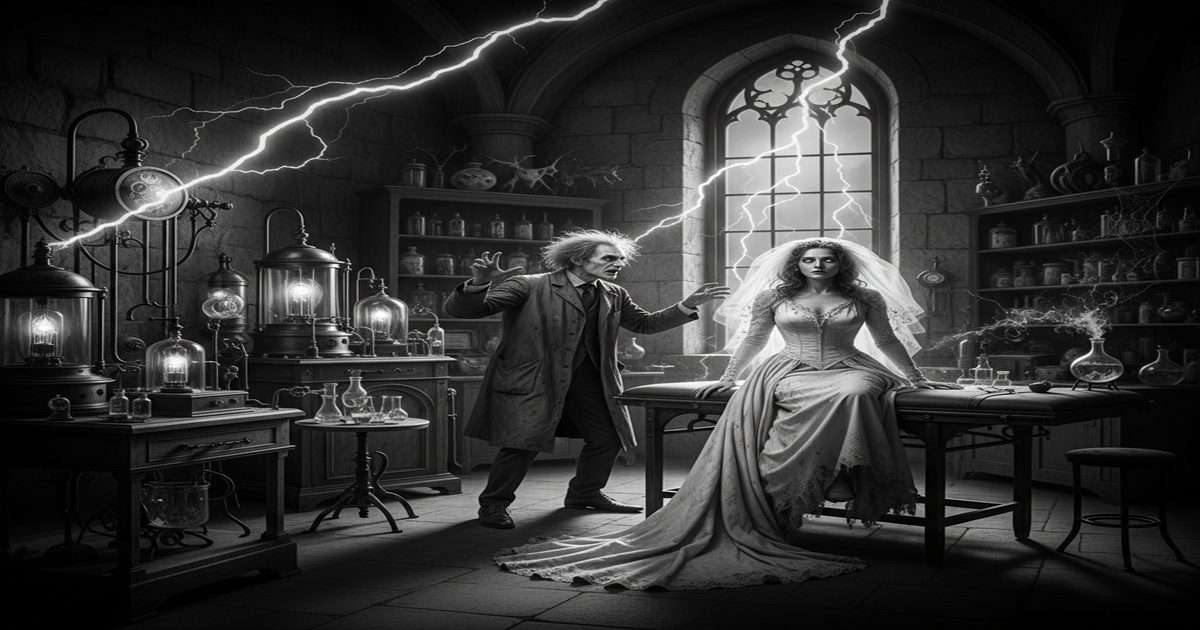
The Bride! (2026) explores the feminine variant of this story. Maggie Gyllenhaal gives voice to the Bride that Shelley only imagined and Whale showed for mere seconds in 1935. Jessie Buckley embodies a creature who opens her eyes, smells the formaldehyde and burnt wire in Christian Bale’s laboratory, and wants something more than the role assigned to her.
The parallel with contemporary dark academia gothic is precise: the doctor is always the one who knows, who creates, who defines. The creature is always the one created, defined, assigned a destiny. 2026 is the year the creature answers back.
Alma Katsu and Dorian Gray: When the Classic Turns Dark Again
Alma Katsu specializes in making classics unrecognizably unsettling. With The Hunger (2018) she transformed the Donner Party tragedy into supernatural horror. With The Fervor (2022), the Japanese-American internment camps of World War II. Now it’s Oscar Wilde’s turn.
Her The Picture of Dorian Gray (2026) takes Wilde’s novel and transforms it into historical horror. It keeps the Victorian frame, the portrait that ages in place of the subject, the progressive moral corruption. But it adds what Wilde couldn’t write explicitly: the body as theater of a genuinely supernatural horror, not merely metaphorical.
This is Katsu’s method: find in the classics the horror dimension that’s already present — often suppressed or sublimated by the original author for cultural reasons — and bring it to the surface. Not betraying the classic. Completing it.
This operation — critical and creative at once — answers a question horror readers have asked for decades: why do the classics feel less frightening on rereading? Not because they’ve become tame. Because those who wrote them had to leave certain doors only slightly ajar.
The Uncanny of the Classics: What Still Frightens Us
Freud describes the Unheimliche — the uncanny — as the sensation of encountering something familiar that suddenly becomes strange. Victorian gothic classics work exactly this way. We’ve read them, we know how they end. And yet, in the right moment, they still frighten.
The explanation is structural. The great Victorian gothic novels aren’t afraid of any specific thing — they’re afraid of the shape of reality itself. Dracula isn’t terrifying because he drinks blood: he’s terrifying because he lives outside time, because his existence denies the natural order, because his presence dissolves the boundary between living and dead.
The gothic literary classics worth rereading today share this quality: they don’t resolve the horror. They leave it open, unresolved, present after the last page. That’s why 2026’s reimaginings work: they don’t try to explain the monster. They deepen it.
The difference between a gothic classic and ordinary horror is that the classic offers no catharsis. At the end of Shelley’s novel, the creature still exists, frozen, in the Arctic dark. Dracula can be killed — but what is the real victory of three men over an entity that has crossed five centuries?
The Porous Border: Originals, Reimaginings, and the Gothic Now
There’s a risk in reimaginings: the classic can become an excuse, a brand to exploit without understanding. The weaker 2026 versions fall into this trap — they recognize the name, not the core. The stronger ones understand that the classic isn’t a story but a structure, a way of asking the right questions.
Victorian gothic asked questions about science, bourgeois morality, repressed sexuality, class. The 2026 reimaginings ask questions about artificial intelligence, pharmaceutical longevity, the body as something modifiable, identity as construction. The monsters are the same. The questions are ours.
In The Brothel of Shadows, Jan Willem Koster walks a similar road. 1980s Amsterdam is a classic urban gothic — a labyrinthine, fog-soaked city saturated with dark history. Xyl’khorrath is an ancient monster, but the questions it poses through Alex’s story are thoroughly contemporary: what are we willing to surrender for knowledge? Where does desire end and the loss of self begin?
Immortal monsters return because the questions they carry have no final answer. Dracula, Frankenstein, Dorian Gray — and all their 2026 reinventions — are mirrors that show what a generation cannot yet look at directly. You need the monster to see the shape of the dark.
It’s not a book. It’s an experience. Whoever enters the Brothel of Shadows leaves changed.
Begin the descent →