
Gothic isn’t something you wear. It’s something you inhabit.
And yet in 2026 you find it on Paris runways, in Pinterest boards with hundreds of thousands of saves, in make-up campaigns promising “vamp romantic vibes” for twenty-eight dollars a lipstick. Gothic minimalism is everywhere. The question is how much of it is still gothic, and how much is simply black.
Gothic as Language — Not as Style
Literary gothic was born as a response to something precise: the anxiety of standing at the edge of the rational. Horace Walpole in 1764, with The Castle of Otranto, wasn’t choosing an aesthetic. He was building a language for things that ordinary language cannot contain. Walls that weep. Portraits that breathe. Doors you should never open.
Mary Shelley, Sheridan Le Fanu, Poe: each of them uses gothic as pressure. Not decoration. The crumbling tower, the vampire, the diseased house are physical metaphors for internal states that realism could not represent without losing their visceral force. The gothic reader feels something in their stomach that the realism reader does not.
That is the starting point. Literary gothic operates on the body before the mind. Its basic unit is not the concept. It is the shudder. And the shudder requires something real to flee from, something dark to never quite understand.
The genre did not stop in the nineteenth century. It expanded, mutated, hybridized with cosmic horror, with gothic eroticism, with the Southern Gothic of Flannery O’Connor, with contemporary urban gothic. Every variation retains that fundamental quality: terror as load-bearing structure, not as ornament.
Gothic Minimalism 2026: the Dark That Sells
Pinterest declared gothic minimalism the trend of the year. Searches for “gothic coffin nails” grew 180% year on year. “Vamp romantic” make-up searches rose 160%. The major European brands’ A/W 2026-27 campaigns use sculptural black silhouettes, catacomb lighting, aesthetic references that cite Giger and Beksinski as if they were Pinterest mood boards.
This is not the first time gothic has gone mainstream. In the eighties it was the subculture of London’s Batcave, of Siouxsie Sioux and The Sisters of Mercy. Then Hot Topic. Then emo. Then dark academia, then cottagecore goth, then witch aesthetic. Each cycle brings the darkness closer to the shopping mall.
What is happening in 2026 is different in scale and direction. It is not a subculture rising but an industry descending — identifying in gothic an aesthetic response to contemporary cultural disorientation. A FashionUnited report calls it “rejection of social norms”: gothic as visible refusal of normalcy. The darkness as design principle for an age that feels unmoored.
This is where the two trajectories — gothic as literature and gothic as aesthetic — converge more than they appear to at first glance.
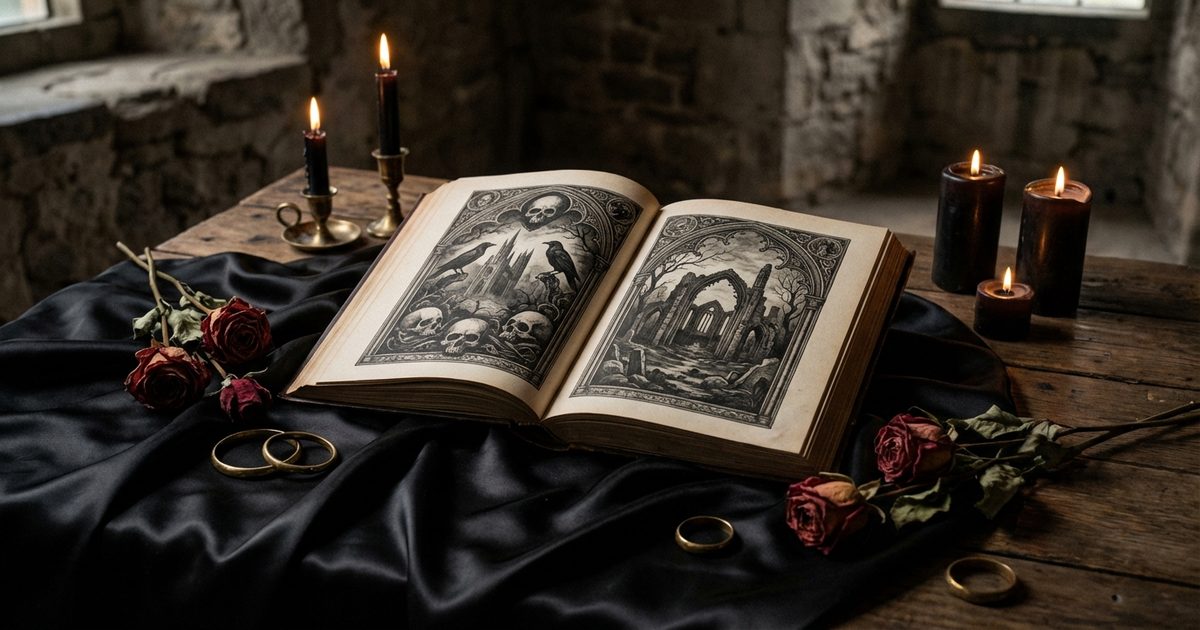
The Shared Root: Where the Two Worlds Meet
Both are acts of refusal. The nineteenth-century gothic novel refused the triumphalism of Enlightenment progress: science doesn’t explain everything, reason isn’t enough, something pulses beneath the civilized surface. Gothic minimalism in 2026 refuses the luminous, optimistic surface of the 2010s internet: the performance of happiness, the body as brand, life as content.
Both use black as a language of separation. Not black for mourning but black as demarcation: I am not what you usually see. Gothic has always carried this identity function. It is worn the way you hold a Poe book on a crowded train: a signal toward those who understand, a filter against those who do not.
Both valorize what dominant culture considers excess. The supernatural in the case of literature; the ornamental, the ceremonial, the dramatic in the case of aesthetics. Both celebrate what endures, what carries weight, what has history: leather-bound books, brass rings, stone, iron. The material culture of both is a culture of things that last.
“Gothic has never been just a genre. It has always been a way of being in the world that admits darkness as a given, not as an exception to be corrected.”
This is where gothic minimalism, at its best, captures something real. It is not just trend. It is a response to an era in which darkness — personal, political, ecological — is systematically aestheticized to make it manageable. Gothic says: darkness is not managed. It is inhabited.
What Is Lost When Gothic Goes Mainstream
But there is a real loss in the transition from desk to runway. Literary gothic always operates through threat. Not the aesthetic of threat — the threat itself. The haunted castle is genuinely frightening. The creature that cannot be named creates real unease. The unreliable narrator of psychological gothic destabilizes. Everything is designed to disturb, not to please.
Gothic minimalism as a fashion trend is designed to please. It must be wearable, photographable, desirable. It must sell. This is not a value judgment — it is simply a different function. An eight-hundred-dollar black dress referencing Giger cannot do what Le Fanu’s Carmilla does, whatever the brand’s press release claims.
Dark academia lived this tension explicitly: it began as an aesthetic tied to intellectual pleasure and love of books, then became a TikTok filter with 52 million posts. The aesthetic survives. The substance dilutes. The books remain as props, not as objects of reading.
The risk of mainstream gothic minimalism is the same: that darkness becomes texture rather than experience. That black becomes a neutral color rather than a declaration. That “gothic” comes to mean simply elegant-with-candles, emptied of everything that made gothic uncomfortable in the first place.
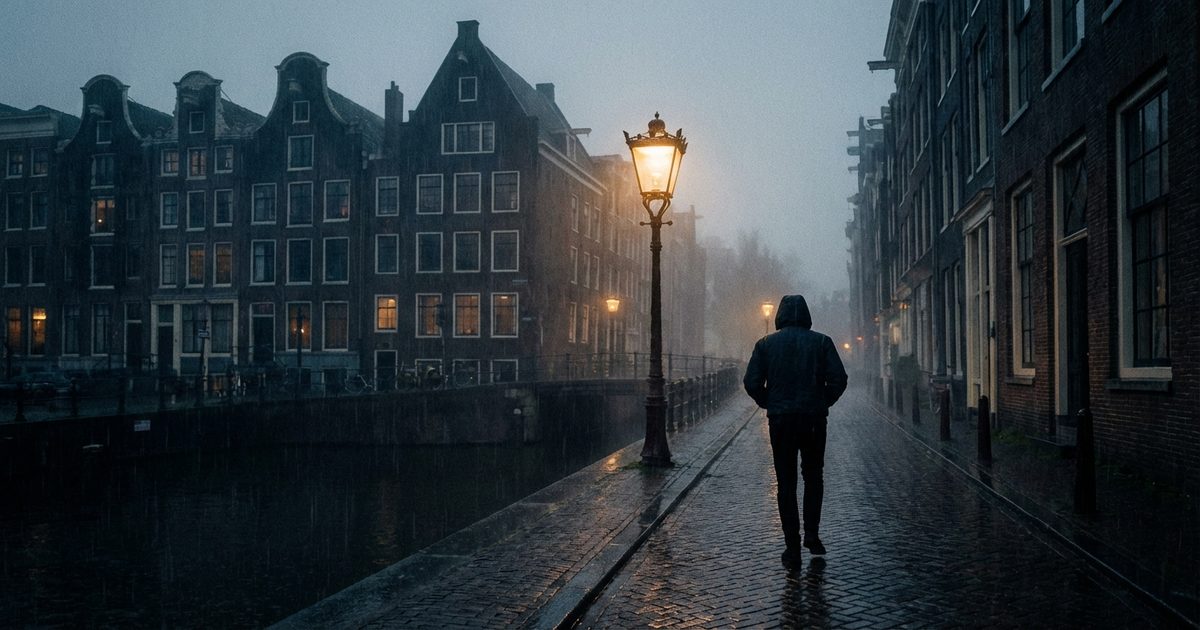
The Short Circuit: When Aesthetic Becomes a Door
But there is also the opposite direction. Aesthetic can be an entry point. How many people bought a Dracula-inspired dress and then, out of curiosity, picked up Bram Stoker? How many fans of Stranger Things and The Haunting of Hill House eventually arrived at Shirley Jackson? The aesthetic → substance path is real, even if it is not guaranteed.
The vampire fiction boom of 2026 has this structure: it starts from the “vamp romantic” aesthetic, from the TikTok make-up machine, and ends on bookstore shelves. Suzy McKee Charnas, Anne Rice reissues, new authors like Alexis Henderson are being bought by readers who arrived from the aesthetic side, not the literary one.
Gothic has always operated this way. The gothic covers of the eighties sold novels. Hammer Horror films brought audiences to Stoker’s Dracula. Every surface that carries darkness into consumption also carries, within it, someone who wants to go deeper. Gothic minimalism mainstream is a surface. What does someone find when they scratch it?
They find, often, that there is something that cannot be bought. Something a brand cannot replicate. The real shudder that a well-written page transmits at two in the morning has no fabric equivalent. And that discovery — that aesthetics are not enough — can be the most gothic moment of all.
The Gothic That Cannot Be Worn
Literary gothic and gothic minimalism share a root and diverge in use. One is a weapon. The other is armor. The gothic novel exposes you to darkness, forces you to remain with it, with no exit until the last page. Gothic clothing covers you in darkness, gives you the shape of someone who has already passed through it.
Both have value. Not every encounter with darkness needs to be the initiation rite of horror literature. Sometimes wearing black is already a declaration. Sometimes aesthetics is the first word of a sentence that books complete.
The Brothel of Shadows has no runway aesthetic. Jan Willem Koster’s brothel smells of something difficult to translate into a color palette: a combination of perfume and decay, warmth and void, desire and horror that does not separate easily. It cannot be worn. It can only be inhabited — across 64 chapters, in an 1980s Amsterdam that no photo filter can render.
Gothic minimalism clears space. Literary gothic puts something inside it that does not leave.
Gothic horror, cosmic eroticism, 1980s Amsterdam. Not your usual horror novel.
Discover the Brothel →