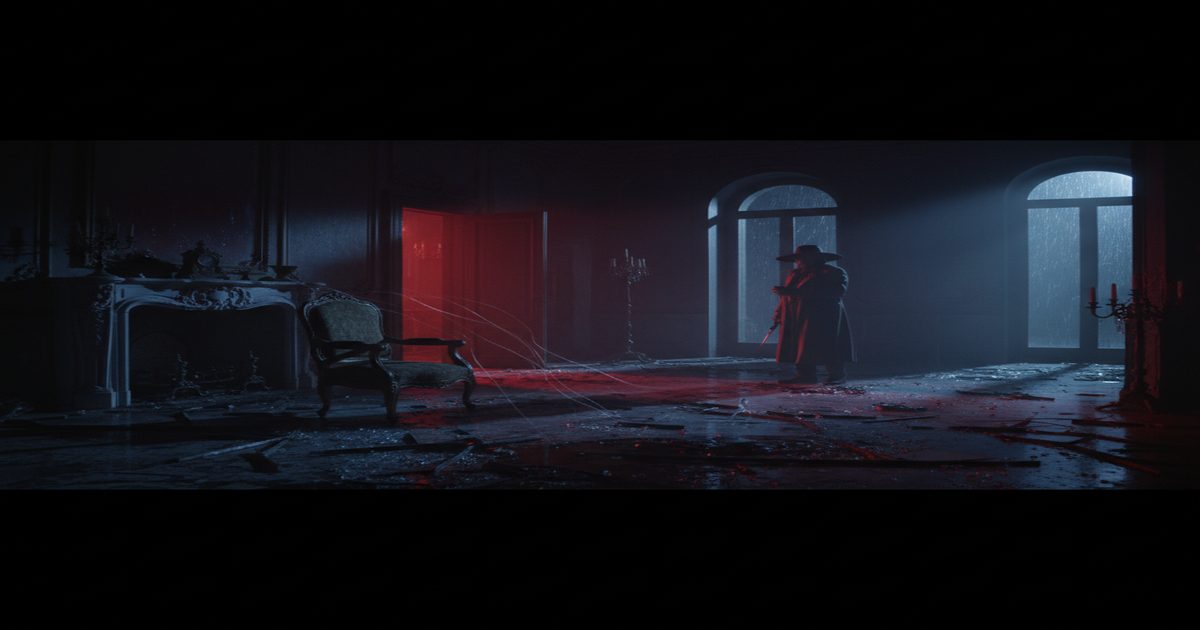
Italian giallo invented the slasher. Years before Halloween, Mario Bava showed a black-gloved hand gripping a knife in a way that made palms sweat. No explanation needed. Just the camera's eye, still and merciless.
Mario Bava and Cinema as Criminal Act
The Girl Who Knew Too Much came out in 1963. Bava shot in black and white, but the result was darker than darkness itself: a world where crime followed no logic, only geometry. The title promises something universal to the genre — someone has seen what they shouldn't have seen.
The word "giallo" comes from Mondadori's cheap paperbacks with their vivid yellow covers. Bava took that popular format and dragged it into pure horror. No longer just a crime to solve. A crime to inhabit, to feel through the skin, to carry home without resolution.
Bava was first and foremost a cinematographer: his father Carlo had been one of the most influential camera operators of Italian silent cinema. This inheritance showed in every frame. Light didn't illuminate; it revealed. And what it revealed was always the wrong moment, the wrong angle, the thing nobody should have noticed.
In 1964, Blood and Black Lace brought color. Bava used colored gels to make every frame feel dreamlike, unreal. The violence didn't seem real because it was too beautiful. This contradiction — beauty and horror inseparable — became the genre's DNA.
The Giallo Rulebook: What Every Film Shares
Every genre has its unwritten rules. The western has gunfighters and frontier towns. Noir has the femme fatale and rain. Italian giallo has a recognizable code that, once seen, you can never unsee in any other work.
Black gloves are the primary symbol — the detail semioticians have written most about. They don't protect from identification: that's retrospective rationalization. They transform hands into something non-human. The black-gloved killer has no fingerprints, no identity, no history. Pure action.
The razor or sharp knife replaces the American machete. The choice is aesthetic before it's functional: a surgeon's instrument, not a butcher's. Giallo violence is precise. Almost professional. That makes it far more unsettling than any massacre.
The amateur detective is another constant. Not a cop, not an expert: someone like us, caught up by accident, who solves the mystery — often badly, often reaching wrong conclusions before the right one. Giallo doesn't trust authorities. The ending often proves it was right not to.
"In giallo, the audience doesn't watch the crime. They commit it." — Italian film criticism on the genre, 1970s
Why Does Giallo Differ from American Horror?
American horror runs on a simple equation: visible threat, survivor, final explanation. Italian giallo breaks all three rules. The killer may stay unknown. Identity doesn't always reveal itself. And when it does, the explanation often generates more questions than it resolves.
The American slasher took giallo's knife and forgot the psychology. Freddy Krueger has a backstory. Jason has a backstory. The giallo killer has no story — just obsession. The difference between a specific character and a natural force. Between a particular lightning bolt and the storm itself.
American cinema feared ambiguity. Every threat needed an origin, an explanation, a solution. Giallo was closer to Kafka than to Agatha Christie: the system works, but you don't understand its rules. You're guilty of something — you just don't know what yet.
The American horror classics of the 1980s owe more to Italian giallo than they like to admit. The subjective camera POV, aestheticized death, structural voyeurism: all of it originates with Bava and his contemporaries.

Dario Argento Turns Fear into Painting
Deep Red came out in 1975. The opening runs four minutes and shows almost nothing — a dark corridor, a child, a piece of music. But the tension is unbearable. Goblin built the entire score around an ostinato bass that the body — not just the ears — cannot ignore.
Argento used colors as emotions, not descriptions. Red isn't just blood: it's obsession, desire, the inability to forget. Blue is death waiting. The walls of Suspiria (1977) look like Klimt paintings dragged through nightmare, lit by lights that exist in no normal physics.
What set Argento apart from every contemporary was his treatment of the camera as an autonomous subject. Not a tool for showing action: a character with its own agenda, its own morbid curiosity. Argento's camera knows things the characters don't yet know.
The soundtracks of Italian horror cinema don't accompany images: they precede them. Goblin grasped by instinct what neuroscience would later prove — the brain processes sound before visual input. Fear arrives with its head down, before you know what's scaring you.
Argento wrote his screenplays like musical scores. He knew where to put silence, where ambient noise, where the sudden bass hit. His films reveal, like the doppelgänger in horror literature, that the threat always had a familiar face — you just hadn't recognized it.
Why Does Giallo Still Terrify Us?
We live in the age of the surveilled. Cameras everywhere, data everywhere, someone always watching. Italian giallo understood this unease half a century ago. Voyeurism was its raw material — and the voyeur was us, sitting in the dark, silent accomplices to every killing.
Between 1968 and 1980, Italy produced over 300 films classifiable as giallo or gothic crime thriller. No other film industry had explored with such intensity the theme of the unwanted witness — of someone who sees what they shouldn't have seen and pays the price.
Violence without explanation is the most terrifying kind. Not the roaring monster. Not the slasher with a backstory. The black-gloved killer who vanishes into the dark without a trace. Like certain traumas: present, real, impossible to name and therefore impossible to process.
Found footage — the most popular horror subgenre of the last twenty years — is deeply indebted to giallo for its obsession with point of view. Both ask: who is watching? Who has the right to see? What happens to those who see too much?
Argento's return in 2022 with Dark Glasses — coolly received by critics, adored by younger audiences discovering him for the first time — proves the genre never died. It just wore different clothes. We find it in Panos Cosmatos's Mandy, in moments of Ari Aster's Hereditary, in everything that uses beauty as a weapon of terror.

Amsterdam as the Natural Giallo Stage
Amsterdam in the 1980s is the natural setting for giallo. The canals reflect lights that shouldn't be there. Alleyways change shape at night. The red-light district — with its logic of visibility and concealment, of what is shown and what is hidden — is the genre's fundamental premise made physical, walkable.
In The Brothel of Shadows, Alex walks this city like an Argento protagonist: absorbing incomprehensible details, surrounded by invisible threats operating according to a logic that exists but remains beyond human grasp. The gothic horror of Amsterdam grows from this same geometry of secrets.
The dimensional brothel follows the same rules as the giallo killer: real, operating on precise logic, but that logic is never fully accessible to its victims. Fear doesn't come from the incomprehensible. It comes from what you almost understand — then discover you've misread entirely.
About the author: Jan Willem Koster is the author of The Brothel of Shadows: Cosmic Interception, a gothic horror novel set in 1980s Amsterdam, available on Amazon.
Giallo teaches you to look more carefully. Then you discover that looking more carefully doesn't protect you.
It exposes you.
Among Amsterdam's red lights, a door leads where no man should go.
Open the door →