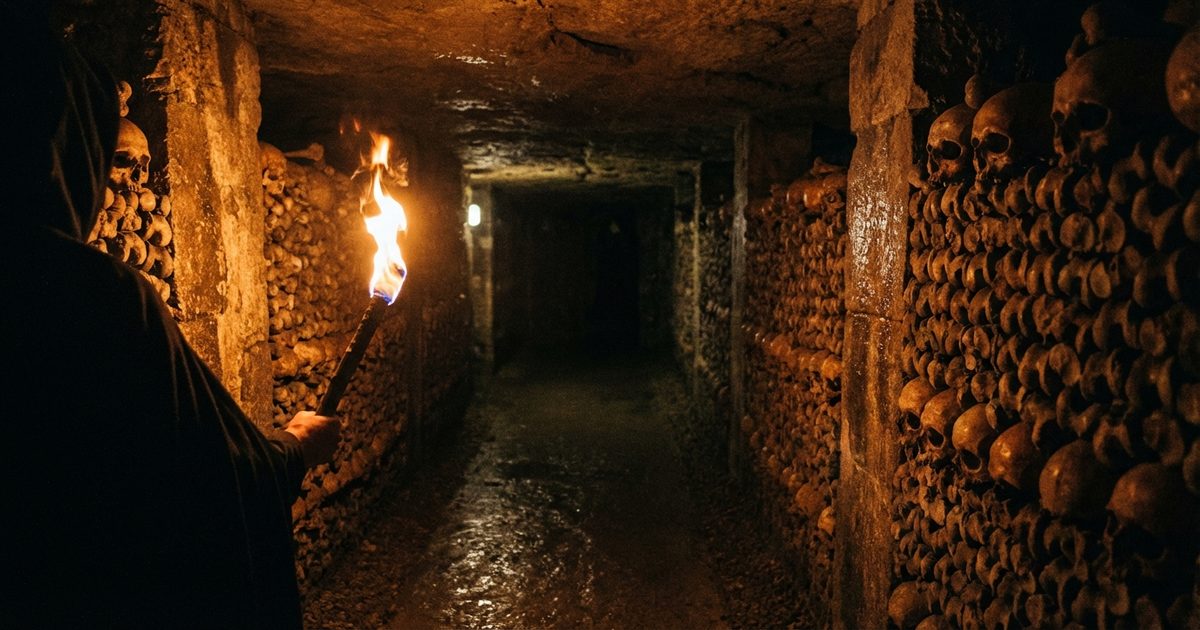
The guide stops. “From here,” she says, “the ceiling drops.” The torch flickers. The air smells of limestone and something older — something the nostrils recognize before the mind does.
You are six meters underground in the Paris catacombs, surrounded by six million dead. The bones are arranged in deliberate geometric patterns: skulls set between femurs, ribs aligned like brickwork. Someone spent time on this. Someone cared. And you don’t know whether that should comfort you or terrify you more.
The guide starts walking again. You have no choice but to follow her into the dark.
Catacombs and ossuaries are the liminal spaces of horror: neither inside nor outside, neither life nor death, neither above nor below. They are thresholds. And thresholds have always fascinated and terrified the horror imagination.
The Geography of the Dead: How Catacombs Began
The first Christian catacombs appeared in Rome in the second century AD. They weren’t secret tombs. They were community cemeteries — practical, necessary, built deep to stay cool in summer. Christians buried their dead there and held funeral rites in spaces carved from grey, damp, porous tufa stone that absorbed sound and sweat and grief with equal indifference.
Over time, the practical function transformed. Catacombs became pilgrimage sites, then legend, then terror. Every culture that discovered them projected its own fears downward. Medieval Romans wouldn’t enter after dark. Nineteenth-century Romantics sought them out at night by candlelight, as though darkness brought them closer to some essential truth.
The truth is that descending underground changes how time feels. Seven meters of rock above your head muffle every surface sound. The silence underground isn’t absence. It’s pressure.
Paris, Palermo, Sedlec: Three Ossuaries, Three Horror Grammars
The Catacombes de Paris hold the remains of roughly six million people, transferred from mass graves during the city’s great eighteenth-century reorganization. The bones aren’t piled randomly. They’re arranged in deliberate geometric patterns: skulls set to form crosses, femurs aligned at precise intervals. Someone turned death into architecture. And that care — that intentionality — is the most unsettling thing of all.
The Capuchin Catacombs of Palermo display roughly eight thousand mummies, dressed, standing upright or seated in corridor niches. Nobles in evening wear, children in white Sunday dresses, monks in their order’s habits. Nineteenth-century Palermitans came here to visit their deceased relatives. They looked them in the eyes — or where the eyes had been. They brought flowers.
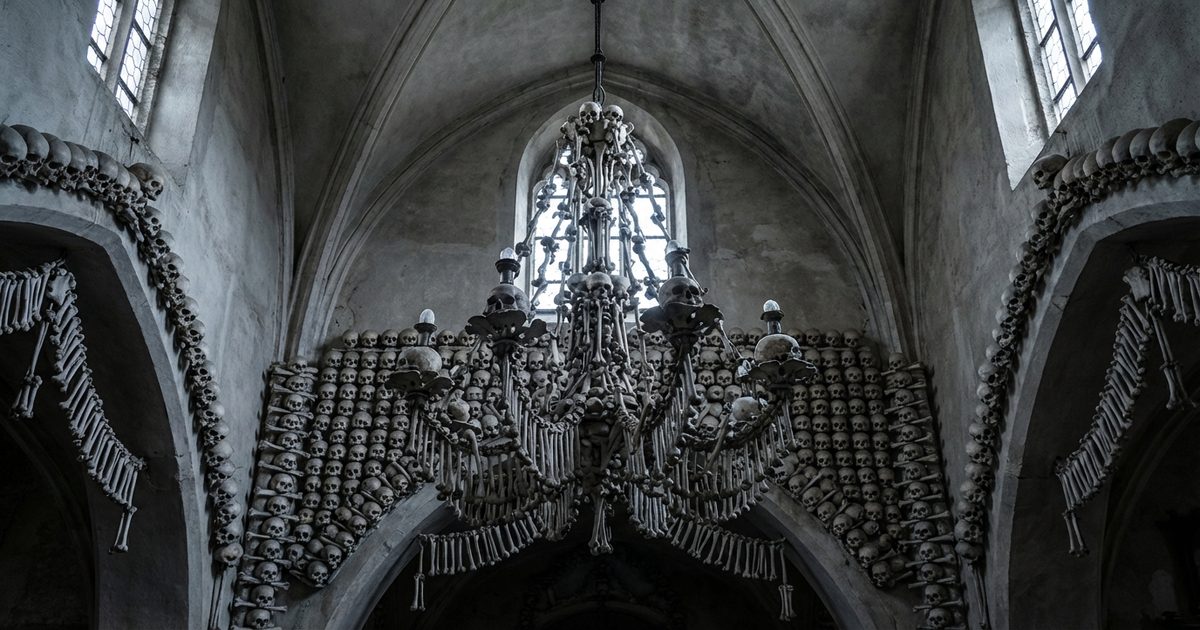
The Sedlec Ossuary in the Czech Republic uses human bones as decorative material. Skull chandeliers, heraldic crests made of femurs, pyramids of bone. The artist who arranged it in the nineteenth century, František Rint, signed his work with a signature made of bones. He had a dark sense of humor that still makes it hard to breathe in there.
“Art doesn’t neutralize death — it amplifies it. Making bones beautiful does not make them less bones.”
Poe and His Heirs: The Literature of the Underground
Edgar Allan Poe understood the power of underground spaces. “The Cask of Amontillado” (1846) is the perfect liminal horror story: a man bricked up alive in cellars during Carnival, surrounded by the smell of saltpeter and old bones, while festival laughter seeps down through the rock above him — muffled, unreachable, grotesque.
Poe grasps that the underground isn’t merely scenery. It’s a psychological state. Descending is an irreversible act — not physically, but mentally. Go down far enough, and something changes in how you perceive the world above.
Neil Gaiman built an entire city in London’s underground in Neverwhere (1996), with its own rules and monsters. Guillermo del Toro used subterranean labyrinths as the theater of the uncanny in Pan’s Labyrinth (2006). Even Lovecraft returned constantly to the underground: R’lyeh, Cthulhu’s city, lies beneath the ocean floor — which is the deepest underground of all.
The Psychology of Descent: Why Underground Spaces Frighten
The anthropologist Mary Douglas, in her study of symbolic contamination systems, identified boundary spaces as primary sources of cultural terror. Not the monster, not death itself — but the place where categories blur. The dead should be separate from the living. Catacombs violate that separation with every second of their existence.
There’s also a sensory dimension that film and literature rarely capture with precision. Underground air has different weight — denser, more humid, with a mineral aftertaste that settles at the back of the throat. Sounds behave strangely: footsteps that seem to come from impossible directions, drips falling impossibly near or far, with no way to locate them.
Absolute darkness — the real kind, with no light source anywhere — is something we almost never experience in ordinary life. Catacombs, with the torch extinguished, offer it. And the nervous system responds as though perception itself is under threat.
The Threshold as Cosmic Horror Space
In the tradition of forbidden place horror, the decisive quality isn’t the presence of ghosts or monsters. It’s the nature of the space itself. A place that doesn’t belong fully to any order of the world. Neither inside nor outside. Neither past nor present. Neither living nor dead.
Philosophers call these spaces heterotopias — Michel Foucault’s term — defining them as places that exist outside normal space, alongside it but separate. Catacombs are perfect heterotopias. Beneath every major European city lies a parallel city of the dead that doesn’t disappear, doesn’t decay, doesn’t transform into something else. It stays. It waits.
This is enough for the folklore of every culture to associate the underground with supernatural presences. Not because ghosts choose to live there. But because the threshold is where categories give way — and when categories give way, anything becomes possible.
The Brothel Is a Catacomb of Dreams
In The Brothel of Shadows, the place Alex enters isn’t a physical location. It’s a threshold between dimensions — a space that exists in the gap between dream and waking, between what you desire and what you fear.
The structure mirrors the catacomb: you descend, and with each step the surface recedes until the surface no longer exists. The entity Xyl’khorrath inhabits this in-between space the way bones inhabit Sedlec — with a silent, geometric presence, ordered within chaos, terrifying in its patience.
The great liminal spaces of horror — catacombs, ossuaries, brothels between dimensions — share one quality. They don’t allow you to remain who you were when you entered. The threshold transforms. That’s why we keep returning, in fiction as in life: because we want to know who we become on the other side.
The brothel exists between dimensions. Alex entered. Will you?
Discover the story →