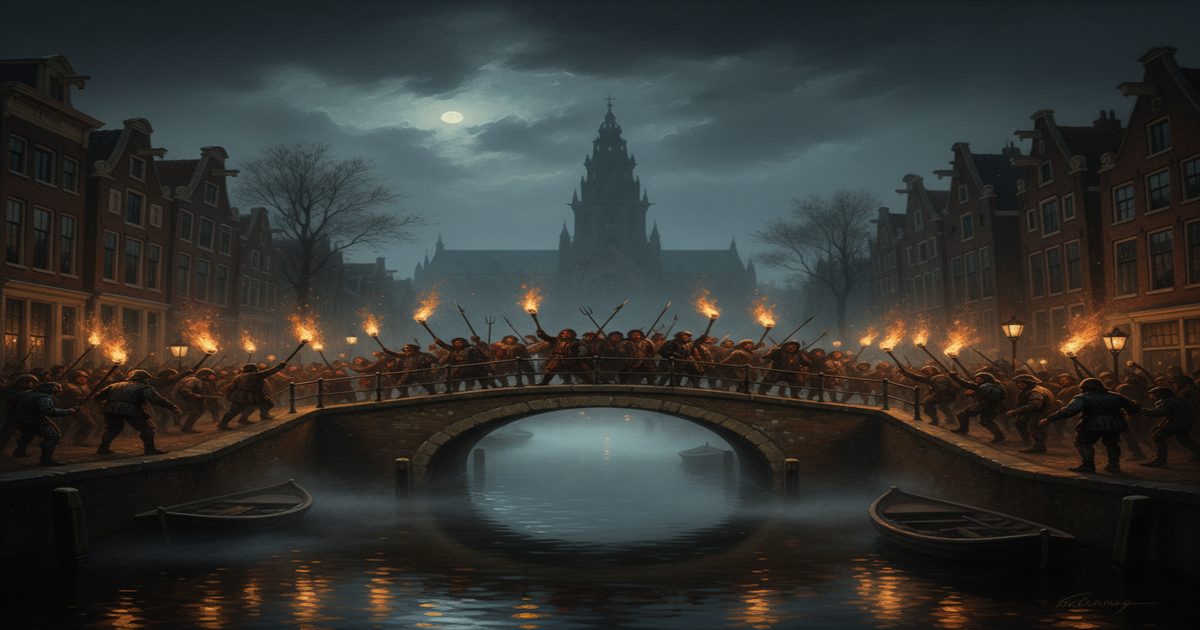
On August 20, 1672, a crowd in The Hague dragged Johan de Witt and his brother Cornelis from prison. They beat them, killed them, dismembered them.
Then they ate them. Not out of hunger. This is the story of what a civilized city can do to itself when fear grows large enough — and of how that horror never truly disappeared. It just settled to the bottom of the canals.
1672: The Year That Nearly Ended the Dutch Republic
The Dutch Republic was, in 1672, the wealthiest nation in Europe. Amsterdam was its beating heart: a global port, banking center, marketplace of the world. The VOC — the Dutch East India Company — controlled trade routes from Java to the Cape of Good Hope. The canal houses rose narrow and tall as columns in a temple to commerce.
Then, in the spring, the armies came. Louis XIV’s France from the west. England from the sea. The German principalities of Cologne and Münster from the east. Within six weeks, two-thirds of the Republic’s territory was occupied. Cities surrendered without a fight. The Dutch army dissolved like fog on the Rhine.
Rampjaar. The Year of Disaster. The Dutch word compresses into a single syllable — ramp, catastrophe, and jaar, year — something that English can’t quite capture. This wasn’t just a lost war. It was the collapse of an entire national identity in a matter of months.
And as always happens when a society loses faith in itself, someone had to be to blame.
Johan de Witt: The Minister Who Governed Without a King
Johan de Witt had been Grand Pensionary of the United Provinces since 1653 — effectively the Republic’s head of government. Twenty years of rigorous republican administration, without a Prince of Orange to command the army. De Witt believed in the Republic as a system. He governed as if reason were sufficient.
He was a mathematician as well as a politician. His treatise on conic sections anticipated developments in calculus that Newton and Leibniz would later formalize. His mind was precise, cold, built for systems. Systems weren’t enough.
When Louis XIV’s armies crossed the Rhine and Dutch soldiers abandoned their posts, Orangist propaganda found its target immediately: de Witt had dismantled the army. He had kept Prince William III — the future King of England — away from military command. He had sold the country out.
None of it was true. But truth doesn’t matter when a city is afraid. Fear wants a body to land on.
August 20: How a Lynching Is Built
Cornelis de Witt, Johan’s brother, had been in prison in The Hague since July 1672, accused of conspiring to assassinate William of Orange. The charges were fabricated. Under torture, he didn’t confess. The court couldn’t secure a death sentence and condemned him to exile.
Johan went to the Gevangenpoort prison on August 20 to accompany his brother out of the city. It was a brotherly gesture, perhaps an incautious one. Perhaps he already knew he wouldn’t leave The Hague alive.
The crowd had gathered outside the prison since morning. It wasn’t a random mob: the civil militias — the schutterijen, the armed bourgeois citizens who were supposed to keep order — opened the gates. Then they stepped aside.
“The crowd dragged them out, killed them, gutted them. Some people took pieces of the bodies home as souvenirs. A surgeon sold Johan de Witt’s finger for a gold coin.” — Chronijck van Holland, 1672
Contemporary chronicles describe the scene with a precision that makes the stomach drop. The De Witt brothers were hung upside down from a post in the Groene Zoodje square. Then the crowd dismembered them. Parts of the bodies were sold, displayed, preserved. Some, according to multiple independent accounts, were eaten. Not out of hunger. Out of a ritual of annihilation that had no name in Dutch Protestant theology.
The Mob as Monster: Anatomy of Collective Horror
The cannibalism of August 20, 1672 isn’t an invention of Dutch Republic detractors. Multiple independent contemporary sources document it — private diaries, diplomatic dispatches, foreign correspondence. It wasn’t the act of isolated individuals in a dissociative state. It was collective, organized, almost ritualistic.
How does a civilized crowd, in one of the most educated cities in Europe, arrive at this? Mass psychology has a brutal answer: a crowd is not the sum of its individuals. It’s a different entity, with a different threshold for moral inhibition and a different capacity for violence.
Gustave Le Bon described it in The Crowd (1895): submerged in a mass, individual consciousness recedes. What remains is instinct. The scapegoat isn’t rationally chosen — it’s felt. And once identified, ritual logic overrides personal morality with a completeness that would be impossible for any individual acting alone.
Cosmic horror in the Lovecraftian tradition always imagined the monster as alien, arriving from outside. The Rampjaar demonstrates something more unsettling: the monster is what a community generates from within when its structures fail. It doesn’t come from outside. It erupts from the square.
Spinoza and the Shame of Reason
Baruch Spinoza was living in The Hague in 1672. He knew Johan de Witt — had received a pension from the Republic for his philosophical work. When he heard about the killings, according to tradition, he wanted to go to the square with a sign reading ultimi barbarorum — the lowest of barbarians.
His host locked him inside. It may have saved his life.
Spinoza had just published the Tractatus Theologico-Politicus, arguing that reason — not faith, not princes, not tradition — was the foundation of a just state. De Witt was the living proof of that thesis: a government of rational men, without a king, without a state religion, without standing armies.
August 20, 1672 was reality’s answer to that philosophy. Reason doesn’t scale. When armies cross the border and fear enters the houses, a crowd doesn’t search for arguments. It searches for flesh.
The Rampjaar in Art and Memory
Jan de Baen painted the bodies of Johan and Cornelis de Witt hanging at the Groene Zoodje. The painting still exists — it’s at the Rijksmuseum in Amsterdam. It’s not anti-Dutch propaganda. It’s a chronicle. Someone decided this had to be remembered.
Rembrandt had died three years earlier, in 1669. He didn’t live to see the Rampjaar. But his portraits of the Republic’s men — the regents, the merchants, the surgeons — seem in retrospect freighted with prophetic unease. Those same faces, that year, watched from their windows as the square filled with the crowd.
Dutch literature absorbed 1672 slowly, never quite finishing the digestion. Historian Pieter Geyl called it “the catastrophe the Republic never truly recovered from.” The fear of that year — of invasion, collapse, and internal violence — settled into the national psyche as a trauma without a name.
Dark tourism has rediscovered the Rampjaar in recent years. The Amsterdam Dungeon reconstructs scenes from the period. Canal ghost tours pass in front of the Gevangenpoort and tell the story of August 20. Every year, thousands of visitors stand in that square and try to understand how it was possible.
Amsterdam, 1983: The Sediment Never Disappears
Alex walks through 1980s Amsterdam without knowing he’s walking on centuries of accumulated violence. The canals — those same seventeenth-century canals, the same stones, the same foundations of wooden piles sunk into soft earth — still carry the echo of what happened.
In The Brothel of Shadows, the city isn’t a neutral backdrop. It’s a layered entity, and every layer holds its memory. 1980s Amsterdam is modern, cosmopolitan, frantic — but beneath the cobblestones, 1672 is still there. And beneath 1672, something older still.
Xyl’khorrath didn’t arrive from the cosmic void into just any city. It arrived here — into a city that already knows the taste of ritual cannibalism. A city that knows how to build an annihilation rite. A city that has already produced the collective monster once, and could do so again.
The stones remember. The canals remember. And on certain nights, when the fog rolls in from the Zuiderzee and the smell of water rises through the alleys, Amsterdam still smells faintly of that August of 1672.
Amsterdam, 1983. A man dreams of an impossible brothel. And the brothel dreams of him.
Enter the dream →