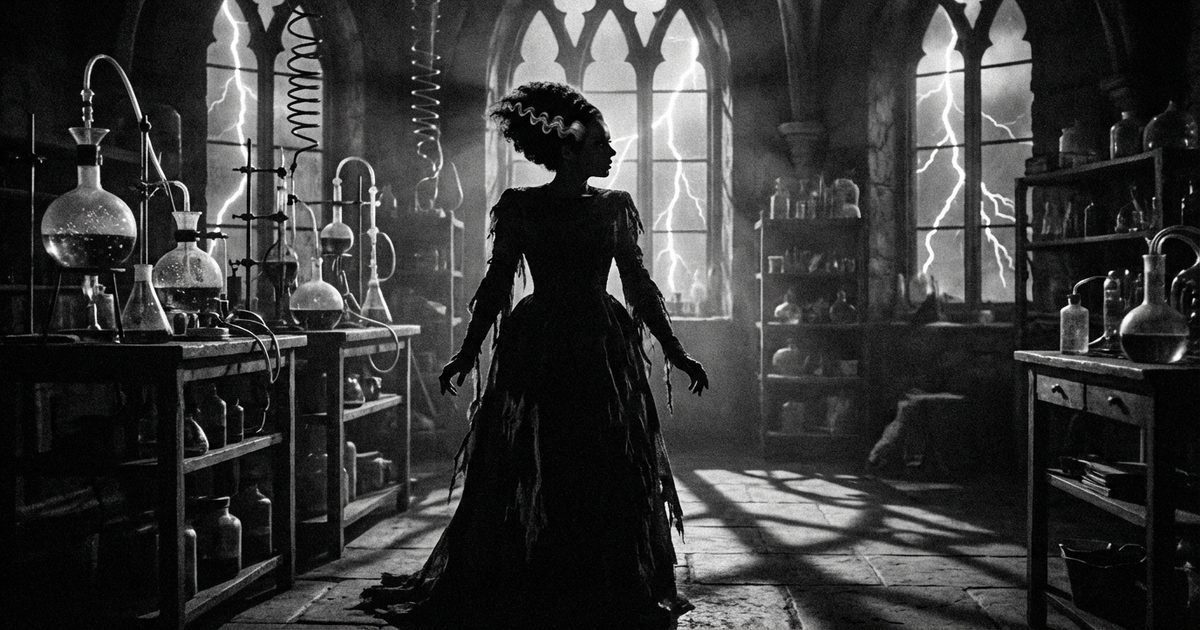
The Bride has no name. She doesn’t need one. She’s the only character in modern gothic who doesn’t.
In 2026, Maggie Gyllenhaal directs The Bride! with Jessie Buckley in the lead and Christian Bale as the monster. It’s a punk reimagining of the Universal classic. It’s also confirmation that this archetype — born in 1818 from the mind of a twenty-year-old woman — never truly ends.
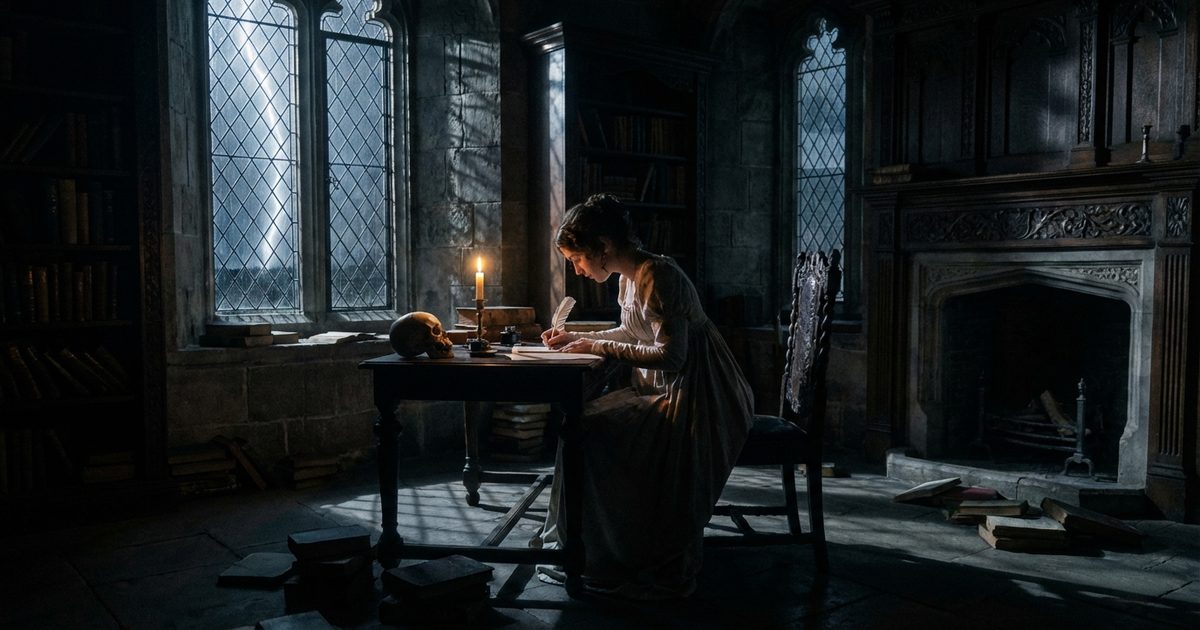
Mary Shelley and the First Female Creature of Modern Terror
In the original 1818 novel, the bride doesn’t exist. Victor Frankenstein begins building her and then destroys her before completion. He tears her apart in a Scottish laboratory while his creature watches from the window.
That destruction is the core. Not the creation: the denial. Mary Shelley was twenty when she wrote Frankenstein, had recently lost a child, and understood viscerally what it meant for the female body to be territory of other people’s decisions. Victor doesn’t destroy the bride out of fear of the monster. He destroys her because he can’t control what she might want.
The horror is in the anticipation of a female will. Not in the sewn body — in what it might choose.
1935: Elsa Lanchester and the Body as Spectacle
James Whale directed Bride of Frankenstein in 1935. Elsa Lanchester played the creature with white-streaked hair and wide eyes, jerky in movement like a wounded bird, producing hisses instead of words.
The Universal film inverted the novel: the bride exists, is created, is displayed. Then — in twelve minutes of screen time — she rejects the monster with a shriek of revulsion and is destroyed with him in the final explosion.
“Twelve minutes. The most powerful female presence in classic horror lasts twelve minutes. Cinema had already understood that the monstrous woman was too dangerous to survive the film.”
Yet Elsa Lanchester became the icon. The white flame hair, the bandaged neck, the gaze of someone who has just discovered the world and doesn’t like it. Pop culture remembered her for decades. Not the monster.
Gyllenhaal’s The Bride!: Punk, Power and 2026 Corruption
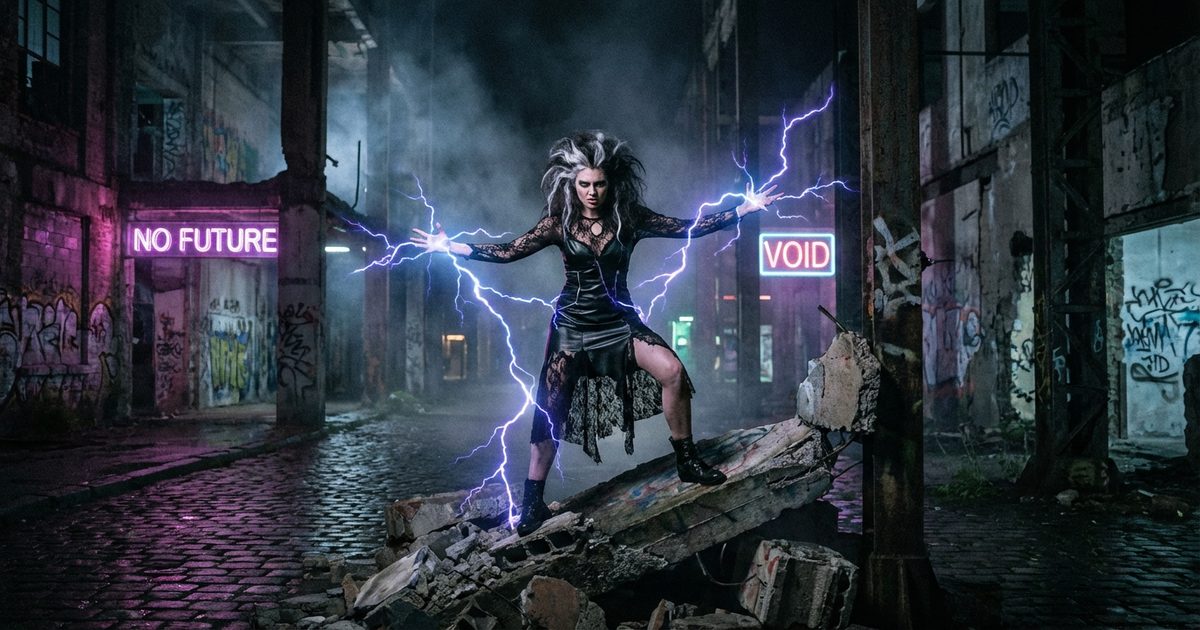
Maggie Gyllenhaal has said her film is not a remake. It’s a response. Jessie Buckley plays a creature who doesn’t hiss but screams, who doesn’t recoil but advances. Christian Bale plays the monster as a man who wants to be loved and cannot understand why he isn’t.
The cast is stacked: Penélope Cruz, Annette Bening, Jake Gyllenhaal. The direction places 1970s punk aesthetics inside classical gothic architecture. From what has emerged, the result is a film where the recreated body doesn’t seek acceptance. It seeks autonomy.
This is the genuine leap from the original. In 1935, the bride dies because she refuses. In 2026, she survives because she refuses. The same scene, read a century apart, produces opposite meanings.
The Transformed Body: Terror and Liberation
The body horror tradition has always treated physical transformation as punishment. The body that changes is the body that betrays, loses control, becomes other than itself.
The female gothic inverts this. In Frankenstein, the sewn body is not a punishment for the bride — it’s a punishment for whoever created her without asking permission. In Moreno-Garcia’s Mexican Gothic, the fungal colonization of the female body becomes an act of reclamation, not destruction.
The monstrous body in female gothic is often the body that has stopped obeying. This makes it terrifying for those who watch — not for those who inhabit it.
Xyl’khorrath and the Seduction of the Monstrous
In The Brothel of Shadows, the cosmic entity makes no distinction between genders. It absorbs, transforms, consumes. But how it operates — through desire, seduction, the offer of what you want without knowing you want it — has deep roots in the female gothic tradition.
The brothel’s creatures use the body as instrument and as trap. Like Shelley’s bride, they exist in a space between human and non-human where normal rules don’t apply. Like Lanchester’s figure, their power is in a gaze that doesn’t ask but evaluates.
The female gothic isn’t a subgenre. It’s the line connecting Victor Frankenstein’s laboratory to Koster’s cosmic brothel, running through every story where a body — real, recreated, or imagined — refuses to do what someone else decided it should.
The Bride has no name. She has too many.
It’s not a book. It’s an experience. Whoever enters the Brothel of Shadows leaves changed.
Begin the descent →