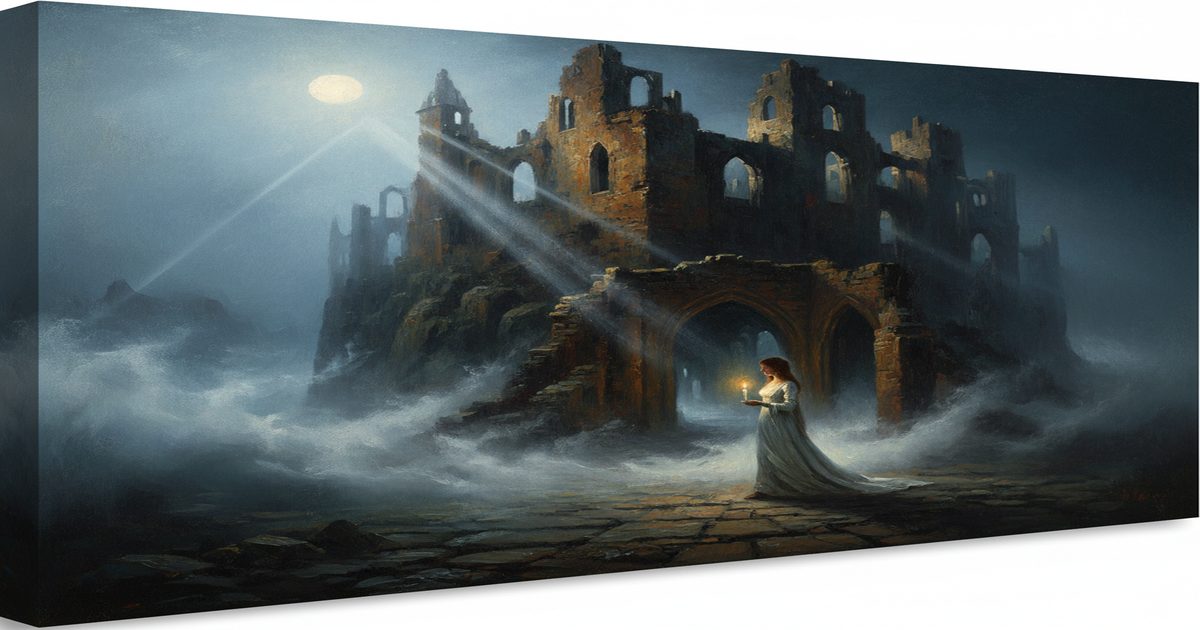
Two centuries ago, a writer decided the monster must never be seen. Only sensed — the creak behind the wall, the shadow at the end of the corridor, the veil concealing something unnameable. Ann Radcliffe died in 1823. In 2026, we mark two hundred years since her final posthumous work. Her method still reigns.
Gothic literature was born from her. Not from Horace Walpole, who built the ruins. From Radcliffe, who made them breathe.
Why Does Ann Radcliffe Still Haunt Us Today?
The American Gothic Society dedicated 2026 to her bicentenary with a series of international conferences. This is not academic nostalgia: it is reconnaissance. Trace the roots of gothic fiction — from Shirley Jackson to Mike Flanagan, from Rebecca to Mexican Gothic — and you always end up here.
Ann Radcliffe (London, 1764–1823) published six novels between 1789 and 1797. The Mysteries of Udolpho (1794) was an immediate bestseller. Jane Austen wrote Northanger Abbey to parody it — the irony being that the parody became a tribute. Her final novel, Gaston de Blondeville, appeared posthumously in 1826, two hundred years ago.
She did not invent the gothic novel — that was Walpole with The Castle of Otranto (1764). She invented something more precise: the atmospheric gothic novel. A method for building terror without gore, without explicit monsters, without blood. Fear as pure mood. If you want to explore the essential classics of gothic literature, Radcliffe is the only place to start.
1. The Terror That Never Shows the Monster
Radcliffe drew an explicit distinction between terror and horror in her posthumous essay On the Supernatural in Poetry (1826). Terror expands the mind, sharpens it, wakes it. Horror contracts it, closes it down, paralyzes it. She always chose terror.
The most famous scene in Udolpho demonstrates this with surgical precision. Emily St. Aubert lifts a black veil covering something in a castle chamber. The reader goes rigid. Radcliffe holds the tension for two hundred pages — then reveals the veil covered only a wax figure, a penitent’s memento mori. Almost a letdown.
But that is a misreading. What the mind imagines behind the veil is always worse than what is there. This is the contract: the empty space that the reader fills alone. From Henry James’s The Turn of the Screw to Mark Z. Danielewski’s House of Leaves, every gothic that works uses this structure.
“Terror and horror are so far opposite, that the first expands the soul and awakens the faculties to a high degree of life.” — Ann Radcliffe, On the Supernatural in Poetry, 1826
2. The Heroine Who Survives Alone
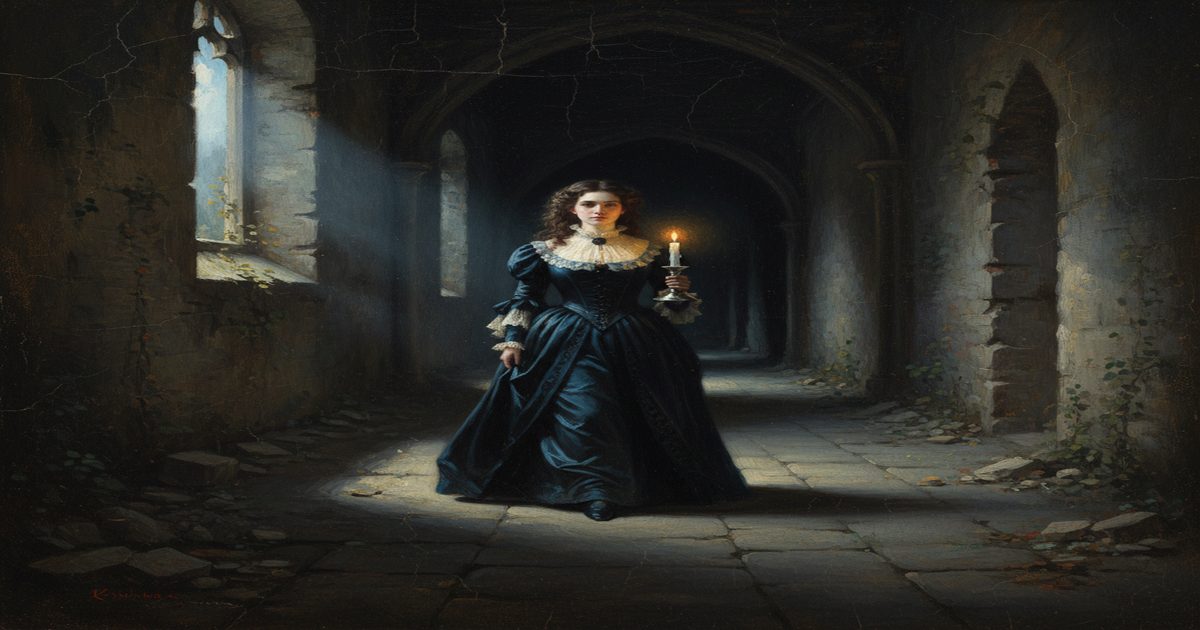
Emily St. Aubert is alone. Her father is dead. Her guardian is tyrannical. Her lover is distant. She is locked inside the castle of Udolpho, surrounded by corridors that smell of wet stone and threatening figures that slip through the shadows.
She is not a victim. She observes. She keeps a journal. She reasons through each apparition. She survives through intellect — not through male rescue. She is thoughtful, sensitive, capable of holding terror without breaking.
Radcliffe wrote this character when women in fiction were typically instruments of other people’s fates. Two hundred years later, horror cinema talks about the Final Girl — the woman who survives because she thinks, not because she is saved. The prototype has a name: Emily St. Aubert.
3. Landscape as Emotional State
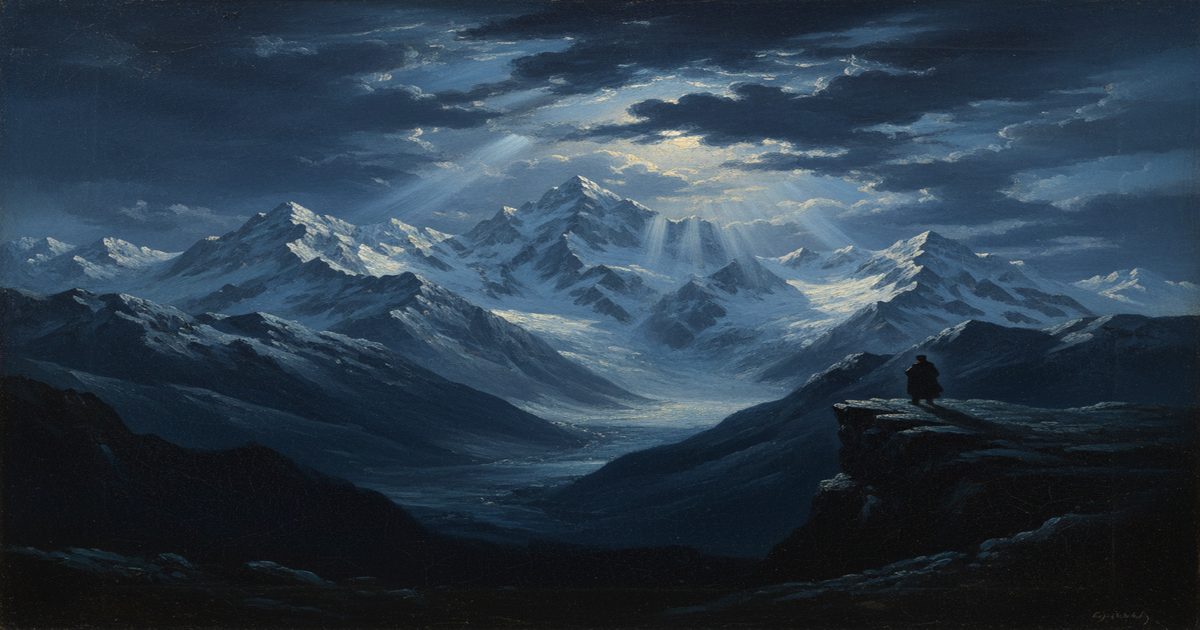
When Emily crosses the Alps toward Udolpho, the mountains are not background. They are co-protagonists. The snow-capped peaks constrict the breath. The precipices produce that mixture of terror and beauty Edmund Burke theorized in the Philosophical Enquiry (1757) as the Sublime.
Radcliffe was the first writer to translate the philosophy of the Sublime into narrative. Storm, dense forest, moonlit ruins are not decoration: they are emotional instruments. The landscape mirrors the character’s inner state — then amplifies it beyond bearing.
This technique became gothic DNA. In Daphne du Maurier’s Rebecca, Manderley is not a house: it is a character with its own will. In Silvia Moreno-Garcia’s Mexican Gothic, the villa sweats poison through its walls. In Shirley Jackson’s The Haunting of Hill House, the house’s geometry is pure psychology. All daughters of Radcliffe.
4. The Secret Buried in the Foundation
Every Radcliffe castle hides a crime. This is not merely plot — it is ideological structure. Gothic fiction rests on a postulate: the past is not dead. It is walled alive inside the house’s stones. Sooner or later, it will emerge.
In The Italian (1797), the monk Schedoni carries a secret that warps every page of the novel. The revelation is not a plot twist: it is the internal logic of the gothic system. Places hold memory. What has been buried eventually seeps through the cracks.
This structure survives intact. In Ari Aster’s Hereditary, the family home bears the weight of generations of unspoken secrets. In The Fall of the House of Usher, a secret is literally walled alive. Whenever a story says “this house has a history,” the Radcliffe system is running.
5. The Sublime: the Pleasure of Being Afraid
Burke wrote that the Sublime is the experience of something vast, dark, potentially lethal — producing not pure fear but a kind of pleasure in terror. Radcliffe made this a conscious narrative mechanism.
Udolpho’s readers sought the vertigo. The pleasure of being afraid in safety — sitting warm at home while Emily faced the abyss. This is still the fundamental contract of every horror: the reader accepts terror because they know they can close the book.
It is controlled distance that transforms terror into aesthetic pleasure. Radcliffe invented this as a deliberate tool. Every horror reader who loves fear without wanting to experience it is inside this contract, unknowingly, for two hundred years.
Who Carries Her Legacy Today?
The gothic revival of 2026 has precise roots. Mike Flanagan builds every series on breathing castles and secrets walled alive. Silvia Moreno-Garcia brings atmospheric gothic to colonial Mexico with the same care for sensory detail. T. Kingfisher works with unresolved tension — terror as a permanent state, not an event.
2026 also marks academic growth: the Ann Radcliffe Society has expanded its gothic studies program in universities across the English-speaking world. Her influence is not just commercial — it is critical. They call her “the mother of everything” without exaggerating.
If you’re looking for the best gothic horror novels of 2026, the Radcliffian tradition runs through almost all of them, often undeclared. Jan Willem Koster’s The Brothel of Shadows carries that method into 1980s Amsterdam: a labyrinth of canals, a brothel between dimensions, a cosmic entity that seduces before it consumes. The terror is never fully shown. Only sensed. Like a sound behind a door you should not open.
Two hundred years, and the veil is still there. We still don’t know what lies beyond. That is precisely why we keep looking.
Sixty-four chapters of pure cosmic terror. An Amsterdam you won’t forget.
Read the novel →