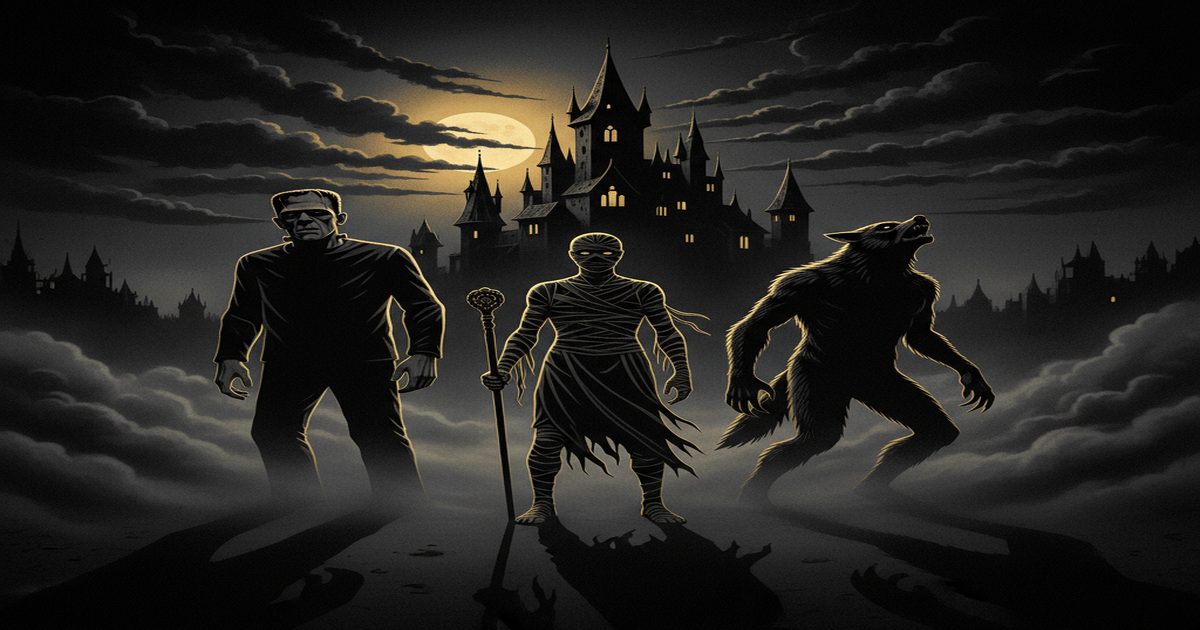
Monsters don’t die. They wait. They wait for society’s fears to realign with their shape. In 2026, the alignment is perfect.
Frankenstein’s creature, the werewolf, the Mummy: three archetypes of cinematic horror are returning to the screen in the same year, carried by three directors with radically different voices. This isn’t coincidence. It’s a symptom. Horror cinema in 2026 has already been called a “generational year” — the most creatively dense for the genre since the late 1980s.
Why Do Classic Monsters Never Really Die?
Classic monsters have survived every cycle of audience fatigue. Frankenstein’s creature has existed for 207 years. The werewolf predates recorded history, rooted in pre-Christian Norse mythology. The Mummy was born from the nineteenth century’s obsession with ancient Egypt. They’ve crossed novels, penny dreadfuls, silent film, Universal Pictures blockbusters, 1990s parody, and early 2000s franchise exhaustion.
Why do they endure? Because each generation reinvents them as mirrors of its specific fears. Frankenstein’s creature is never just a thing of stitched parts — it’s the question of constructed identity, of creator and creation, of the body as object. The werewolf is never just a beast: it’s the latent violence beneath the civil surface, the instinct that civilization can’t quite extinguish.
The Mummy is death that refuses to stay buried. The past returning to reclaim what belongs to it.
“A monster is always an allegory. Anyone who sees only the fiction has already lost the most important fear.”
The Bride: Maggie Gyllenhaal Rewrites Frankenstein as Feminine Gothic
That Maggie Gyllenhaal would choose Frankenstein for her second feature was, in retrospect, predictable. Her debut The Lost Daughter had already explored the maternal body as a site of conflict. The Bride shifts that same tension onto more explicit territory.
Gyllenhaal’s Bride isn’t Mary Shelley’s creature — or not only. She’s a figure assembled from others’ parts, forced to negotiate her own humanity in a world that made her exist for a specific purpose. The horror here is psychological before it’s physical.
Gyllenhaal has said she’s reread Shelley every year since she was seventeen. The film carries that familiarity into its direction: gothic architecture isn’t decorative scenery but language. The Bride’s body is the set. The Frankenstein tradition in feminine gothic finds its most contemporary chapter here — and arguably its most personal.
Werwulf: Robert Eggers and the Werewolf as Ancestral Trauma
Robert Eggers has built his career reinventing horror through historical precision. The Witch was the Puritan horror of New England. The Lighthouse was Greek myth filtered through nineteenth-century pragmatism. Werwulf takes Eggers into the medieval Nordic world — a territory where he seems to have been born.
The premise is as simple as it is devastating: a medieval Scandinavian village confronting something men have always known exists in the forest beyond the fence. But Eggers doesn’t make creature horror. He makes horror out of belief systems. The werewolf in Werwulf is not a cursed individual — it’s what the village decides to call “monster” because it needs a name for its collective fear.
The film is shot in reconstructed Old Norse and medieval Germanic dialects. The darkness is real: no artificial lights, only torches and fires. The smell of leather, ash, and wet timber comes through the screen. Horror cinema has had its formative decades, but 2026 marks something different: a genre that has finally grown up.
The Mummy: Lee Cronin and the Resurrection of Egyptian Terror
Lee Cronin debuted with The Hole in the Ground — a domestic horror of quiet devastation — and followed it with Evil Dead Rise. He knows how to generate fear without relying on gratuitous brutality. The Mummy brings that sensibility to material the Universal franchise had made ridiculous in the 2000s.
Egyptian horror in the gothic tradition has its roots in nineteenth-century colonial anxiety: the fear of the desecrated sacred, of the dead reclaiming what was stolen. Cronin takes that root and places it at the center of the film without irony. The Mummy isn’t a monster to defeat. It’s a justice advancing.
The past’s revenge as horror — it’s one of gothic literature’s oldest themes. In 2026, with debates around cultural repatriation still unresolved, it lands with unexpected weight.
The Myth Cycle: Monsters as Mirrors of Our Deepest Fears
There’s a pattern running through all three 2026 films. None of these monsters are external to the human world. The Bride is made of human parts. The werewolf is someone from the village. The Mummy is the result of a human action — the violation of a tomb.
The monster that comes from absolute outside is cosmic horror — the Lovecraftian entity that has no interest in humanity. That’s the territory of The Brothel of Shadows: Xyl’khorrath isn’t a creature of human nature. It’s something radically other, using human desire as its door.
But 2026’s cinematic monsters choose a different direction. They say: the danger is inside. In the creature we constructed. In the instinct we repressed. In the sacred we violated. It’s an older kind of horror — and in a certain sense, a more honest one. Body horror as the language of transformation runs through all three films, each in its own register.
Why 2026 Is a Defining Year for Horror Cinema
Generational years for horror are only visible in retrospect. 1968 gave us Rosemary’s Baby and Night of the Living Dead. 1978 gave us Halloween and Dawn of the Dead. 2017 gave us Get Out and It.
2026 is different: it doesn’t introduce a new subgenre but a new maturity for the genre itself. Films like The Bride, Werwulf, and The Mummy aren’t trying to scare you. They’re trying to explain something. They use fear as a grammar for speaking about the body, about identity, about the past that returns.
It’s the direction literary horror had been moving for years. In 2026, cinema finally caught up.
About the author: Jan Willem Koster is a Dutch-born writer whose novel The Brothel of Shadows: Cosmic Interception explores the intersection of cosmic horror, erotic gothic, and 1980s Amsterdam. Available on Amazon.
Every night, the dream returns. Every night, the brothel calls.
Enter the dream →